

On a lot of the best fishing lakes in the state park system, you never hear an outboard. Electric-only regulations keep the water calm at places like Punderson Lake in Ohio and Ogle Lake at Brown County State Park in Indiana — and on those lakes, your trolling motor battery isn’t an accessory. It is the fuel tank. When it dies, your fishing day is over, no matter how good the bite is. That makes battery choice one of the few gear decisions that directly sets how many hours you get on the water. If you’re still planning where to go, start with our guide to fishing in state parks.
This guide covers what changed in the battery market for 2026 (a lot — lithium is now the default, not the upgrade), the simple runtime math that tells you what capacity you actually need, our tested picks by chemistry and use case, and the part no generic battery roundup gives you: which state park lakes are electric-motor-only, and how to keep a battery charged and legal on a multi-day park trip.
America’s State Parks is reader-supported. If you buy through links on this page we may earn a commission at no extra cost to you — see our affiliate disclosure and editorial review methodology. Manufacturer specifications cited below were verified in July 2026.
How to choose a trolling motor battery in 2026
- Chemistry first. LiFePO4 (lithium) delivers 80–100% of its rated capacity with steady voltage to the end; AGM lead-acid should not be drained below about 50%, and its power sags as it discharges. A “100Ah” AGM is really a ~50Ah battery in practice.
- Weight matters more than you think. A 100Ah lithium runs about 23–25 lb; a 100Ah AGM runs about 64 lb. If you’re carrying a battery from an electric-only parking lot down to a kayak launch, that difference decides the trip.
- Match capacity to thrust. Rule of thumb: maximum amp draw roughly equals pounds of thrust on 12V motors (a 30 lb motor pulls up to ~30A, a 55 lb motor ~50A at full throttle). Runtime = usable Ah ÷ amp draw.
- Deep-cycle only — never a car battery. Starting batteries use thin plates built for one short burst and fail quickly under trolling loads. Buy deep-cycle, or dual-purpose if the same battery must also crank an outboard.
- Cold-weather plan. Standard lithium batteries must not be charged below freezing (32°F); AGM can be. If you fish shoulder seasons, pick a lithium with low-temperature charging protection in the BMS — or stay with AGM.
Before you buy: check whether your home lake is gas, electric-only, or non-motorized — the rules differ lake by lake even inside one park. Our fishing guide and state pages like Ohio and Indiana are the place to start, and the electric-only section below lists verified examples.
The 2026 market shift: lithium stopped being the upgrade and became the default
For a decade the standard advice was “buy AGM, lithium if you can afford it.” That advice is now backwards. Three numbers explain why. First, weight: a 100Ah LiFePO4 weighs roughly 23–25 lb against about 64 lb for a 100Ah AGM — roughly one-third — and because you can actually use 80–100% of the lithium’s capacity versus ~50% of the AGM’s, the lithium effectively replaces an even bigger lead-acid battery. Second, cycle life: quality LiFePO4 packs are rated for 3,000–5,000+ charge cycles (our top pick is rated 4,000+ at full depth of discharge), while AGM typically delivers 200–500 cycles — two to four seasons of regular use. Third, price: lithium-ion pack prices hit a record-low $108/kWh in late 2025 per BloombergNEF, and the upfront gap between LiFePO4 and lead-acid has narrowed from 3–4x a couple of years ago to often under 30% on a usable-energy-per-dollar basis in 2026.
The honest math: if you fish 20+ days a year, a lithium battery typically pays for itself within two to three seasons through cycle life and full usable capacity — lifetime cost of ownership runs far below AGM. One nuance worth knowing: lithium raw-material prices rebounded sharply from their mid-2025 lows, so the rock-bottom retail deals of 2023–24 are not expected to return. There is no strong reason to wait. AGM still earns its place in two situations — the lowest possible upfront cost for an occasional weekend angler, and cold-weather use, since AGM can be charged below freezing while standard lithium cannot.
The runtime math (do this before you buy anything)
Runtime is not a mystery — it’s division. Runtime in hours = usable amp-hours ÷ amp draw. A trolling motor’s maximum amp draw roughly equals its pounds of thrust on a 12V system: a 30 lb kayak motor pulls up to about 30A wide open, a 55 lb motor about 50A.
Worked example with a 100Ah lithium battery and a 55 lb thrust motor: at a medium cruising speed drawing ~20A, you get 100 ÷ 20 = about 5 hours. Hold full throttle at ~50A and that collapses to roughly 2 hours. Same battery, same motor — throttle discipline more than doubles your day. For AGM, halve the rated capacity before you divide: a “100Ah” AGM gives you ~50 usable Ah, so that 5-hour medium-speed day becomes about 2.5 hours. That single fact is why lithium took over. Sizing shorthand: a 30 lb motor on a kayak or jon boat is happy on a single 12V 50–100Ah battery (50Ah lithium ≈ a half-day); a 55 lb motor draws roughly twice as much, so treat 100Ah as the minimum for a full day on the water.
Comparison: our 2026 picks at a glance
| Model | Chemistry | Capacity | Weight | Best for |
|---|---|---|---|---|
| LiTime 12V 100Ah TM | LiFePO4 | 100Ah (80–100% usable) | ~23.4 lb | The 2026 default — full-day trips, kayak-cart portages |
| UPG UB121000 | AGM | 100Ah (~50% usable) | 63.9 lb | Lowest upfront cost, occasional outings |
| VMAX MR137-120 | AGM | 120Ah (~50% usable) | Group 31 (not published) | Best AGM performer, 50–110 lb thrust motors |
| Optima BlueTop D34M | AGM dual-purpose | 55Ah / 750 CCA | 43.5 lb | One battery that cranks the outboard and trolls |
| Interstate DCM0035 | AGM | 35Ah (~50% usable) | Group U1 (compact) | Light-duty: 30 lb kayak motors, short outings |
Specs are manufacturer figures (verified July 2026); where a maker doesn’t publish weight we list the BCI group size instead. Prices change often — check the current price via the links.
LiTime 12V 100Ah TM LiFePO4
At about 23 lb it weighs a third of a comparable 100Ah AGM, delivers essentially all of its rated capacity at steady voltage, and is rated for 4,000+ charge cycles — against 200–500 for AGM. The TM version adds what trolling use actually needs: a low-temperature charging protection BMS, 300A/5-second surge tolerance for motor startup, and salt-spray resistance. Unless you need sub-freezing charging on a bare-bones budget, this is the battery to buy in 2026.
Lithium (LiFePO4) — the 2026 default
If you fish more than a handful of days a year, start here. The LiTime 100Ah TM is the value leader in trolling-specific lithium: Group 31 sizing drops into standard battery trays, the BMS blocks charging below freezing (protecting the cells instead of quietly damaging them), and the manufacturer rates it at 4,000+ cycles at 100% depth of discharge — 15,000 if you typically use 60%. Run the math from above: 100 usable Ah at a 20A cruise is a genuine five-hour day, something no 100Ah lead-acid battery can deliver.
Who shouldn’t buy it: anglers who need to charge in below-freezing weather regularly (the protection BMS will — correctly — refuse; AGM below), and anyone whose charger only has AGM modes with a desulfation setting. Budget for a charger with a lithium profile; details in the care section.
LiTime 12V 100Ah TM Deep Cycle LiFePO4 Lithium Battery for Trolling Motors, Low-Temp Protection, Group 31
- 12V 100Ah LiFePO4 purpose-built for trolling motors: about 23.4 lb — roughly one-third the weight of a comparable 100Ah AGM, with 80–100% usable capacity at steady voltage
- Rated 4,000+ charge cycles at 100% depth of discharge (15,000 at 60% DoD per manufacturer)
- Low-temperature charging protection BMS, 300A/5s surge current for motor startup, 20+ layers of BMS protection, salt-spray resistance for marine use
- BCI Group 31 format fits standard marine battery trays and boxes
AGM — budget & cold-weather
AGM still makes sense in two honest cases: you fish a few weekends a year and want the lowest upfront spend, or you fish and charge in genuinely cold weather, where AGM’s ability to accept a charge below freezing beats standard lithium. Earlier editions of this guide listed three near-identical 100Ah AGM batteries; we’ve consolidated those interchangeable options down to the one budget pick and kept the AGM that’s actually built and marketed for trolling duty.
The UPG UB121000 is the classic budget 100Ah AGM: sealed, maintenance-free, mountable in any orientation, sold everywhere. Go in with open eyes — it weighs 63.9 lb, and as AGM it gives you roughly 50 usable amp-hours, so it’s a half-day battery on a 55 lb motor at moderate speed. For an occasional angler with a boat trailer and a short carry, that trade for the low price is fair. For a kayak angler hauling gear from the lot to the ramp, it isn’t.

UPG Universal Power Group UB121000 12V 100Ah Solar Wind AGM SLA DEEP Cycle VRLA Battery 12V 24V 48V
- UB121000 SLA is a 12V 100AH Group 30H Sealed Lead Acid (SLA) Maintenance Free Rechargeable Battery, UL Listed
- USA-based company | UL recognized | Reliable power for critical applications with exceptional quality and dedicated U.S.-based customer support.
- Absorbent Glass Mat (AGM) technology, designed for versatile mounting, including upside-down installation.
- Valve-regulated design offers exceptional resistance to vibration, shock, and heat.
If you want the best AGM can do rather than the cheapest, the VMAX MR137-120 is the pick: a Group 31, 120Ah marine battery explicitly built and rated for trolling motors in the 50–110 lb thrust range, with heavy-duty lead-tin grids that tolerate the repeated deep discharges that kill cheaper AGMs. The extra 20Ah over the budget 100Ah units matters precisely because AGM only gives you half its rating — here that’s ~60 usable Ah instead of ~50. It’s still a heavy Group 31 lead battery, so plan on a permanent spot in the boat rather than a carry-in.
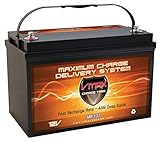
VMAX MR137-120 AGM Sealed Marine AGM Battery 12V 120AH for 50lb -110lb thrust Minn Kota Newport Vessels Cobra Sevylor and other trolling motors VMAX MR137 Deep Cycle 12V 120Ah Battery BCI group 31
- Electrolyte Suspension system VMAX tanks utilize an electrolyte suspension system consisting AGM (Absorbed Glass Matt) of a high porosity that totally absorb and contain the electrolyte; No silica gels or any other contaminants are used
- Heavy Duty Grids: VMAX heavy duty lead tin alloys provide an extra margin of performance and service life in either float or cyclic applications, even after repeated over discharges
- Maintenance Free Operation: There is no need to check specific gravity of the electrolyte or add water to VMAX tanks during float service life; In fact, there is no provision for this type of maintenance
Dual-purpose & light-duty
Two picks for specific boats rather than maximum runtime. The Optima BlueTop D34M solves a different problem than the batteries above: one battery that both starts an outboard (750 CCA) and runs a trolling motor between spots. Its spiral-cell AGM construction is 15 times more vibration-resistant than flooded batteries and it weighs a manageable 43.5 lb. Be honest about the trade: at 55Ah it is not a full-day trolling battery — it’s the right answer for boats where the trolling motor is the secondary motor, not the only one. On an electric-only lake where trolling is all you do, put your money into capacity instead.

OPTIMA Batteries High Performance D34M BlueTop Dual Purpose Deep Cycle and Starting Sealed AGM Boat and RV Battery 750 CCA Dual Terminal Maintenance Free Versitile Mounting
- BATTERY SPECS: 12-Volt, 750 Cold Cranking Amps, Size: 10.06″ Length x 6.88″ Wide x 7.94″ Tall, Weight: 43.5 pounds, Dual SAE & 5/16″ Stainless Steel Stud Posts, C20 Capacity: 55 AH, MCA 870
- RESERVE CAPACITY of 120 minutes for constant performance. Faster charging capabilities.
- SPIRALCELL TECHNOLOGY: Spircalcell Technology with 99.99% pure lead delivers more power and consistently outperforms conventional flat-plate batteries. Optimal starting power even in bad weather.
- LONG LASTING: Fifteen times more resistant to vibration than standard flooded battieres for durability and Up to 3 times longer life vs. standard flooded batteries.
The Interstate DCM0035 needs honest framing: it’s a 35Ah AGM developed for mobility devices like wheelchairs and scooters, not a marine battery. It earns its spot here for one niche — light-duty trolling. On a 30 lb kayak or canoe motor run at low speeds, its compact Group U1 case and sealed, spill-proof, mount-any-way build make it an easy-to-carry choice for short evening sessions on a small electric-only lake. Remember the AGM rule: ~17 usable Ah means an hour or two of gentle trolling, not a full day. If that describes your fishing, it’s a tidy little battery; if not, size up.
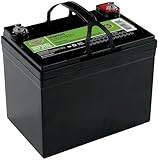
Interstate Batteries 12V 35AH Sealed Lead Acid SLA AGM Deep Cycle Battery DCM0035 Insert Terminals
- DEEP CYCLE MOBILITY BATTERY: Interstate Batteries DCM0035 professional-grade, high-quality battery developed specifically for electric wheelchair’s, electric scooter’s and more. Longer life & more cycles for deep discharge usage – Interstate’s DCM batteries rated as the best performer for heavy-demand deep-cycle batteries, making them Outrageously Dependable
- DCM0035 BATTERY REPLACEMENTS: Download the Compatibility Guide below under Product Guides & Documents to see some devices this battery powers. ABEC WHEELCHAIRS, BEST TECHNOLOGIES, BURKE, DAMACO WHEELCHAIR, ELECTRIC SCOOTERS, EVEREST JENNINGS, EXIDE, EXPERT POWER, GOLDEN TECHNOLOGY, HOMELITE, HOVEROUND, INVACARE, JAZZY, KUBOTA, LEISURE LIFT, MERITS HEALTH, MIGHTY MAX ML35, ODYSSEY, OPTIMA, ORTHO KINETICS, PACE SAVER, PRIDE MOBILITY, RANGER, SONNENSCHEIN, UNIVERSAL POWER GROUP, WEIZE & more
- RECHARGEABLE, MAINTENANCE-FREE, SPILL-PROOF: Rechargeable, maintenance-free, & spill-proof because of the AGM & VRLA technology (valve regulated) that eliminates spills & overpressure. 12 Volt, 35 Amp hours. 7.68” x 5.16” x 6.42” (LxWxH). Industry size Group U1 or GT9L. Insert terminal with bolt, replaces FLAG TY. This battery is not a replacement for Golf Cart batteries
- HIGH-QUALITY, HIGH-PERFORMANCE BATTERY: No other brand puts their products through more rigorous testing than Interstate Batteries 7-Point Quality Protocol. We don’t meet industry standards – we exceed them & back our products with an unmatched warranty. 12-Month Performance Warranty (DCM0035) – please contact Interstate Batteries directly on Amazon for questions
Electric-only state park lakes: where the battery IS the fuel tank
Here’s the part generic battery guides skip. Many state park lakes ban gas outboards entirely — and on those waters, battery capacity literally defines your fishing day. A few verified examples below — and for the complete list, see our 50-state directory of electric-only lakes at state parks (rules verified July 2026; always confirm at the park office, since regulations change):
- Ohio keeps a codified electric-motors-only list in its administrative code (OAC 1501:47-3-17). It includes Nimisila Reservoir at Portage Lakes State Park, the reservoir at Deer Creek, and Punderson Lake at Punderson State Park. See all Ohio state parks and our Ohio state park fishing guide for regulations, license costs, and where the bite is.
- Indiana: at Chain O’Lakes State Park, only electric trolling motors may be operated — you can leave a gas motor mounted, but you may not run it. At Brown County State Park, Ogle Lake is non-motorized/electric-only water. More at our Indiana state parks hub and the Indiana fishing guide.
- Iowa: Lake Virginia at Waubonsie State Park and the lakes at Pine Lake State Park are restricted to electric trolling motors only.
Charging on a multi-day park trip: if you’ve booked an electric campsite, an onboard or portable marine charger plugged into the campsite pedestal recharges your battery overnight — the most underrated perk of an electric hookup for anglers. On non-electric sites, a solar panel or a small inverter generator (where the park allows generators, at posted hours) does the job more slowly. A lithium battery’s fast charge acceptance makes overnight pedestal charging comfortably enough for a full next day.
Transport and the Coast Guard rule: U.S. Coast Guard requirements say a boat battery must be secured so it cannot move more than one inch in any direction, and the ungrounded (positive) terminal must be protected so a dropped metal object can’t short across it. A strapped-down covered battery box, or a tray plus non-conductive terminal covers, satisfies the rule — and a ranger at the launch ramp can check for it. (Verified July 2026.)
Charging and care: the mistakes that kill batteries
Charger compatibility: LiFePO4 wants roughly 14.2–14.6V absorption and about 13.6V float (or no float at all). Many AGM charger profiles fall inside that window, but any equalization or desulfation mode above 15V will damage lithium cells, and a high AGM float voltage held all season causes real capacity fade. If you switch to lithium, use a charger with a dedicated lithium profile — it’s cheap insurance on a battery rated for 4,000 cycles.
Never charge lithium below freezing. Charging a standard LiFePO4 below 32°F causes lithium plating — permanent, invisible damage. Batteries with low-temperature protection (like our top pick) simply refuse the charge; batteries without it let you hurt them. AGM can be charged below freezing, which is its one remaining technical advantage.
Winter storage: store lithium at about 50% state of charge in a cool, dry place — not full, not empty — and it will happily sit for months. AGM is the opposite: store it fully charged and keep it topped up on a maintainer, because a lead-acid battery left partly discharged sulfates and loses capacity permanently.
Which one do you need?
Fishing 20+ days a year, or carrying your battery any real distance to a kayak or jon boat: the LiTime 100Ah TM — the weight savings and 5-hour cruising runtime settle it. A few casual weekends a year on a trailered boat, lowest cost wins: the UPG UB121000, accepted with its 64 lb and half-day runtime. Committed to AGM but want a full day: the VMAX MR137-120’s 120Ah is the ceiling of what lead-acid can do for trolling. One battery that must also crank an outboard: Optima BlueTop D34M. A 30 lb motor on a kayak for short evening sessions: the compact Interstate DCM0035.
Frequently asked questions
What size battery do I need for a 30 lb thrust trolling motor?
A single 12V deep-cycle battery. A 30 lb motor draws up to about 30A at full throttle; a 50Ah lithium covers roughly a half-day of mixed-speed use, a 100Ah a full day.
How long will a 100Ah battery run a 55 lb thrust motor?
Roughly 2 hours at full throttle (~50A draw) and about 5 hours at a 20A medium cruise — if it’s lithium. An AGM only delivers about half its rated capacity usable, so halve those numbers.
Can I just use my car battery?
No. Car (starting) batteries use many thin plates designed for one short high-amp burst; repeated deep discharge from a trolling motor destroys them in short order. Use a deep-cycle battery, or a dual-purpose marine battery if it must also start an engine.
Can I charge a lithium battery with my old AGM charger?
Sometimes — if it charges in the 14.0–14.6V range and has no desulfation/equalization pulse above 15V. But a charger with a proper lithium profile is strongly recommended, and never charge lithium below freezing.
Is lithium really worth the extra cost over AGM?
If you fish 20+ days a year, yes — 8–10x the cycle life and full usable capacity mean it typically pays for itself in two to three seasons. For a couple of outings a year, a budget AGM is the rational buy.
How should I store my battery over winter?
Lithium: at about 50% charge in a cool, dry place, and never charge it below freezing. AGM: store fully charged and keep it on a maintainer so it doesn’t sulfate.
Reviewed and updated July 2026 by the America’s State Parks Editorial Team. Product specifications are manufacturer figures verified in July 2026; park regulations cited above were checked against the current state administrative codes and official park pages at the same date. See our editorial review methodology and affiliate disclosure for how we choose and maintain gear recommendations.
