🌤 Weather at Lincoln Woods State Park by season
| Spring | Summer | Fall | Winter |
|---|---|---|---|
| 28–70 °F | 57–84 °F | 33–75 °F | 19–43 °F |
Each range runs from the coldest monthly average low to the warmest monthly average high in that season (1991-2020 climate normals), measured at Woonsocket, 7 mi away, elevation 110 ft. Conditions at the park can differ from the station, especially where elevation differs — check a forecast before you go.

🏆 Rhode Island’s First State Park — 627 acres of glacial boulders, freshwater swimming, and world-class bouldering since 1909
There’s a moment, deep inside Lincoln Woods, when you forget you’re twelve minutes from downtown Providence. The traffic noise fades behind a wall of oak and maple, a massive glacial erratic rises from the forest floor like something dropped by a careless giant, and the only sound is the crunch of your boots on a trail that’s been walked for over a century. Then a climber appears on the face of a 15-foot boulder, chalked hands searching for the next hold, and you realize: this isn’t just a city park with trees. This is one of the most unique state parks in New England.
Lincoln Woods State Park was Rhode Island’s first — established in 1909 when the state purchased the land to give the growing industrial communities of the Blackstone Valley a place to breathe. A hundred and seventeen years later, it remains the most heavily used state park in Rhode Island, drawing hikers, swimmers, boulderers, anglers, horseback riders, and families who simply need an afternoon of green space without the two-hour drive to the countryside. At 627 acres, it packs a remarkable amount of terrain into a compact footprint: Olney Pond anchors the center with a sandy freshwater beach, the surrounding forest is littered with hundreds of glacial boulders that have made Lincoln Woods famous among rock climbers, and a 2.5-mile paved loop road circles the pond for walkers, joggers, and cyclists.
Best of all? It’s completely free. No entrance fees, no parking charges, no reservations needed. Just show up, pick a trail, and start exploring.
Table of Contents
History: Rhode Island’s First State Park
Lincoln Woods carries a distinction that shapes everything about the place: it was the first state park ever established in Rhode Island, with the land purchase authorized in 1909. At the time, the Blackstone Valley was one of the most industrialized regions in America — mills, factories, and dense housing crowded every riverbank. The state recognized that the rapidly growing workforce needed accessible outdoor recreation, and the forested, boulder-strewn hills north of Providence were the perfect answer.
The park’s geological story, however, goes back thousands of years. The massive boulders scattered throughout the forest are glacial erratics, deposited by retreating ice sheets approximately 12,000 years ago at the end of the last Ice Age. Some of these erratics are house-sized, their surfaces polished smooth by millennia of weather. They create the dramatic, almost otherworldly landscape that gives Lincoln Woods its distinctive character — and they’re the reason the park became a world-class bouldering destination.
Olney Pond, the 88-acre body of water at the park’s heart, was historically part of the Moshassuck River system. The pond was created through a combination of natural geology and early dam construction, and it has served as the centerpiece of park recreation since the beginning — swimming, fishing, boating, and winter ice sports have all taken place on its waters for over a century.
Hiking & Trail Guide
Lincoln Woods offers a surprisingly deep trail network for its size. The marquee route is the Loop Road, a 2.5-mile paved path that circles Olney Pond and serves as the park’s main artery. It’s flat, fully accessible, and popular with joggers, walkers, and families with strollers. This road is closed to vehicular traffic from late October through mid-April, transforming it into a peaceful pedestrian loop during the cooler months.
Beyond the Loop Road, the real adventure begins on the unpaved trail network that threads through the boulder fields and forest. Be warned: the trail system can be confusing, with many informal and unmarked paths created over decades of use. Carrying a downloaded trail map or using a GPS app is strongly recommended.
| Trail / Route | Distance | Difficulty | Highlights |
|---|---|---|---|
| Loop Road | 2.5 miles | Easy (paved) | Pond views, accessible, great for jogging/cycling |
| Les Pawson Trail | 1.8 miles | Easy–Moderate | Named loop through mixed forest, pond access |
| Boulder Field Trail (Zone B) | 1.5 miles | Moderate | Giant glacial erratics, bouldering access |
| Equestrian Trails (Zone A) | 3+ miles | Moderate | West of Quinsnicket Rd, horses only — no bikes |
| Mountain Bike Loop (Zone B) | 4+ miles | Moderate–Hard | East of Quinsnicket Rd, technical terrain |
🥾 Trail Zone System — Know Before You Go
• Zone A (West of Quinsnicket Road): Reserved exclusively for equestrian use. Mountain biking is NOT permitted. Hiking is allowed but ride cautiously — horses always have right of way.
• Zone B (East of Quinsnicket Road): Multi-use trails open to hikers, mountain bikers, and climbers. This is where you’ll find the main bouldering areas.
• Dogs: Allowed on all trails but must be leashed (6-foot max) at all times. Clean up after your pet — rangers do enforce this.
Bouldering & Rock Climbing
Lincoln Woods is, without question, the premier bouldering destination in Rhode Island and one of the best in all of New England. The park contains hundreds of glacial boulders ranging from beginner-friendly 5-foot blocks to intimidating 20-foot highballs that have attracted climbers from across the Northeast for decades. The rock type is primarily a dense, grippy conglomerate with embedded pebbles that provides excellent friction — a unique climbing surface unlike the granite found at most New England climbing areas.
The bouldering areas are concentrated in Zone B (east of Quinsnicket Road), with problems ranging from V0 to V12+. Classic problems like “The Wave,” “Fire Roof,” and “Magnum” are pilgrimage routes for the Northeast climbing community. The approach to most boulders is short — typically 5 to 15 minutes from the nearest parking area — making Lincoln Woods an ideal spot for after-work sessions.
🧗 Bouldering Essentials
• Crash pads: Essential for anything above V0. The landings are rocky and uneven — bring at least one pad, ideally two.
• Navigation: Download the 27 Crags or Mountain Project app before you arrive. The boulder locations are geotagged, which is critical because the informal trails can be disorienting.
• Best conditions: Fall (October–November) offers the best friction due to cooler temperatures and lower humidity. Spring mornings are also excellent.
• Park hours: Sunrise to sunset ONLY. No nighttime climbing — the park gates are locked after dark.
• Chalk use: Acceptable but be mindful. Brush tick marks off boulders after your session as a courtesy to next visitors.
Swimming at Olney Pond
The Frank Moody State Beach on the northern shore of Olney Pond provides a genuine freshwater swimming experience that’s a welcome alternative to the crowded saltwater beaches along the coast. The beach features a sandy bottom that slopes gently into the pond, making it safe and enjoyable for families with children. Lifeguards are on duty seasonally, typically from late June through Labor Day.
The water in Olney Pond is noticeably warmer than the Atlantic Ocean beaches — expect temperatures of 72–78°F (22–26°C) during peak summer — making it particularly comfortable for swimmers who find ocean water too cold. The bathhouse, built in the park’s early decades and renovated since, provides changing rooms and restroom facilities. Facilities are typically open from May 1 through October 31.
Fishing Guide
Olney Pond is stocked by the Rhode Island Department of Environmental Management with brook trout, rainbow trout, and brown trout, primarily during the spring season. Opening day for trout fishing — traditionally the second Saturday of April — is a major local event that draws hundreds of anglers from across the state. The pond also holds a healthy population of largemouth bass, chain pickerel, and panfish (bluegill, perch, and crappie).
| Species | Best Season | Method | Tips |
|---|---|---|---|
| 🐟 Rainbow Trout | Apr–May (stocked) | PowerBait, spinners | Near shore, morning bite best |
| 🐟 Brown Trout | Apr–May, Oct | Live worms, Rapala lures | Hold over near deeper areas |
| 🐟 Largemouth Bass | May–Sep | Soft plastics, topwater | Work the lily pad edges and boulder structures |
| 🐟 Chain Pickerel | Year-round | Shiners, spinnerbaits | Aggressive feeders; weedy coves |
| 🐟 Bluegill / Crappie | May–Aug | Worms, small jigs | Great for kids; plentiful near beach area |
A Rhode Island freshwater fishing license is required for anglers 15 and older. Licenses can be purchased online at the RI DEM website. Accessible shoreline fishing is available from the second Saturday of April through Columbus Day. Motorized boats are permitted on weekdays only (under 10 HP) — weekends and holidays during the summer season are non-motorized only.
Horseback Riding
Lincoln Woods is one of the few Rhode Island state parks that actively welcomes equestrian recreation. Zone A, encompassing the trails west of Quinsnicket Road, is exclusively reserved for horseback riding — mountain bikes are prohibited in this area to prevent trail conflicts. The terrain is wooded and undulating, with moderate elevation changes and occasional stream crossings that provide a rewarding ride through mixed hardwood forest.
Riders must bring their own horses — there is no on-site rental or stable facility. Trailer parking is available in designated lots near the Zone A trailheads. The trails are maintained by volunteer equestrian groups in partnership with RI DEM, and the community has a strong etiquette culture: hikers encountering horses should step to the downhill side of the trail, speak calmly, and let the horse pass. Contact the park office at (401) 723-7892 for current trail conditions.
Winter Activities
Lincoln Woods doesn’t shut down when the temperature drops — it transforms. The park is one of the designated Rhode Island sites where ice thickness on Olney Pond is officially monitored by RI DEM staff. When ice conditions are deemed safe (typically 4+ inches of clear ice), the pond opens for ice fishing and ice skating. Check the RI State Parks website for current ice condition reports before heading out.
The Loop Road, closed to vehicles from late October through mid-April, becomes a popular route for snowshoeing and cross-country skiing after significant snowfall. The bouldering community also shifts to winter — cold, dry conditions actually provide the best friction for rock climbing, and you’ll find dedicated climbers working on projects throughout the colder months.
Facilities & Amenities
| Facility | Details | Season / Notes |
|---|---|---|
| 🅿️ Parking | Multiple lots throughout park | FREE year-round |
| 🚻 Restrooms | Near beach and picnic areas | Open May 1 – Oct 31 |
| 🏖️ Beach | Frank Moody State Beach | Lifeguards Jun–Labor Day |
| 🍔 Concessions | Seasonal food service | Summer only |
| 🏕️ Picnic Areas | Tables, fireplaces, shelters | Permits required for groups |
| ⚾ Playing Fields | Baseball, game fields | Permits required |
| 🚣 Boat Ramp | Small boat launch on Olney Pond | Motors under 10 HP, weekdays only in season |
| 🐕 Dog Policy | Dogs allowed, leashed (6 ft max) | Clean up required — enforced |
Best Time to Visit
| Season | Weather | Crowds | Best For |
|---|---|---|---|
| 🌸 Spring (Apr–May) | 50–68°F | Moderate | Trout fishing (opening day!), wildflowers, hiking |
| ☀️ Summer (Jun–Aug) | 75–88°F | High | Swimming, picnicking, full amenities |
| 🍂 Fall (Sep–Nov) | 45–70°F | Moderate | Peak foliage, bouldering (best friction), photography |
| ❄️ Winter (Dec–Mar) | 25–40°F | Low | Ice fishing, ice skating, winter hiking/climbing |
The park truly shines in two seasons: mid-October, when the foliage transforms the boulder fields into a spectacular canvas of red, orange, and gold, and late April, when trout season opens and the dogwoods bloom. For bouldering, October and November offer the best rock friction — cooler temps and low humidity equal sticky fingers and hard sends.
Nearby State Parks
| Destination | Distance | Highlights |
|---|---|---|
| Colt State Park | 18 miles | Narragansett Bay shoreline, cycling, open fields |
| Goddard Memorial State Park | 22 miles | Performing arts center, golf course, beach |
| Snake Den State Park | 8 miles | Historic Dame Farm, hiking, quiet trails |
| Pulaski State Park | 15 miles | Remote hiking, George Washington Memorial Forest |
| Fort Adams State Park | 35 miles | Newport’s iconic fort, sailing, harbor views |
Photography Tips
📸 Best Shots at Lincoln Woods
• Glacial erratics: Use a wide-angle lens (16–24mm) and get low to emphasize the massive scale of the boulders against the forest canopy. Include a person for scale when possible.
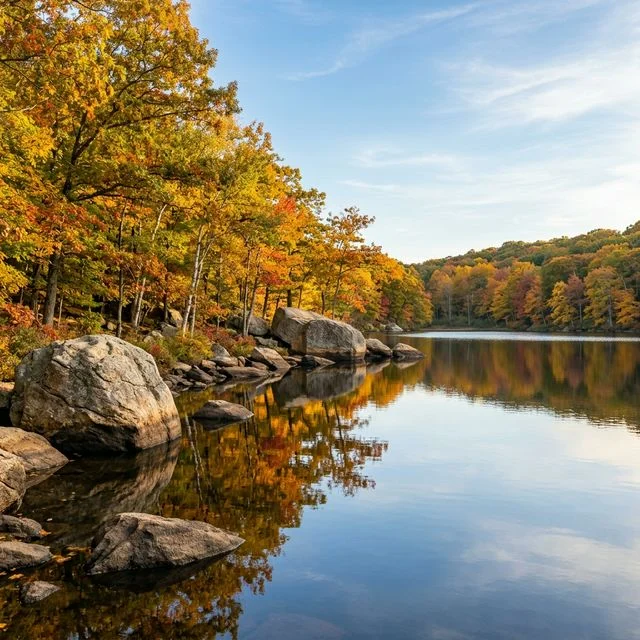
• Fall foliage: Peak color typically arrives in mid-to-late October. The Loop Road provides the best vantage points for reflections of autumn color on Olney Pond. Shoot at golden hour for warm, soft light.
• Bouldering action: A 70–200mm lens from ground level captures dramatic climbing angles. Late afternoon light filtering through the canopy creates beautiful rim lighting on the climber.
• Olney Pond: Early morning mist on the pond during September and October produces ethereal conditions. Arrive at sunrise with a tripod for mirror-like reflections.
• Drone note: Check FAA regulations. Lincoln Woods is near T.F. Green International Airport airspace. Always verify you are outside restricted zones using the B4UFLY app.
Safety Information
| Hazard | Risk Level | Prevention |
|---|---|---|
| 🧗 Bouldering Falls | Moderate–High | Always use crash pads, climb with a spotter, know your limits |
| 🦟 Ticks | High (Apr–Oct) | DEET repellent, long pants, thorough tick check after hiking |
| 🧊 Thin Ice | High (winter) | ONLY venture onto ice when officially declared safe by RI DEM |
| 🐍 Snakes | Low | Non-venomous species present; watch step in rocky areas |
| 🌲 Trail Navigation | Moderate | Many unmarked informal trails — carry GPS/map, don’t rely on signage |
Frequently Asked Questions
Is there a fee to enter Lincoln Woods State Park?
No. Lincoln Woods State Park is completely free to visit year-round — no entrance fees, no parking charges. This makes it one of the best free outdoor recreation options in the greater Providence area. Some group picnic shelters and playing fields do require a permit reservation through the park office, but general access is unrestricted.
Can you go bouldering at Lincoln Woods State Park?
Absolutely — Lincoln Woods is the premier bouldering destination in Rhode Island and one of the best in New England. The park contains hundreds of glacial erratic boulders with climbing problems ranging from V0 (beginner-friendly) to V12+ (elite difficulty). The rock is a unique conglomerate that provides excellent friction. You’ll need crash pads and a navigation app (try 27 Crags or Mountain Project) to find specific boulders in the forest. The climbing zone is in Zone B, east of Quinsnicket Road.
Can you swim at Lincoln Woods?
Yes. The Frank Moody State Beach on the north shore of Olney Pond provides a freshwater swimming beach with a sandy bottom and gradual slope. Lifeguards are on duty seasonally from approximately late June through Labor Day. The water temperature (72–78°F in summer) is significantly warmer than Rhode Island’s ocean beaches, making it a popular alternative for families with young children.
Are dogs allowed at Lincoln Woods State Park?
Yes, dogs are welcome at Lincoln Woods but must be kept on a leash no longer than 6 feet at all times. Owners are required to clean up after their pets, and rangers do enforce this rule. Dogs are not permitted on the swimming beach when lifeguards are on duty. The trail system (both Zone A and Zone B) is dog-friendly.
Is there camping at Lincoln Woods?
No, camping is not permitted at Lincoln Woods State Park. It is a day-use facility open from sunrise to sunset only. For camping near Providence, consider Burlingame State Park in Charlestown (about 45 minutes south) or George Washington State Campground in Glocester (about 25 minutes west).
Can you mountain bike at Lincoln Woods?
Yes, but only in Zone B (east of Quinsnicket Road). Zone A is reserved exclusively for equestrian use and mountain biking is prohibited there. The Zone B trails offer moderate to challenging terrain with roots, rocks, and varying elevation changes. The 2.5-mile Loop Road around Olney Pond is also open to bicycles — it’s paved and flat, making it ideal for casual cycling.
What fish can you catch at Lincoln Woods?
Olney Pond is stocked by RI DEM with brook, rainbow, and brown trout, primarily in spring. The pond also holds largemouth bass, chain pickerel, bluegill, and crappie year-round. Trout season opens on the second Saturday of April — it’s a major local event. A Rhode Island freshwater fishing license is required for anglers 15 and older. In winter, ice fishing is permitted when ice conditions are officially declared safe.
🌲 Plan Your Visit to Lincoln Woods State Park
Rhode Island’s first state park offers 627 acres of glacial boulders, freshwater swimming, and some of the best bouldering in New England — all completely free. Check current conditions and trail maps before your visit.
🗺️ Official Park Info & Maps 🎣 Get Your Fishing LicenseExplore More Rhode Island State Parks
Lincoln Woods State Park is one of many outstanding state parks in Rhode Island. Discover more parks in our Best State Parks in Rhode Island guide, or use our Park Finder to search by activity, location, or features.

🐾 Dogs & Pets at Lincoln Woods State Park
- Pets allowed? statewide rule
- Domestic animals are allowed in Rhode Island state parks but must be leashed and under a handler's control at all times.
- Leash rule statewide rule
- Leash no more than 6 feet in length required (up to 25 feet in state management areas)
- Beaches & swim areas statewide rule
- No animals allowed on any state bathing beach, East Beach/Ninigret or Burlingame Picnic Area from April 1 through September 30
- Cabins & lodging statewide rule
- No cabin lodging program; camping allows a maximum of two pets (dogs or cats) per campsite, but pets are not permitted at Charlestown Breachway or East Beach campgrounds
- Statewide exceptions statewide rule
- Current rabies vaccination certificate required for camping pets; e-collars/e-leashes do not count as leashed
Are dogs allowed at Lincoln Woods State Park?
Domestic animals are allowed in Rhode Island state parks but must be leashed and under a handler's control at all times. Individual parks can post stricter rules — check signage on arrival.
Rules verified July 2026 via rules.sos.ri.gov. More: Rhode Island state parks guide · Dog rules in all 50 states compared
Park Location
Plan your gear for Lincoln Woods State Park
From our editorial guides, matched to this park’s activities: