
Blood Run National Historic Landmark

National Historic Landmark — Largest Oneota Culture Archaeological Site in America, 1300–1700 AD Trading and Ceremonial Center, Ancestors of Omaha Ponca Iowa and Oto Tribes, Bi-State Site on Big Sioux River, Iowa–South Dakota Border
Blood Run National Historic Landmark is a nationally significant archaeological site on the Iowa–South Dakota border along the Big Sioux River, near Larchwood, Lyon County, Iowa. The landmark features the largest and most complex Oneota culture site in North America, a major trading, village, and ceremonial center occupied from approximately 1300 to 1700 AD, ancestral homeland of the Omaha, Ponca, Iowa, and Oto-Missouria peoples, burial mounds and sensitive cultural features requiring strict trail adherence, the Iowa side with self-guided walking tours along mowed trails (check current access with Lyon County Conservation Board), the South Dakota side fully developed as Good Earth State Park at Blood Run with visitor center, exhibits, and hiking trails, and designation as a National Historic Landmark recognizing its exceptional cultural significance.
Blood Run is one of the most important archaeological sites in the Great Plains — the Oneota culture complex was a major regional trading and ceremonial center from 1300 to 1700 AD. The site is the ancestral homeland of the Omaha, Ponca, Iowa, and Oto-Missouria peoples and spans both sides of the Big Sioux River.
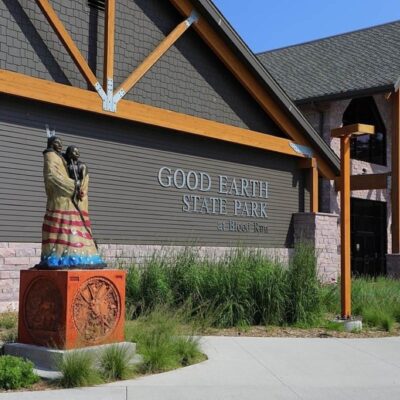
The South Dakota side is fully developed as Good Earth State Park at Blood Run with a visitor center, interpretive exhibits, and hiking trails. The Iowa side offers self-guided walking tours along mowed trails.
What to See
- Oneota site — largest + most complex in North America
- History — 1300–1700 AD trading + ceremonial center
- Good Earth SP (SD) — visitor center, exhibits, trails
- Iowa side — self-guided mowed trail walks
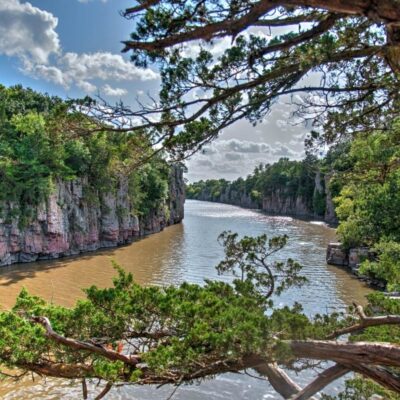
- Big Sioux River — scenic bi-state corridor
- Cultural significance — Omaha, Ponca, Iowa, Oto peoples
Site Information
| Feature | Details |
|---|---|
| Iowa Location | Near Larchwood, Lyon County, IA |
| SD Location | Good Earth SP — 26924 480th Ave, Sioux Falls |
| Culture | Oneota — largest site in North America |
| Period | 1300–1700 AD |
| Peoples | Omaha, Ponca, Iowa, Oto-Missouria ancestors |
| Iowa Access | Self-guided walks — check Lyon Co. Conservation |
| SD Access | Good Earth SP — visitor center + hiking trails |
| Designation | National Historic Landmark |
| Coordinates | 43.4674° N, 96.5761° W |
Frequently Asked Questions
Wildlife & Nature
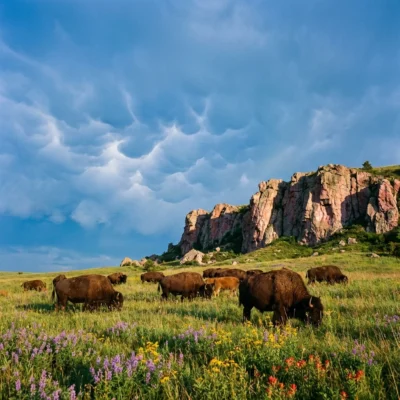
Blood Run NHL — preserves a massive Native American village and trading center occupied from AD 1500-1714 — once home to an estimated 8,000-10,000 Oneota people. This was one of the largest communities in North America at its peak. The site’s prairie, river bluffs, and mounds support bald eagles, red-tailed hawks, and prairie wildflowers.
Nearby Attractions
Lyon County — surrounding. Big Sioux River — adjacent (Iowa-South Dakota border). Good Earth SP (SD) — across the river.
What is Blood Run National Historic Landmark?
Blood Run National Historic Landmark is the largest and most complex Oneota culture archaeological site in North America, located along the Big Sioux River on the Iowa–South Dakota border. It was a major trading, village, and ceremonial center from about 1300 to 1700 AD and is the ancestral homeland of the Omaha, Ponca, Iowa, and Oto-Missouria peoples. The South Dakota side is fully developed as Good Earth State Park at Blood Run (26924 480th Ave, Sioux Falls) with a visitor center, interpretive exhibits, and hiking trails. The Iowa side near Larchwood offers self-guided walking tours — check access with the Lyon County Conservation Board.
Last updated: May 2026

Park Location
Top Tours & Activities Near Sioux Falls
 from $110
 from $10
 from $12