
🌤 Weather at Palms Book State Park by season
| Spring | Summer | Fall | Winter |
|---|---|---|---|
| 19–57 °F | 51–74 °F | 28–66 °F | 10–31 °F |
Each range runs from the coldest monthly average low to the warmest monthly average high in that season (1991-2020 climate normals), measured at Manistique Wwtp, 7 mi away, elevation 600 ft. Conditions at the park can differ from the station, especially where elevation differs — check a forecast before you go.

Overview: Michigan’s Largest Freshwater Spring
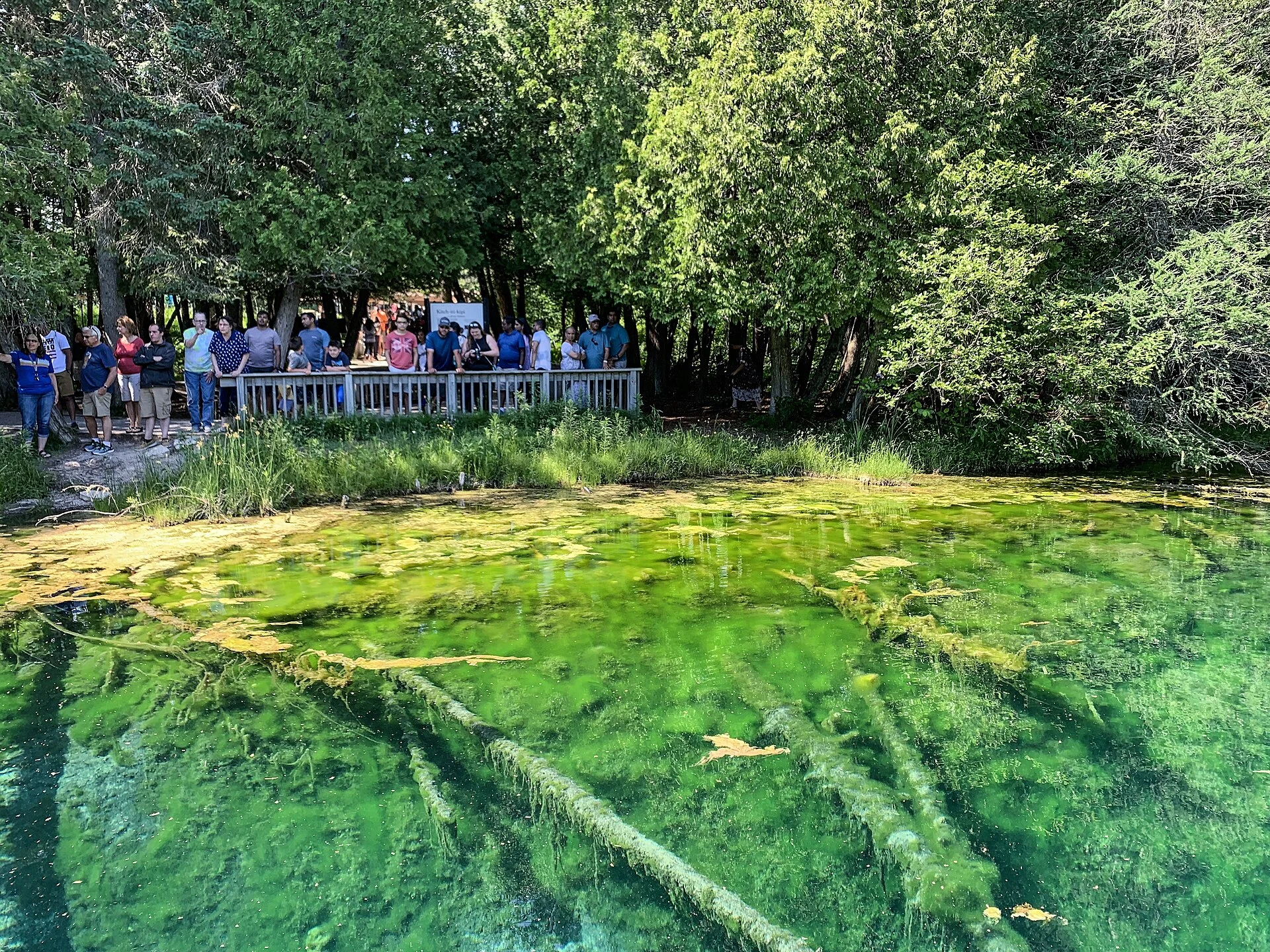
Tucked into a quiet corner of Schoolcraft County in the central Upper Peninsula, Palms Book State Park exists for a single, extraordinary reason: Kitch-iti-kipi, Michigan’s largest natural freshwater spring. Known in the Ojibwe language as “the big cold spring” and poetically called the “Mirror of Heaven,” Kitch-iti-kipi is a 200-foot-wide, 40-foot-deep pool of impossibly clear, emerald-green water that pumps over 10,000 gallons per minute from fissures in the underlying limestone bedrock at a constant year-round temperature of 45°F.
This is not a park for camping, hiking, or swimming—it is a park for witnessing one of the most visually stunning natural phenomena in the Great Lakes region. Visitors view the spring from a self-operated observation raft that glides across the surface on a cable, providing a moving window into the crystal-clear depths where ancient submerged tree trunks, swirling sand “boils” from the spring vents, and large trout are all visible with startling clarity 40 feet below.
Kitch-iti-kipi: The Big Spring
The Numbers
- Pool Diameter: Approximately 200 feet across
- Depth: 40 feet at the deepest point
- Flow Rate: Over 10,000 gallons per minute—enough to fill a standard swimming pool every 2–3 minutes
- Water Temperature: Constant 45°F (7°C) year-round, regardless of air temperature
- Source: Water emerges from fissures in limestone bedrock, rising under pressure from deep underground aquifers
What You’ll See from the Raft
The self-operated observation raft—essentially a flat platform with a large viewing window cut into the bottom—glides silently across the surface of the spring pool on a tethered cable. Visitors pull the raft across the water using a hand-operated cable mechanism, stopping anywhere along the route to observe the underwater landscape below.
The clarity of the water is extraordinary. Looking down through the viewing window, you will see:
- Sand Boils: Pressurized plumes of sand and silt erupting from the spring vents in the limestone floor, creating miniature underwater volcanoes that demonstrate the enormous volume of water forcing its way to the surface
- Submerged Tree Trunks: Ancient fallen trees preserved in the cold, mineral-rich water, their trunks coated in a pale mineral crust that gives them an otherworldly, ghostly appearance
- Trout: Large brook and brown trout cruise through the crystal-clear water, easily visible at depths that would be invisible in any ordinary body of water
- The Bottom: The limestone floor of the spring pool is visible at its full 40-foot depth—a level of clarity rarely experienced outside tropical ocean environments
The Color
Kitch-iti-kipi’s most immediately striking visual quality is its color: a deep, vivid emerald green created by the combination of the water’s exceptional clarity, the mineral content of the limestone-filtered spring water, and the play of natural light across the pool’s surface. Depending on cloud cover, time of day, and season, the color shifts from pale jade to deep forest green—but it is always intensely, almost artificially vivid.
Rules and Restrictions
The spring is an ecologically sensitive and culturally significant site. The following activities are strictly prohibited:
- No swimming — The water is dangerously cold (45°F) and the spring is a protected natural feature
- No fishing — The trout are protected and may not be harvested
- No boating — Only the park’s observation raft is permitted on the water
- No throwing objects — Coins, cameras, drones, and other objects may not be launched into the spring
Accessibility
The trail from the parking area to the observation raft is ADA-accessible, making Kitch-iti-kipi one of the most accessible natural wonders in the Upper Peninsula. The raft itself can accommodate wheelchairs and mobility devices, ensuring that virtually all visitors can experience the spring. This thoughtful accessibility—allowing people who might never be able to hike to a backcountry waterfall or climb a mountain to experience a genuinely spectacular natural phenomenon—is one of the park’s most admirable qualities.
Practical Information
- Location: Thompson Township, Schoolcraft County, approximately 12 miles west of Manistique
- Season: Open year-round, though winter access may be limited by snow. The raft operates whenever ice-free conditions permit.
- Camping: None at this park. Indian Lake State Park (nearby) offers camping.
- Duration: Allow 30–60 minutes for the raft crossing, photography, and interpretive displays
- Fees: Michigan Recreation Passport required for vehicle entry
- Best Time: Midday on sunny days produces the most vivid green color and best visibility into the depths
Frequently Asked Questions
What does “Kitch-iti-kipi” mean? “Big cold spring” in the Ojibwe language. The spring is also poetically known as the “Mirror of Heaven.”
How do I see the spring? A self-operated observation raft glides across the spring pool on a cable. Visitors pull the raft by hand, stopping to observe the underwater features through a viewing window. No swimming, boating, or submersion of objects is permitted.
Is it wheelchair accessible? Yes. The trail to the raft and the raft itself are ADA-accessible, making Kitch-iti-kipi one of the most accessible natural attractions in the Upper Peninsula.
Can I swim in the spring? Absolutely not. The water is 45°F year-round (dangerously cold), and swimming is strictly prohibited to protect this sensitive natural feature.
Is Kitch-iti-kipi really that clear? Yes. The limestone-filtered spring water achieves clarity that allows visibility to the full 40-foot depth of the pool—a level of transparency rarely experienced outside tropical marine environments.
Wildlife & Nature
Palms Book SP — home of Kitch-iti-kipi (“Big Spring”), Michigan’s largest spring — is one of the Upper Peninsula’s most magical attractions. The 200-foot wide, 40-foot deep spring produces 10,000 gallons per minute of crystal-clear, 45°F water. Visitors ride a self-propelled observation raft to view ancient tree trunks and bubbling sands on the bottom. Brook trout and brown trout thrive in the outflow.
Nearby Attractions
Manistique — 10 miles east. Indian Lake SP — 15 miles east. Fayette HSP — 30 miles west — has the ghost town. Seul Choix Point Lighthouse — 25 miles east.
Make it a road trip: Pair a visit with Indian Lake State Park (a short drive away) or Fayette Historic State Park (within about an hour’s drive).

🐾 Dogs & Pets at Palms Book State Park
- Pets allowed? statewide rule
- Pets are welcome in Michigan state parks, campgrounds, harbors and state-designated trails, except designated swim beaches and other posted areas.
- Leash rule statewide rule
- Pets must always be on a 6-foot leash and under the owner's immediate control.
- Beaches & swim areas statewide rule
- Pets are prohibited in buoyed swim areas but allowed along the shoreline outside them (on a 6-ft leash, even in the water); 50+ parks have pet-friendly shoreline or designated dog beaches.
- Cabins & lodging statewide rule
- Up to two pets (cats and dogs only) allowed at ~12 parks' designated pet-friendly cabins, yurts and lodges; $10 per night per pet (cabins) or $15 (lodges); otherwise pets barred from overnight lodging.
- Pet fees statewide rule
- No day-use pet fee; pet-friendly lodging costs $10/night per pet (cabins) or $15/night per pet (lodges).
- Statewide exceptions statewide rule
- Leash laws do not apply to dogs used for hunting on land open to such use; pets may not be left unattended.
Are dogs allowed at Palms Book State Park?
Pets are welcome in Michigan state parks, campgrounds, harbors and state-designated trails, except designated swim beaches and other posted areas. Individual parks can post stricter rules — check signage on arrival.
Rules verified July 2026 via michigan.gov. More: Michigan state parks guide · Dog rules in all 50 states compared
Park Location
Plan your gear for Palms Book State Park
From our editorial guides, matched to this park’s activities:


Top Tours & Activities Near Green Bay & Door County
 from $57
 from $49
 from $101