
🌤 Weather at Hot Springs State Park by season
| Spring | Summer | Fall | Winter |
|---|---|---|---|
| 26–71 °F | 51–92 °F | 22–80 °F | 12–42 °F |
Each range runs from the coldest monthly average low to the warmest monthly average high in that season (1991-2020 climate normals), measured at Thermopolis, 0 mi away, elevation 4,321 ft. Conditions at the park can differ from the station, especially where elevation differs — check a forecast before you go.

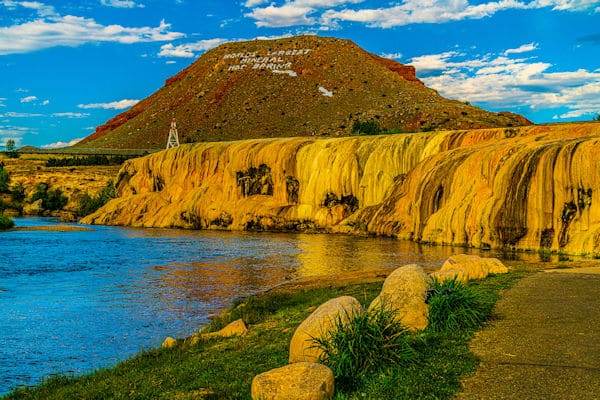
♨️ Wyoming’s First State Park — World’s Largest Mineral Hot Spring — 3.6 million gallons per day flowing at 127°F, a FREE public bathhouse (honoring an 1896 treaty with the Shoshone and Arapaho), Rainbow Terraces mineral formations, a resident bison herd, the Bighorn River Swinging Bridge, and 6.2 miles of trails in Thermopolis
In the town of Thermopolis — a name that literally means “hot city” — at the edge of the Wind River Canyon where the Bighorn River carves through ancient limestone, the earth opens up and releases a torrent of superheated mineral water that has been rising from deep underground for thousands of years. Big Spring, the centerpiece of Hot Springs State Park, produces over 3.6 million gallons of mineral-rich water per day at a scorching 127°F — making it one of the world’s largest mineral hot springs. And thanks to a treaty signed in 1896, soaking in these waters is completely free.
The story behind that free access is remarkable. In 1896, Chief Washakie of the Eastern Shoshone and Chief Sharp Nose of the Northern Arapaho negotiated the sale of the hot springs area to the federal government with one extraordinary condition: a portion of the mineral waters must remain forever free and open to the public. The Wyoming State Bathhouse has honored that promise for over 125 years, providing free indoor and outdoor soaking pools maintained at a therapeutic 104°F. This makes Hot Springs State Park — established in 1897 as Wyoming’s first state park — one of the most culturally significant and historically unique state parks in the American West.
Big Spring and the Bathhouse
| Feature | Details |
|---|---|
| Flow Rate | 3.6+ million gallons per day |
| Temperature | 127°F at source |
| Bathhouse Temperature | 104°F (therapeutic) |
| Cost | FREE — by treaty since 1896 |
| Soak Limit | 20 minutes per session |
| Bathhouse Hours | Mon-Sat 8 AM-5:30 PM; Sun 12-5:30 PM |
Rainbow Terraces
As the superheated mineral water flows from Big Spring across the landscape toward the Bighorn River, it deposits layer after layer of travertine — calcium carbonate — creating stunning, multicolored terraces that shift from brilliant white to deep orange and rusty red. These Rainbow Terraces are reminiscent of (though smaller than) the terraces at Yellowstone’s Mammoth Hot Springs, and they’re actively growing. A boardwalk trail allows close-up viewing without damaging the fragile formations.
Bison Herd
| Feature | Details |
|---|---|
| Herd | Resident bison (American buffalo) |
| Viewing | From park roads — remain in vehicles |
| History | Maintained as a living heritage herd |
Bighorn River and Swinging Bridge
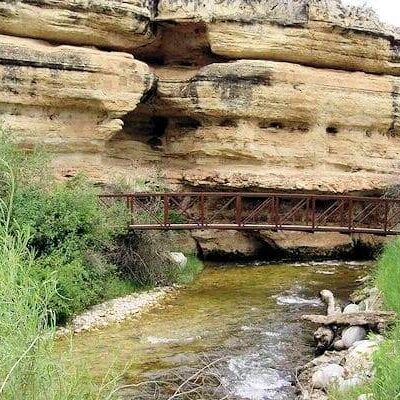
A suspension footbridge — locally known as the “Swinging Bridge” — crosses the Bighorn River within the park, offering excellent views of the river, the mineral terraces, and the surrounding canyon landscape. The Bighorn River itself is a world-class trout fishery downstream.
Trails — 6.2 Miles
| Trail Type | Difficulty | Highlights |
|---|---|---|
| Boardwalk Trails | Easy (ADA accessible) | Rainbow Terraces, Big Spring viewing |
| River Trails | Easy-Moderate | Bighorn River, Swinging Bridge |
| Park Loop | Moderate | Bison viewing, canyon scenery |
The 1896 Treaty — Gift of the Waters
Every year in early August, Thermopolis hosts the “Gift of the Waters” Pageant — a community celebration that commemorates the 1896 agreement between the Shoshone, Arapaho, and the federal government. The pageant includes a reenactment of the treaty signing and celebrates the legacy of Chief Washakie’s stipulation that the waters remain free. It’s one of Wyoming’s most culturally significant annual events.
Essential Visitor Information
| Detail | Information |
|---|---|
| Address | 220 Park Street, Thermopolis, WY 82443 |
| Park Hours | 6 AM – 10 PM |
| Admission | FREE (park and bathhouse) |
| Established | 1897 — Wyoming’s first state park |
Getting There
- From Cody: 84 miles south (~1 hour 30 minutes)
- From Yellowstone (East Entrance): 130 miles southeast (~2 hours 30 minutes)
- From Casper: 130 miles northwest (~2 hours)
- From Billings, MT: 170 miles south (~2 hours 45 minutes)
Wildlife & Nature
Hot Springs SP — features the world’s largest mineral hot spring — Big Spring — flowing at 8,000 gallons per minute at 135°F. The park’s hot springs, travertine terraces, and Bighorn River support bison (a free-roaming herd), mule deer, and bald eagles.
Nearby Attractions
Thermopolis — adjacent. Wyoming Dinosaur Center — nearby. Wind River Canyon — 5 miles south.
Is the hot spring bath really free?
Yes — completely free! The Wyoming State Bathhouse at Hot Springs State Park offers free soaking in indoor and outdoor pools maintained at a therapeutic 104°F. This has been the case for over 125 years, honoring the 1896 treaty in which Chief Washakie (Eastern Shoshone) and Chief Sharp Nose (Northern Arapaho) stipulated that access to a portion of the mineral waters must remain forever free and open to the public. Sessions are limited to 20 minutes.
How hot is the water at Big Spring?
The water at Big Spring emerges from the ground at approximately 127°F (53°C) — far too hot to touch. The spring produces over 3.6 million gallons per day at this temperature. The water is cooled to a therapeutic 104°F (40°C) before it enters the State Bathhouse soaking pools. The excess water flows across the landscape, depositing minerals and creating the park’s famous Rainbow Terraces.
Insider Tips
World’s largest mineral hot spring: Hot Springs State Park in Thermopolis features the world’s largest single mineral hot spring — Big Spring produces 3.6 million gallons of 135°F water daily. Pro tip: The State Bath House offers FREE soaking in the mineral water. Bison: A small bison herd grazes in the park.
Best Time to Visit
Year-round: Hot springs are always 104°F in the pools. Winter: Steaming pools in snow — magical. Summer: Combine with Bighorn Canyon. Fall: Golden cottonwoods along the Bighorn River.
Frequently Asked Questions
Is soaking at Hot Springs really free?
Yes. The State Bath House at Hot Springs State Park offers free mineral hot spring soaking — a 20-minute session per person. This has been free by treaty since 1896 when the Eastern Shoshone and Arapaho tribes granted the hot springs to Wyoming with the condition that they remain free to all. Commercial pools nearby offer longer soaking for a fee.
More parks in Wyoming: Legend Rock State Archaeological Site and Woodruff Cabin Site. See the full Wyoming state parks guide.

🐾 Dogs & Pets at Hot Springs State Park
- Pets allowed? statewide rule
- Pets are welcome in Wyoming state parks, historic sites and recreation areas, but must be in a vehicle or on a leash whenever outside a camping unit.
- Leash rule statewide rule
- Leash no longer than 10 feet, physically controlled at all times (statewide rule)
- Beaches & swim areas statewide rule
- Pets are prohibited on designated beach areas statewide
- Cabins & lodging statewide rule
- Pets are prohibited in public buildings, eating places and food stores; no statewide pet-lodging policy published
- Statewide exceptions statewide rule
- Guide dogs are exempt; hunting dogs allowed where hunting is permitted; pets may not be left unattended longer than one hour; pets are prohibited in the reservoirs at Curt Gowdy State Park
Are dogs allowed at Hot Springs State Park?
Pets are welcome in Wyoming state parks, historic sites and recreation areas, but must be in a vehicle or on a leash whenever outside a camping unit. Individual parks can post stricter rules — check signage on arrival.
Rules verified July 2026 via wyoparks.wyo.gov. More: Wyoming state parks guide · Dog rules in all 50 states compared
Park Location
Plan your gear for Hot Springs State Park
From our editorial guides, matched to this park’s activities:
Top Tours & Activities Near Wyoming
 from $1,999
 from $2,443
 from $548