🌤 Weather at Watoga State Park by season
| Spring | Summer | Fall | Winter |
|---|---|---|---|
| 27–72 °F | 54–82 °F | 28–75 °F | 19–42 °F |
Each range runs from the coldest monthly average low to the warmest monthly average high in that season (1991-2020 climate normals), measured at Buckeye, 7 mi away, elevation 2,123 ft. Conditions at the park can differ from the station, especially where elevation differs — check a forecast before you go.
The park itself ranges from about 2,090 to 3,230 ft in elevation — higher ground runs cooler than the figures above.

Watoga State Park is a 10,100-acre mountain wilderness in the heart of Pocahontas County, West Virginia — making it the largest state park in the Mountain State. Tucked deep in the Allegheny Mountains along the Greenbrier River, Watoga offers 40 miles of hiking trails, CCC-era stone cabins, a swimming pool, three campgrounds, and a sense of backcountry solitude that’s increasingly rare on the East Coast.
The name “Watoga” derives from the Cherokee word “watauga” meaning “river of islands” — a fitting name for a park where the beautiful Greenbrier River, dotted with sandbars and gentle rapids, forms the park’s eastern boundary. Whether you’re a thru-hiker connecting to the Allegheny Trail, a family looking for a woodland cabin getaway, or a cyclist riding the famous Greenbrier River Trail, Watoga delivers the wild West Virginia experience at its finest.
Quick Facts at a Glance
| Location | Pocahontas County, West Virginia (Allegheny Mountains) |
| Park Size | 10,100 acres (WV’s largest) |
| Hiking Trails | 40 miles (easy to strenuous) |
| Campgrounds | 3 (Riverside 50 sites, Beaver Creek 38 sites, Laurel Run 12 primitive) |
| Cabins | CCC-era vacation cabins (seasonal & year-round) |
| Pool | Swimming pool (Memorial Day – Labor Day) |
| Long Trails | Allegheny Trail & Greenbrier River Trail accessible |
| CCC Heritage | 3 camps built infrastructure 1933–1937 |
| Nearest Town | Marlinton (12 miles) / Hillsboro |
History & CCC Heritage
Watoga’s development is inseparable from the Civilian Conservation Corps (CCC), one of President Roosevelt’s most successful New Deal programs. Between 1933 and 1937, three CCC camps — Camp Watoga, Camp Seebert, and Camp Will Rogers — built nearly everything you see in the park today:
- Rustic stone and timber vacation cabins that still house guests
- Roads, bridges, and the administration building
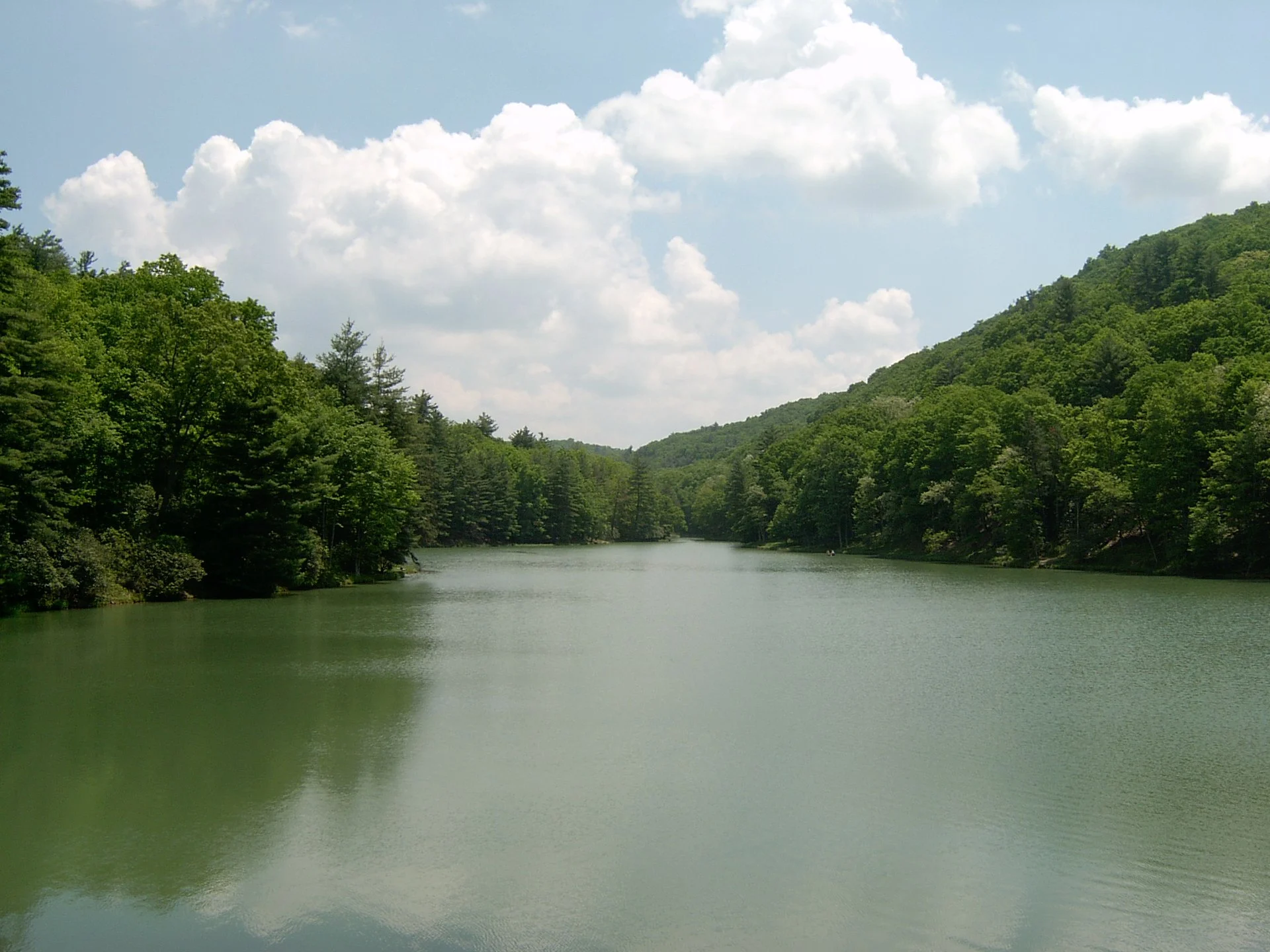
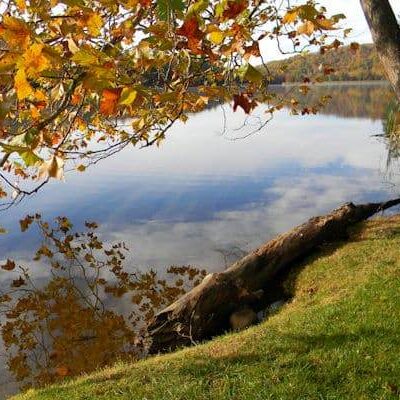
- The 11-acre Watoga Lake
- Horse and foot trails throughout the mountains
- The park’s swimming pool
These CCC structures, built from native stone and timber by young men during the Great Depression, represent some of the finest surviving examples of Depression-era park architecture in the Eastern United States.
Trails & Hiking
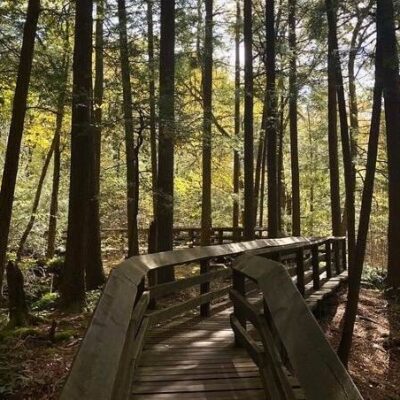
Watoga’s 40-mile trail system winds through dense Appalachian hardwood forests, up ridge crests, and along mountain streams. The terrain is moderately rugged with significant elevation changes — classic Allegheny Mountain hiking.
Notable Trails
| Trail | Distance | Difficulty | Highlights |
| Ann Bailey Lookout Tower Trail | Varies | Moderate-Strenuous | 360° views of Greenbrier Valley from fire tower |
| T.M. Cheek Trail | Moderate loop | Moderate | Classic hardwood forest hiking |
| Lake Trail | Short loop | Easy | Circles Watoga Lake, family-friendly |
| Brooks Memorial Arboretum Trail | Short | Easy | Labeled native tree and plant species |
| Pine Run / Ten Acre / Honeymoon Loop | Multi-trail loop | Moderate-Strenuous | Longer backcountry experience |
| Allegheny Trail (AT connector) | Through-hike | Strenuous | WV’s longest trail traverses the park |
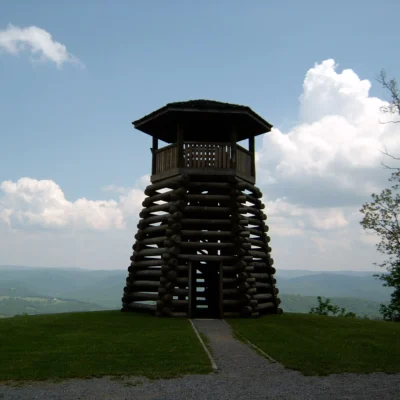
Ann Bailey Lookout Tower is the signature hike — multiple trails lead to this fire tower where panoramic views stretch across the entire Greenbrier Valley.
Greenbrier River Trail (Adjacent)
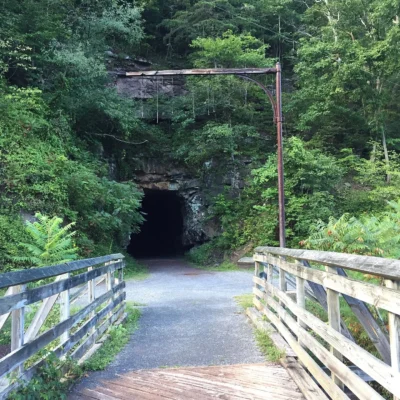
The Greenbrier River Trail, a 78-mile rail-trail following the river through tunnels and over bridges, is directly accessible from the park. It’s one of the finest cycling/jogging trails in the East — flat, scenic, and car-free.
Wildlife & Nature
Watoga’s 10,100 acres of recovering Appalachian forest (most of West Virginia was clear-cut by 1900) now supports rich biodiversity:
- Black Bear — West Virginia’s state animal, increasingly common in the park
- White-tailed Deer — abundant, especially along meadow edges at dawn
- Wild Turkey — gobbling echoes through spring mornings
- Ruffed Grouse — drumming on fallen logs in spring
- Barred Owl — vocal residents of the deep ravines
- Brook Trout — native West Virginia trout in mountain streams
- Spring wildflowers — trillium, jack-in-the-pulpit, rhododendron blooming in June
Camping
| Campground | Sites | Electric | Season |
| Riverside | 50 | 38 with hookups | April – October |
| Beaver Creek | 38 | All 50-amp | Memorial Day – deer season |
| Laurel Run (Primitive) | 12 | None | Year-round |
The Riverside Campground is the most popular, with sites along the beautiful Greenbrier River — swimming holes are accessible right from camp. Beaver Creek offers newer 50-amp service for larger RVs.
Cabins
The park offers CCC-era vacation cabins — rustic but charming stone and timber structures from the 1930s. Some are available year-round, others seasonally. These are among the most atmospheric cabin experiences in the East — book well in advance.
Swimming
The park’s swimming pool is open Memorial Day through Labor Day. For a more natural experience, swim in the Greenbrier River — sandy beaches and shallow pools near the Riverside Campground are popular unofficial swimming spots.
How to Get There
- From Charleston, WV (3 hours): I-64 East to US-219 South through Lewisburg to Watoga.
- From Richmond, VA (4 hours): I-64 West to US-219 South.
- From Washington, DC (5 hours): I-66 West to I-81 South, US-220 to US-219 into Pocahontas County.
Insider Tips
- Combine park trails with the Greenbrier River Trail for a multi-day hiking/biking adventure
- Hike to Ann Bailey Tower at sunrise for the best mountain light and valley fog
- Book CCC cabins months in advance — these historic retreats are beloved and fill quickly
- Fall foliage peaks in mid-October — the Allegheny hardwoods deliver some of the best color in West Virginia
- Riverside campsites along the Greenbrier offer unofficial swimming holes just steps from your tent
- Spring wildflower season (May–June) brings rhododendron, mountain laurel, and trillium
- Laurel Run primitive sites are open year-round — perfect for winter solitude
Best Time to Visit
| Season | Conditions | Best For |
| Spring (Apr–May) | Cool (50–70°F), wildflowers, rushing streams | Hiking, wildflowers, trout fishing |
| Summer (Jun–Aug) | Warm (70–85°F), pool and river swimming | Swimming, camping, cycling GRT |
| Fall (Sep–Nov) | Cool (45–70°F), stunning foliage | Hiking (peak season), photography, cabin stays |
| Winter (Dec–Mar) | Cold (25–45°F), snowy mountains | Solitude, primitive camping, cross-country skiing |
Frequently Asked Questions
Is Watoga the largest state park in West Virginia?
Yes — at 10,100 acres, Watoga is the largest state park in West Virginia, located in the remote Allegheny Mountains of Pocahontas County.
Can I swim in the Greenbrier River?
Yes — swimming at your own risk, especially near sandy beaches by the Riverside Campground. The park also has a swimming pool open Memorial Day through Labor Day.
What are the CCC cabins like?
These 1930s-era stone and timber cabins are rustic but charming, built by the Civilian Conservation Corps during the Great Depression. They represent outstanding craftsmanship and offer an atmospheric mountain getaway. Book well in advance.
Explore More West Virginia State Parks
Discover more in our Best State Parks in West Virginia guide, or use our Park Finder to search by activity or features.
More parks nearby: Droop Mountain Battlefield State Park is a short drive away, while Beartown State Park lies a short drive away.

🐾 Dogs & Pets at Watoga State Park
Park policy: West Virginia State Parks names Watoga on both of its pet-friendly lists - cabins and camping - and the park's own lodging page confirms that designated pet-friendly cabins are available. The state does not publish which individual units are the pet cabins, so call the park and ask for one by name before you reserve.
- Pets allowed?
- Watoga carries both designated pet-friendly cabins and a pet-friendly campground
- Leash rule statewide rule
- Pets must be leashed and restrained at all times; in lodging public areas a sturdy leash no longer than 10 ft is required
- Cabins & lodging statewide rule
- Select pet-friendly cabins, cottages and lodge rooms at 16 state parks and 4 state forests (e.g. Babcock, Blackwater Falls, Cacapon Resort, Twin Falls Resort); lodge rooms $25 first night + $10 each additional night per pet (capped at $75 per visit), cabins $50 first night + $5 each additional night per pet
- Pet fees statewide rule
- Lodging pet fees: lodge rooms $25 first night + $10/additional night per pet (max $75/visit); cabins $50 first night + $5/additional night per pet
- Park-specific rules
- Classic cabins here rent all year while Legacy (CCC) cabins run April through October, which narrows your choices if you want a dog along in winter.
- Statewide exceptions statewide rule
- Only dogs and cats permitted; maximum two pets in pet-friendly lodging; rabies certification required for lodging stays
Are dogs allowed at Watoga State Park?
Watoga carries both designated pet-friendly cabins and a pet-friendly campground.
Beyond that, West Virginia’s statewide rules apply.
Rules verified July 2026 via wvstateparks.com. More: West Virginia state parks guide · Dog rules in all 50 states compared
Park Location
Plan your gear for Watoga State Park
From our editorial guides, matched to this park’s activities:
Top Tours & Activities Near West Virginia
 from $103
 from $200
 from $60