


🏆 Virginia’s Roadside Masterpiece — A spectacular 80-foot waterfall visible from the road, admired by Thomas Jefferson, in the Alleghany Highlands
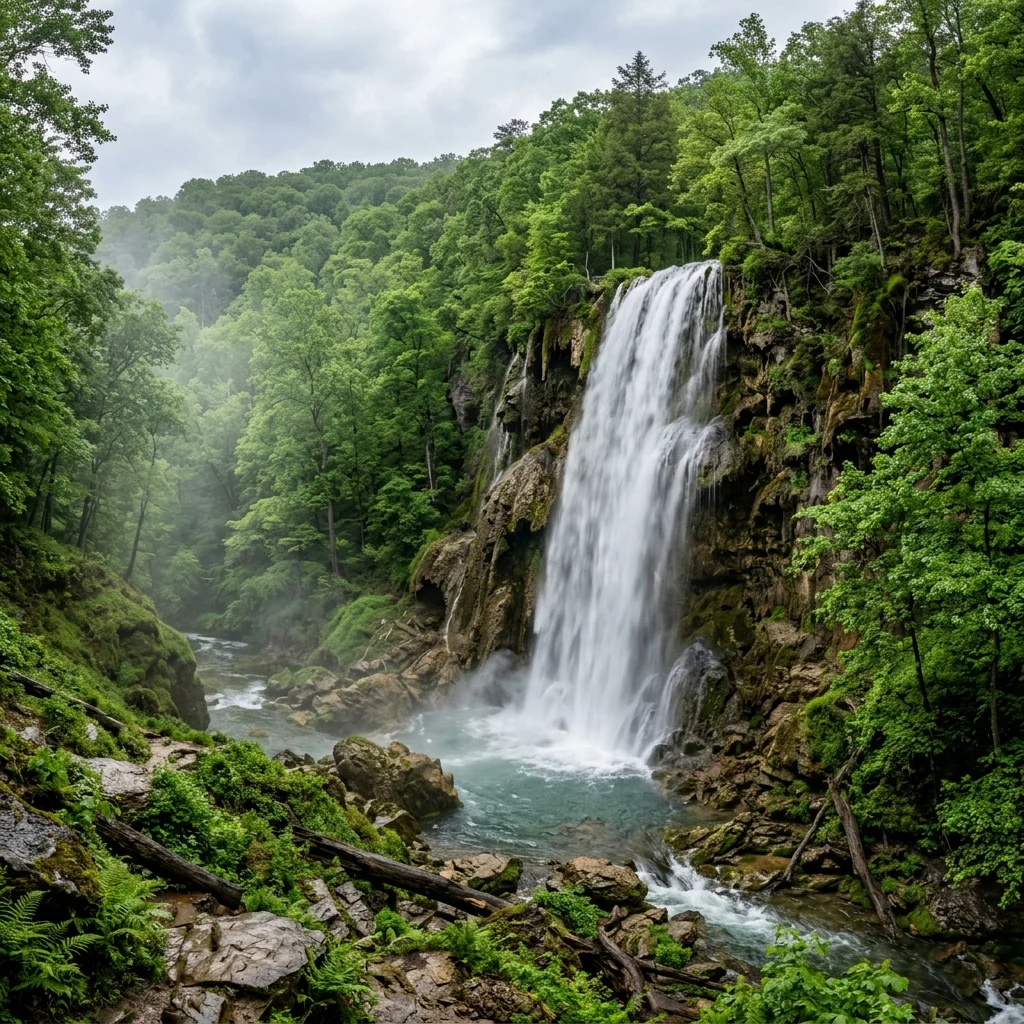
Along US-220 in the Alleghany Highlands of western Virginia, drivers round a curve and encounter one of the most beautiful waterfalls in the eastern United States: Falling Spring Falls, an 80-foot cascade that Thomas Jefferson himself described as a “remarkable cascade” in his Notes on the State of Virginia (1781). The waterfall plunges over a travertine cliff into a pool surrounded by hemlock forest, all visible from a roadside overlook.
Table of Contents
The Falls
Falling Spring Falls is an 80-foot freefall waterfall fed by a natural spring that emerges from the hillside above the cliff. The spring flows year-round, so the falls are always active — though flow is strongest in winter and spring. The water falls over a travertine (calcium carbonate) cliff into a pool below, creating a picturesque scene framed by hemlock trees.
Thomas Jefferson’s Description
Thomas Jefferson described Falling Spring in his 1781 Notes on the State of Virginia: “The only remarkable cascade in this county is that of the Falling Spring… It falls over a rock 200 feet into the valley below.” Jefferson overestimated the height, but his description brought early attention to this natural wonder.
Geology
The falls are formed by a karst spring that emerges from limestone bedrock. As the mineral-laden water flows over the cliff, it deposits travertine (calcium carbonate), gradually building up the cliff face. The falls and the spring are part of the extensive karst system of the Alleghany Highlands.
Viewing & Access
The falls are viewable from a roadside overlook along US-220, about 5 miles north of Covington, Virginia. The overlook has a small parking area and a railed viewing platform. The entire visit takes about 15–30 minutes. Access to the base of the falls involves a scramble down a steep, unofficial path — use caution.
Visitor Information
| Detail | Information |
|---|---|
| 📍 Location | US-220, ~5 miles north of Covington, VA |
| 🕐 Hours | Year-round, daylight hours |
| 💰 Fee | Free |
| 🅿️ Parking | Small pulloff at overlook |
| 🚻 Restrooms | None |
| ⏱️ Duration | 15–30 minutes |
Best Time to Visit
| Season | Best For |
|---|---|
| 🌸 Spring (Apr–May) | Strongest water flow, green surroundings |
| ☀️ Summer (Jun–Aug) | Full foliage framing, moderate flow |
| 🍂 Fall (Oct) | Fall colors, photography |
| ❄️ Winter (Dec–Feb) | Ice formations on falls, dramatic |
Nearby Attractions
| Destination | Distance | Highlights |
|---|---|---|
| Douthat State Park | 20 miles | CCC-built park, lake, cabin rentals |
| The Homestead Resort | 30 miles | Historic hot springs resort |
| George Washington NF | Adjacent | Hiking, camping, mountain streams |
Nearby parks: If you have extra time, Douthat State Park is a short drive away, and Green Pastures Recreation Area is a short drive away.
Frequently Asked Questions
Can you see the falls from the road?
Yes — Falling Spring Falls is visible from a roadside overlook along US-220. You don’t need to hike to see the falls. A small parking area and viewing platform provide the best views.
Did Thomas Jefferson write about these falls?
Yes — Jefferson described Falling Spring in his 1781 Notes on the State of Virginia, calling it a “remarkable cascade.” He estimated the height at 200 feet (actual: ~80 feet).
Is there a fee?
No — viewing the falls is free. There are no developed facilities.
Can you hike to the base?
An unofficial, rough path leads to the base. It’s steep and can be slippery. Use caution. The overlook provides the better view for most visitors.
Do the falls run year-round?
Yes — the falls are spring-fed, so they flow year-round. Flow is strongest in winter and spring. In winter, ice formations on the falls create dramatic scenery.
How tall is the waterfall?
Approximately 80 feet — one of the tallest waterfalls in western Virginia. The water falls freely over a travertine cliff into a pool below.
What’s nearby?
Douthat State Park (20 mi), The Homestead hot springs resort (30 mi), and George Washington National Forest surround the area. Covington (5 mi south) has fuel and food.
💧 See Falling Spring Falls
Witness the 80-foot cascade that Thomas Jefferson called remarkable — visible from the road in Virginia’s beautiful Alleghany Highlands.
🗺️ Virginia DCRExplore More Virginia State Parks
Falling Spring Falls State Park is one of many outstanding state parks in Virginia. Discover more parks in our Best State Parks in Virginia guide, or use our Park Finder to search by activity, location, or features.
Wildlife & Nature
Falling Spring Falls SP — features a spectacular 80-foot waterfall that Thomas Jefferson described in his “Notes on the State of Virginia” (1781) as one of the most remarkable natural features of the state. The park’s gorge, limestone cliffs, and forest support peregrine falcons, ravens, and eastern phoebes.

🐾 Dogs & Pets at Falling Spring Falls State Park
- Pets allowed? statewide rule
- Pets are welcome throughout Virginia State Parks, including campgrounds and trails, as long as they are confined or leashed and supervised.
- Leash rule statewide rule
- 6 ft maximum leash (or confinement) required, with pet under supervision at all times
- Beaches & swim areas statewide rule
- State regulations prohibit pets on public swimming beaches and at designated swimming areas
- Cabins & lodging statewide rule
- Pet-friendly cabin stays available for a $20 per pet per night fee; yurts do not allow pets; pets prohibited in public facilities
- Pet fees statewide rule
- No charge for pets in campgrounds; $20 per pet per night in cabins
- Statewide exceptions statewide rule
- At False Cape, pets may not pass through Back Bay National Wildlife Refuge
Are dogs allowed at Falling Spring Falls State Park?
Pets are welcome throughout Virginia State Parks, including campgrounds and trails, as long as they are confined or leashed and supervised. Individual parks can post stricter rules — check signage on arrival.
Rules verified July 2026 via dcr.virginia.gov. More: Virginia state parks guide · Dog rules in all 50 states compared
Park Location
Plan your gear for Falling Spring Falls State Park
From our editorial guides, matched to this park’s activities:
Top Tours & Activities Near Roanoke
 from $50
 from $82
 from $109