
Toadstool Geologic Park

🍄 34 Million Years of Fossils, Mushroom-Shaped Hoodoos, and Dark Sky Camping in Nebraska’s Hidden Badlands — Completely Free — A geologic park on the Oglala National Grassland in the Nebraska panhandle with mushroom-shaped hoodoo rock formations, 34-million-year-old marine and mammal fossils, prehistoric animal trackways, a 1-mile interpretive trail, Bison Bonebed archaeology, dark sky astrophotography, primitive camping, and Badlands-style scenery — Sioux County, northwest Nebraska
Toadstool Geologic Park looks like another planet. Mushroom-shaped rock formations — hoodoos — rise from an eroded moonscape of white and tan sedimentary layers that are 34 million years old. Fossilized bones of titanotheres, ancient rhinos, saber-toothed cats, and “hell pigs” are embedded in the rock. Prehistoric animal trackways are preserved right in the trail surface beneath your feet.
The park sits on the Oglala National Grassland in the far northwest corner of Nebraska — one of the most remote, least-visited, and darkest-sky locations in the lower 48. There are no entrance fees, no reservations, and no crowds. At night, the Milky Way arcs over 34-million-year-old hoodoos in complete silence. This is one of America’s best-kept geological secrets.
How the Hoodoos Formed
The “toadstools” are a textbook example of differential erosion:
| Layer | What’s Happening |
|---|---|
| Cap Rock (Top) | Hard sandstone layer resists erosion — acts as a “roof” |
| Pedestal (Below) | Softer siltstone and clay erodes faster — wears away underneath |
| Result | Mushroom-shaped pillars standing on narrow stems — hoodoos |
| Timeline | Millions of years of wind and rain sculpt the formations |
The rock layers belong to the White River Group — specifically the Chadron Formation (older, lower) and Brule Formation (younger, upper). These sediments were deposited 34–45 million years ago when this region was a warm, humid savannah with meandering rivers. Volcanic ash from eruptions further west frequently blanketed the area, helping to preserve the extraordinary fossil record.
The Fossil Record — A Window Into Ancient America
Toadstool’s White River Group contains one of the world’s richest Oligocene-era fossil beds. Here’s what lived here 34 million years ago:
| Creature | What It Was | Size |
|---|---|---|
| Titanotheres (Brontotheres) | Massive rhino-like mammals with bony nose horns | Up to 8 feet tall |
| Oreodonts | Stout herbivores unique to North America | Sheep-sized |
| Ancient Rhinoceros | Ancestral rhino species | Various sizes |
| Entelodonts (“Hell Pigs”) | Massive pig-like predators with crushing jaws | Up to 6 feet at shoulder |
| Three-Toed Horses | Early horse ancestors | Dog-sized |
| Poebrotherium | Ancient camel ancestors | Deer-sized |
| Saber-Toothed Cats | Early predatory cats | Varied |
| Giant Tortoises | Large land turtles | 3+ feet |
The Trackway Site
One of Toadstool’s most remarkable features is a fossilized trackway preserved in sandstone slabs right along the trail. You can see footprints of rhinos, camels, entelodonts, birds, and small mammals — frozen in stone for 34 million years. It’s like walking through an ancient watering hole.
⚠️ Important: All fossils are protected under federal law. You can observe and photograph them, but removing any fossil material is illegal and carries serious penalties.
The Trail
| Trail | Distance | Difficulty | Features |
|---|---|---|---|
| Toadstool Interpretive Loop | 1 mile | Easy | Numbered posts, hoodoos, fossils, trackway |
| Bison Trail | 3 miles (one-way) | Moderate | Connects to Hudson-Meng Bison Bonebed |
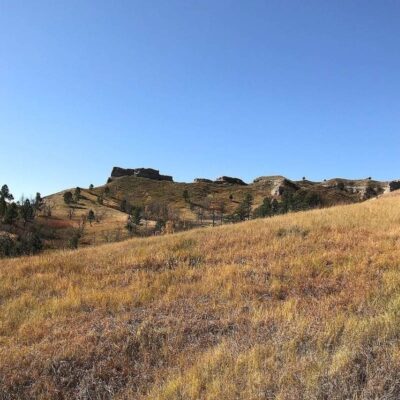
| Off-Trail Exploration | Unlimited | Varies | Open grassland, extended badlands, no marked route |
Hudson-Meng Bison Bonebed
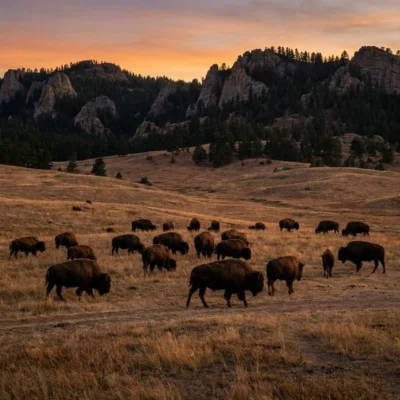
Just 3 miles from Toadstool via the Bison Trail, the Hudson-Meng site contains the remains of up to 600 bison killed approximately 10,000 years ago. Whether this was a natural event or a massive ancient hunt remains one of the great debates in American archaeology.
The on-site visitor center operates seasonally (typically Memorial Day through Labor Day, often Fridays only). The exposed bone bed is visible through a viewing floor. Combined with Toadstool, you can span 34 million years of history in a single day hike.
Dark Sky Astrophotography
Toadstool is one of the premier dark-sky locations in the Great Plains. The Nebraska Panhandle has some of the lowest light pollution in the lower 48 states, and the park is open 24 hours.
| Feature | Details |
|---|---|
| Light Pollution | Bortle Class 1–2 (among the darkest in the US) |
| Milky Way | Clearly visible to the naked eye, core visible Mar–Oct |
| Best Conditions | New moon phase, clear night, arrive before sunset |
| Photography Tip | Hoodoos make extraordinary foreground for long exposures |
| Temperature Warning | Panhandle nights can drop below 40°F even in summer |
Camping
| Feature | Details |
|---|---|
| Sites | ~12 primitive sites |
| Amenities | Picnic tables, fire rings, grills, vault toilet at trailhead |
| Water | ❌ NONE — bring everything you need |
| Reservations | First-come, first-served |
| Fees | ~$15/night camping, ~$3 day-use (honor system) |
| Cell Service | ❌ Unreliable to none |
Essential Packing List
- Water: Minimum 1 gallon per person per day — there is NO water source
- Food: Pack everything in, pack everything out
- Layers: Panhandle temperatures swing dramatically — 90°F days, 40°F nights
- Flashlight/headlamp: For night hiking and astrophotography
- Offline maps: No cell service means no GPS — download before you leave
- Camera + tripod: If you’re here for astrophotography, a sturdy tripod is essential
Getting There
Access is via gravel roads that can become impassable after rain. A high-clearance vehicle is recommended.
| From | Route | Distance | Notes |
|---|---|---|---|
| Crawford, NE | Hwy 2 N → Toadstool Rd → FS Road 902 | ~20 miles | Gravel, watch for mud |
| Harrison, NE | Dirt road north | ~15 miles | Well-maintained when dry |
| Chadron, NE | Hwy 20 W → Hwy 2 N | ~45 miles | Nearest larger town |
| Rapid City, SD | I-90/US-385/Hwy 20 | ~120 miles | Combine with Black Hills trip |
Best Time to Visit
| Season | Weather | Sky Conditions | Best For |
|---|---|---|---|
| Fall (Sep–Oct) | 40–72°F | Clear, dark, Milky Way core visible | Astrophotography, golden light, perfect hiking temps |
| Spring (Apr–May) | 40–70°F | Clear after storms | Wildflowers, green grassland, fewer rattlesnakes |
| Summer (Jun–Aug) | 65–95°F | Excellent dark sky | Long days, hot midday — carry extra water, early starts |
| Winter (Dec–Feb) | 10–38°F | Crystal clear | Snow-dusted hoodoos (stunning photos), brutally cold |
Nearby Attractions
| Attraction | Distance | Why Go |
|---|---|---|
| Hudson-Meng Bison Bonebed | 3 mi (trail) | 10,000-year-old mass bison kill site |
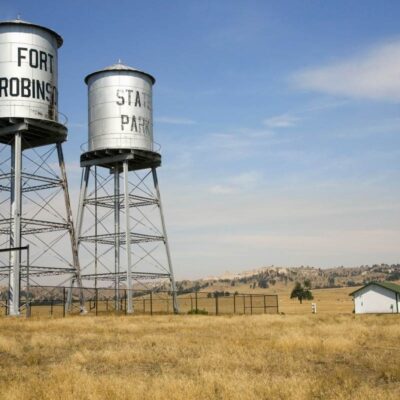
| Fort Robinson SP | ~25 mi | Historic military post, museums, horseback, Jeep tours |
| Chadron SP | ~40 mi | Ponderosa pine forest, swimming, camping |
| Agate Fossil Beds NM | ~60 mi | National Monument, 19-million-year-old mammals |
| Pine Ridge | Adjacent | Scenic escarpment, ponderosa pine, wildlife |
| Soldier Creek Wilderness | ~30 mi | Nebraska’s only designated wilderness area |
💰 Trip Cost Estimator
| Trip Style | Duration | Total Cost | Includes |
|---|---|---|---|
| Day Trip | Half day | $3 | Day-use fee + interpretive trail + fossils |
| Overnight Dark Sky | 1 night | $15–$18 | Camping + Milky Way + hoodoo photography |
| Explorer Weekend | 2 nights | $30–$36 | Camping + Toadstool + Bison Trail + Hudson-Meng |
| NE Panhandle Road Trip | 3–4 days | $60–$150 | Toadstool + Fort Robinson + Chadron + Agate Fossil Beds |
| Best Value | 2 nights | $30–$36 | 34 million years of geology + dark sky + fossil trail = under $40 |
Frequently Asked Questions
Is Toadstool Park a state park?
Not technically — it’s on the Oglala National Grassland, managed by the USDA Forest Service. It functions like a park with a campground, trails, and vault toilets, but it’s federal grassland, not state-managed.
Can I take fossils home?
Absolutely not. All fossils on federal land are protected under the Paleontological Resources Preservation Act. Removing any fossil material is a federal offense. Observe and photograph — but leave everything in place.
Is there water at the campground?
No. There is no water source at Toadstool. Bring at least 1 gallon per person per day. The nearest water and supplies are in Crawford (~20 miles) or Harrison (~15 miles).
Can I drive a sedan there?
When dry, yes — carefully. The gravel access roads are maintained but can become muddy and impassable after rain. A high-clearance vehicle is recommended, especially if conditions are uncertain. Check weather before departing.
How dark is the sky really?
Bortle Class 1–2 — among the darkest in the continental US. The Milky Way is visible to the naked eye with incredible clarity. The hoodoos make extraordinary foreground subjects for long-exposure astrophotography. Plan your visit around the new moon for the darkest conditions.
What’s the Bison Bonebed?
A 10,000-year-old archaeological site 3 miles from Toadstool containing remains of up to 600 bison. Whether it was a natural die-off or a Paleoindian mass hunt is still debated. The visitor center opens seasonally (Memorial Day–Labor Day). You can hike there via the Bison Trail.
Are there rattlesnakes?
Yes — prairie rattlesnakes live in the grassland. Watch where you step, especially around rocks and in warm months. They’re typically not aggressive but stay alert on the trail.
Can I combine this with other Nebraska sites?
Definitely. The Nebraska Panhandle’s “Fossil Highway” connects Toadstool, Fort Robinson, Chadron State Park, Agate Fossil Beds National Monument, and the Pine Ridge. A 3–4 day road trip covers millions of years of geological history.
🍄 34 Million Years Under the Darkest Sky
Mushroom-shaped hoodoos, Oligocene fossils in the trail, titanotheres and hell pigs, dark sky camping, and a 10,000-year-old bison bonebed — Nebraska’s most otherworldly landscape, completely free.
🌌 Astrophotography Heaven
Bortle Class 1–2 dark sky, Milky Way over 34-million-year-old hoodoos, 24-hour access, and zero light pollution. Plan around the new moon.