🌤 Weather at Fort King George State Historic Site by season
| Spring | Summer | Fall | Winter |
|---|---|---|---|
| 51–83 °F | 72–91 °F | 52–86 °F | 43–64 °F |
Each range runs from the coldest monthly average low to the warmest monthly average high in that season (1991-2020 climate normals), measured at Sapelo Is, 8 mi away, elevation 10 ft. Conditions at the park can differ from the station, especially where elevation differs — check a forecast before you go.

Overview
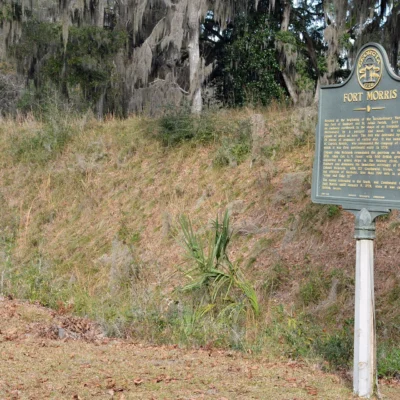
Fort King George State Historic Site stands as a sentinel over the Altamaha River in Darien, Georgia, preserving one of the most strategically important colonial outposts in the American Southeast. Built in 1721 by British Colonel John “Tuscarora Jack” Barnwell, this cypress-block fortification served as the southernmost outpost of the British Empire in North America. For seven years, a garrison of His Majesty’s Independent Company endured disease, isolation, and conflict in the swampy lowlands of coastal Georgia before the fort was ultimately abandoned in 1727.
Today, the reconstructed fort and its surrounding grounds transport visitors back through centuries of human habitation along this stretch of the Georgia coast. The site encompasses not only the British colonial period but also evidence of Spanish mission-era activity, the pre-Columbian Guale Indian culture, and the 19th-century sawmill industry that once made Darien one of the busiest timber ports in the world. A comprehensive museum houses artifacts recovered from archaeological excavations, bringing each era of the site’s complex history to vivid life.
Historical Significance
The strategic importance of this location extends far beyond the British colonial fort. Archaeological evidence reveals Guale Indian occupation dating back hundreds of years before European contact. The Spanish established missions in the region during the 16th and 17th centuries, seeking to convert and control the indigenous population. When the British arrived, they recognized the same strategic advantages — a commanding view of the Altamaha River and access to the interior — that had drawn earlier inhabitants.
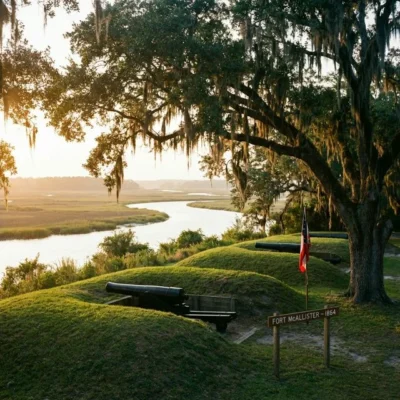
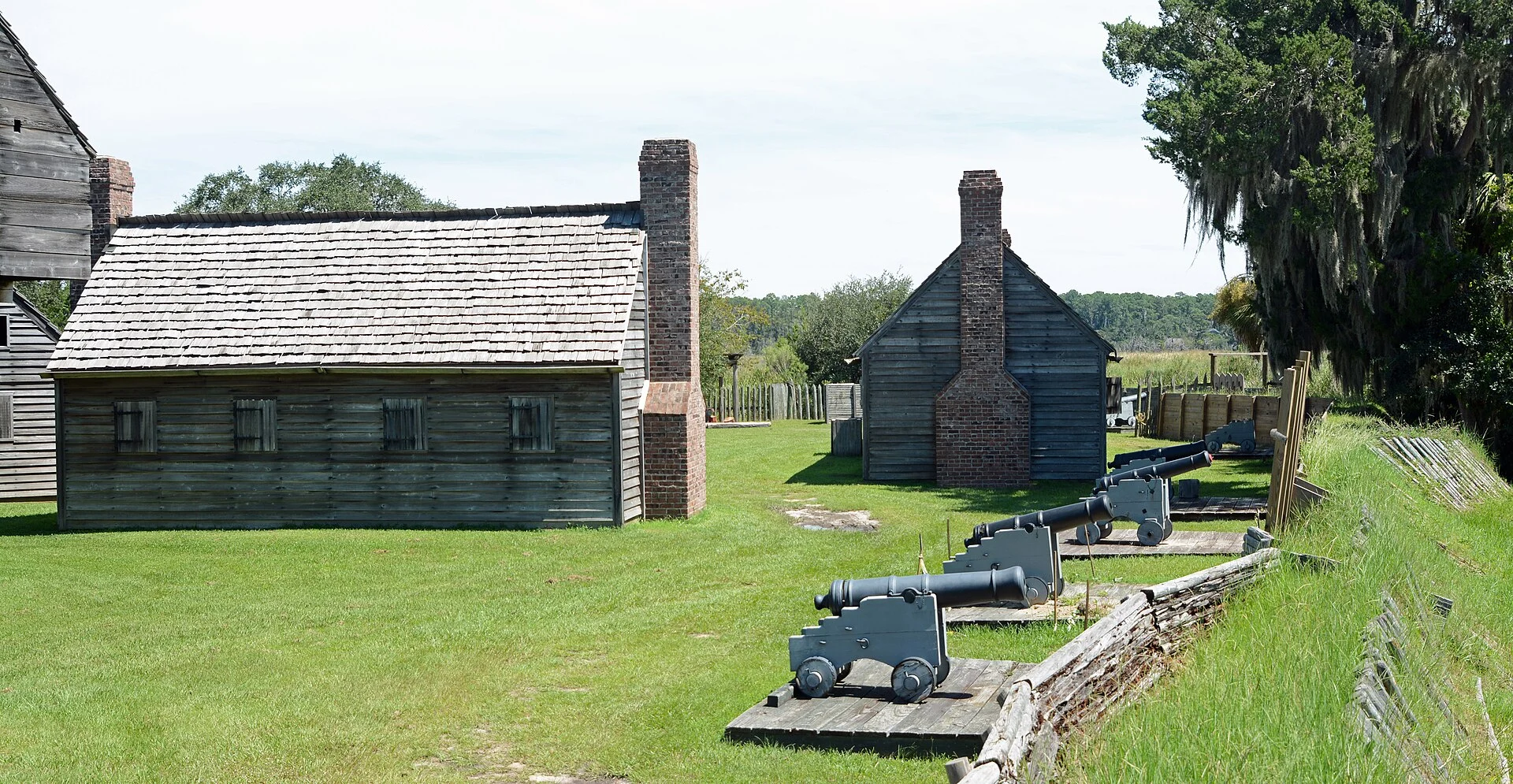
The reconstructed blockhouse, officers’ quarters, barracks, and palisade walls faithfully represent the original 1721 fortification. Interpretive programs include musket and cannon firing demonstrations, colonial cooking presentations, and living history events that immerse visitors in the daily challenges faced by the garrison. The adjacent museum features a timeline exhibit that traces human activity at the site from prehistoric times through the lumber boom era of the 1800s.
Visiting Information
Fort King George State Historic Site is located at 302 McIntosh Road SE in Darien, Georgia. The site is open Thursday through Saturday from 9:00 AM to 5:00 PM. Admission fees apply, and annual Georgia State Parks passes are accepted. The museum and grounds are largely accessible, though some areas of the fort reconstruction involve uneven terrain. Special events throughout the year include the annual Siege of Fort King George reenactment and various living history weekends that bring the colonial period to life with period-accurate demonstrations and encampments.
Frequently Asked Questions
How do I get to Fort King George State Historic Site?
The site is located off US Highway 17 in Darien, Georgia, approximately one hour south of Savannah. From I-95, take Exit 49 and follow the signs to US 17 South. The site entrance is on McIntosh Road SE.
Is there an admission fee?
Yes, standard Georgia State Historic Site admission fees apply. Children under 6 are admitted free. Georgia State Parks annual passes and ParkPass holders receive free admission.
What can I see at Fort King George?
Visitors can explore the reconstructed blockhouse and fort, tour the museum with artifacts from multiple historical periods, walk the nature trails, and enjoy views of the Altamaha River marshlands. Interpretive programs include musket demonstrations and colonial-era cooking.
Wildlife & Nature
Fort King George SHS — preserves the site of the first English settlement on Georgia’s coast (1721) — 12 years before Oglethorpe founded Savannah. The reconstructed blockhouse and barracks overlook the Altamaha River delta. The site’s salt marsh and river support osprey, wood storks, and alligators. Dolphins feed in the river.
Nearby Attractions
Darien — adjacent — one of Georgia’s oldest cities (1736). Sapelo Island — accessible by ferry — has the last Geechee-Gullah community in Georgia. Altamaha River — one of the last free-flowing rivers on the East Coast.
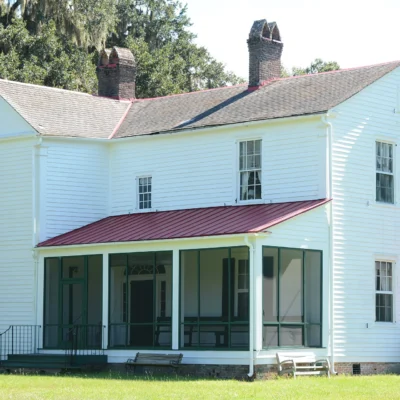
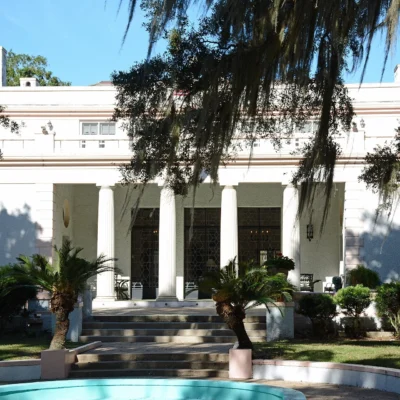
More parks nearby: Hofwyl-Broadfield Plantation State Historic Site is a short drive away, while Reynolds Mansion on Sapelo Island lies a short drive away.

🐾 Dogs & Pets at Fort King George State Historic Site
- Pets allowed? statewide rule
- Leashed dogs are welcome in Georgia State Parks, including campgrounds and most park trails, and must be accompanied by the owner at all times.
- Leash rule statewide rule
- Leash no longer than 6 feet required at all times; dogs may not be tied to trees or fences.
- Beaches & swim areas statewide rule
- Pets are not permitted in swimming areas or on beaches.
- Cabins & lodging statewide rule
- Pets are banned from lodges, yurts and group camps; designated dog-friendly cottages are available for a $50 fee per dog (maximum 2 dogs) covering the entire stay.
- Pet fees statewide rule
- No day-use pet fee; $50 per dog (max 2) per stay in dog-friendly cottages.
- Statewide exceptions statewide rule
- Dogs prohibited on certain trails at Tallulah Gorge and Panola Mountain; fenced dog park at Laura S. Walker State Park; 'Tails on Trails Club' rewards program.
Are dogs allowed at Fort King George State Historic Site?
Leashed dogs are welcome in Georgia State Parks, including campgrounds and most park trails, and must be accompanied by the owner at all times. Individual parks can post stricter rules — check signage on arrival.
Rules verified July 2026 via gastateparks.org. More: Georgia state parks guide · Dog rules in all 50 states compared