🌤 Weather at New Echota State Historic Site by season
| Spring | Summer | Fall | Winter |
|---|---|---|---|
| 40–80 °F | 65–90 °F | 40–84 °F | 31–55 °F |
Each range runs from the coldest monthly average low to the warmest monthly average high in that season (1991-2020 climate normals), measured at Dalton, 16 mi away, elevation 799 ft. Conditions at the park can differ from the station, especially where elevation differs — check a forecast before you go.

Overview
New Echota State Historic Site preserves the location of the last capital of the Cherokee Nation in Georgia, a place of profound historical significance where a sovereign indigenous government thrived before the devastating forced removal known as the Trail of Tears. Established in 1825 near present-day Calhoun, New Echota served as the seat of Cherokee government and witnessed remarkable achievements in self-governance, education, and cultural innovation that challenged the prevailing narrative of the era.
The site commemorates the Cherokee Nation’s extraordinary accomplishments, including the creation of a written constitution modeled on that of the United States, the establishment of a supreme court, and the publication of the Cherokee Phoenix — the first Native American newspaper, printed in both English and the Cherokee syllabary invented by Sequoyah. It was also here, in 1835, that a small unauthorized faction signed the Treaty of New Echota, ceding all Cherokee lands east of the Mississippi River and setting the stage for the forced removal of approximately 16,000 Cherokee people along the Trail of Tears in 1838.
Historical Significance
New Echota represents one of the most significant chapters in Native American history. The Cherokee Nation’s experiment in constitutional self-governance was unprecedented among indigenous peoples in North America. The capital featured a Council House, Court House, and Print Shop where the Cherokee Phoenix was published beginning in 1828 under the editorship of Elias Boudinot. The newspaper served as a powerful voice for Cherokee sovereignty and resistance to removal.
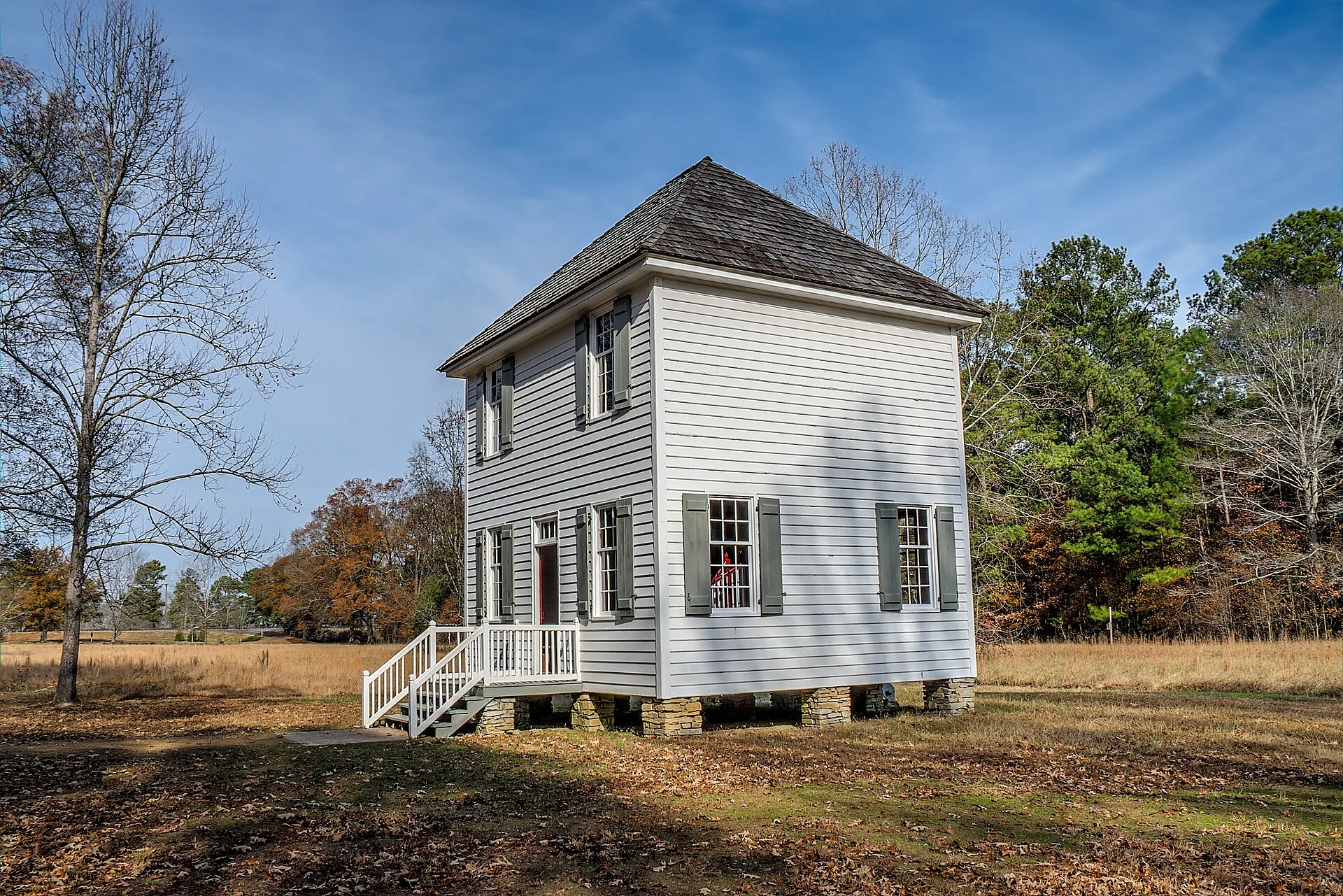
Today, visitors can explore original and reconstructed buildings, including the Worcester House — the home of missionary Samuel Worcester, whose landmark Supreme Court case (Worcester v. Georgia, 1832) affirmed Cherokee sovereignty. Despite the Supreme Court ruling in the Cherokee’s favor, President Andrew Jackson refused to enforce the decision, leading ultimately to the forced removal. The site’s museum houses an extensive collection of artifacts and exhibits that trace Cherokee history from ancient times through removal and beyond.
Visiting Information
New Echota State Historic Site is located at 1211 Chatsworth Highway NE in Calhoun, Georgia. The site features a comprehensive museum, original and reconstructed Cherokee buildings, and interpretive trails. Open Thursday through Saturday from 9:00 AM to 5:00 PM. Self-guided walking tours allow visitors to explore the grounds at their own pace, while the museum provides essential context through artifacts, documents, and multimedia presentations.
Frequently Asked Questions
What buildings can I visit at New Echota?
The site features reconstructed Cherokee Council House and Court House, the Print Shop where the Cherokee Phoenix was printed, the original Worcester House, and a traditional Cherokee farmstead. Each building is furnished with period-appropriate items and interpretive displays.
Is New Echota part of the Trail of Tears National Historic Trail?
Yes, New Echota is a certified site on the Trail of Tears National Historic Trail administered by the National Park Service. It serves as one of the most important starting points for understanding the Cherokee removal story.
Is the site suitable for school groups?
Yes, the site offers educational programs aligned with Georgia’s social studies curriculum. Group tours and special programming can be arranged in advance by contacting the site directly.
Wildlife & Nature
New Echota SHS — the last capital of the Cherokee Nation before the Trail of Tears (1838). Here, Sequoyah’s syllabary was used to print the Cherokee Phoenix — the first Native American newspaper (1828). The reconstructed buildings include the Supreme Court, council house, and print shop. Songbirds and white-tailed deer inhabit the grounds.
Nearby Attractions
Calhoun — adjacent. Chief Vann House SHS — 20 miles north. Etowah Indian Mounds SHS — 20 miles south. Chickamauga Battlefield — 30 miles north.
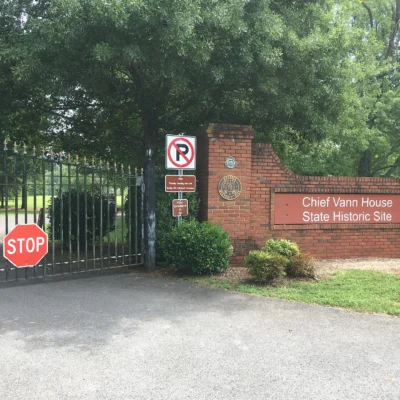
More parks nearby: Chief Vann House State Historic Site is within about an hour’s drive, while Fort Mountain State Park lies within about an hour’s drive.

🐾 Dogs & Pets at New Echota State Historic Site
- Pets allowed? statewide rule
- Leashed dogs are welcome in Georgia State Parks, including campgrounds and most park trails, and must be accompanied by the owner at all times.
- Leash rule statewide rule
- Leash no longer than 6 feet required at all times; dogs may not be tied to trees or fences.
- Beaches & swim areas statewide rule
- Pets are not permitted in swimming areas or on beaches.
- Cabins & lodging statewide rule
- Pets are banned from lodges, yurts and group camps; designated dog-friendly cottages are available for a $50 fee per dog (maximum 2 dogs) covering the entire stay.
- Pet fees statewide rule
- No day-use pet fee; $50 per dog (max 2) per stay in dog-friendly cottages.
- Statewide exceptions statewide rule
- Dogs prohibited on certain trails at Tallulah Gorge and Panola Mountain; fenced dog park at Laura S. Walker State Park; 'Tails on Trails Club' rewards program.
Are dogs allowed at New Echota State Historic Site?
Leashed dogs are welcome in Georgia State Parks, including campgrounds and most park trails, and must be accompanied by the owner at all times. Individual parks can post stricter rules — check signage on arrival.
Rules verified July 2026 via gastateparks.org. More: Georgia state parks guide · Dog rules in all 50 states compared