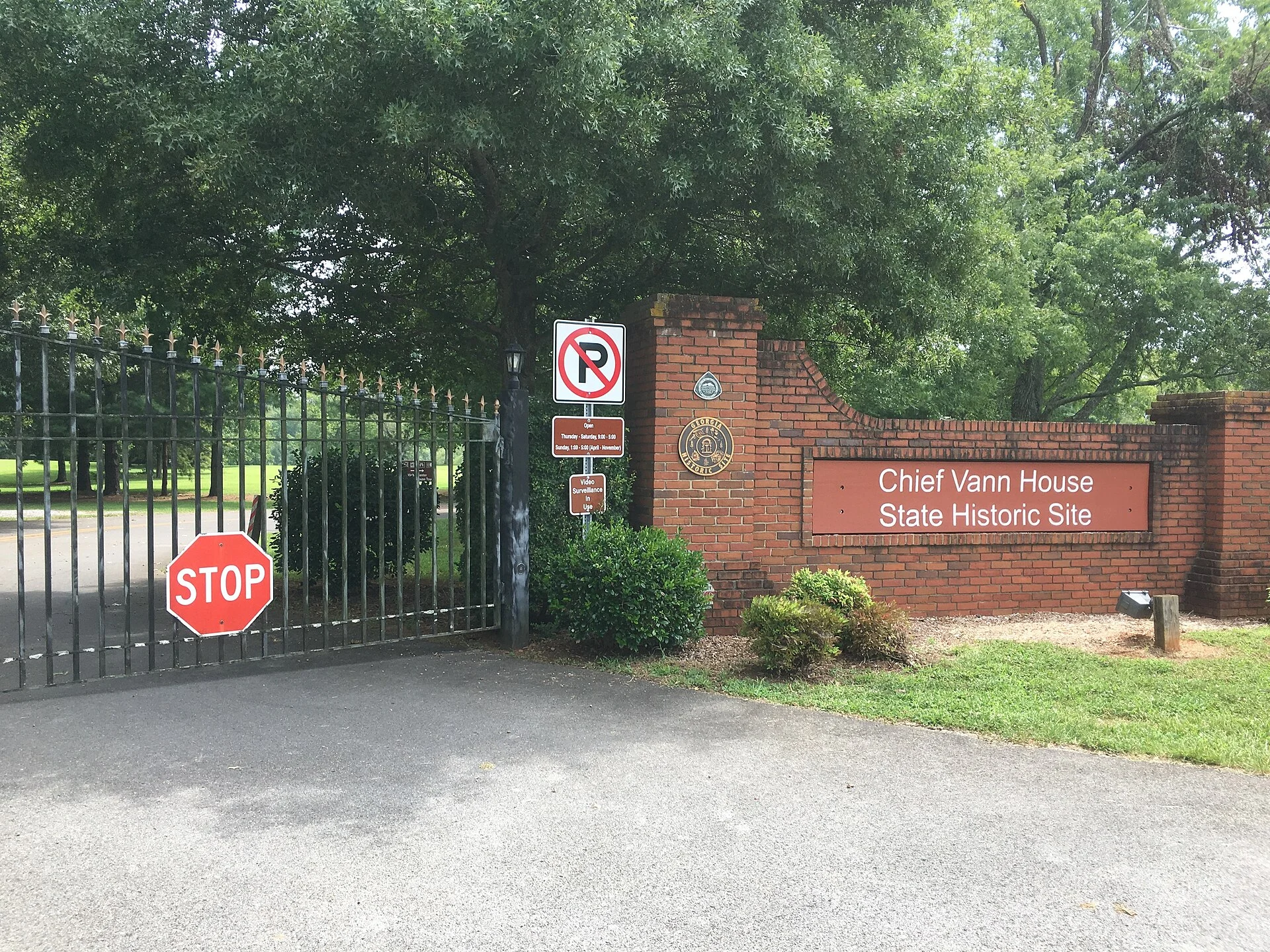
🌤 Weather at Chief Vann House State Historic Site by season
| Spring | Summer | Fall | Winter |
|---|---|---|---|
| 40–79 °F | 64–89 °F | 38–84 °F | 30–55 °F |
Each range runs from the coldest monthly average low to the warmest monthly average high in that season (1991-2020 climate normals), measured at Chatsworth 2, 1 mi away, elevation 710 ft. Conditions at the park can differ from the station, especially where elevation differs — check a forecast before you go.

🏛️ The Showplace of the Cherokee Nation — A Brick Mansion Built by a Cherokee Chief in 1804, Before America Took It All Away — Chief Vann House State Historic Site in Chatsworth, Georgia, 1804 Federal-style brick mansion, James Vann (Cherokee leader, entrepreneur, Moravian mission supporter), cantilever staircase, hand-carved mantels, Cherokee Rose windows, “Showplace of the Cherokee Nation”, Trail of Tears connection, Spring Place Moravian Mission, Cherokee culture museum — Murray County, GA
In 1804 — 34 years before the Trail of Tears — Cherokee Chief James Vann completed a three-story brick mansion in the mountains of northwest Georgia that was the finest home in the region. White settlers, Cherokee leaders, and travelers along the Federal Road all marveled at it. They called it the “Showplace of the Cherokee Nation.”
The house tells a story that most Americans don’t know: before removal, the Cherokee had built a sophisticated civilization — with brick homes, written language, a constitution, a national newspaper, and prosperous plantations. The Vann House is the physical proof that survived.
What to See
| Feature | Details |
|---|---|
| The Mansion | 1804 Federal-style brick house — the oldest surviving brick structure in the Cherokee Nation. Three stories, hand-carved mantels, original Cherokee Rose windows, cantilevered “floating” staircase |
| Cherokee Rose Windows | Transom windows featuring the Cherokee Rose design — a symbol that became Georgia’s state flower. Original to the 1804 construction |
| Cantilever Staircase | Self-supporting staircase with no central support column — a masterpiece of early American craftsmanship. Built by Moravian mission workers and Cherokee artisans |
| Museum | Exhibits on Cherokee history, culture, and the Vann family. Artifacts from the Moravian mission at Spring Place. The story of Cherokee removal |
| Grounds | Gardens and outbuildings on the original plantation site. The Moravian mission cemetery is nearby |
The Timeline
| Year | Event |
|---|---|
| 1790s | James Vann becomes one of the wealthiest men in the Cherokee Nation — trader, tavern keeper, ferry operator, plantation owner |
| 1801 | Vann invites Moravian missionaries to Spring Place to establish a school for Cherokee children |
| 1804 | The brick mansion is completed — the finest home in northwest Georgia, Cherokee or otherwise |
| 1809 | James Vann assassinated (the circumstances remain disputed). His son Joseph (“Rich Joe”) Vann inherits |
| 1821 | Sequoyah introduces the Cherokee syllabary — the Cherokee become one of the most literate peoples in North America |
| 1835 | Treaty of New Echota — signed by a minority faction. The U.S. government uses it to justify removal |
| 1838 | Trail of Tears. The Cherokee are forcibly removed from Georgia. Joseph Vann loses the house and his entire estate |
| 1952 | The house is restored and opened as a State Historic Site |
Best Time to Visit
| Season | Best For |
|---|---|
| Fall (Oct–Nov) | 🍂 Mountain fall color in Murray County. Annual Cherokee history events. Cool weather |
| Spring (Apr–May) | 🌸 Cherokee Rose in bloom. Dogwood and azalea season. Comfortable temperatures |
| Summer (Jun–Aug) | Full hours. Hot but the mountain elevation helps. Good for families |
| Winter (Dec–Feb) | Christmas candlelight tours (special events). Otherwise reduced hours |
Frequently Asked Questions
Was James Vann Cherokee?
Yes — and one of the most powerful men in the Cherokee Nation. His mother was Cherokee; his father was a Scottish trader. Vann was a shrewd businessman who operated taverns, ferries, and a plantation. He was also instrumental in bringing education to the Cherokee through the Moravian mission at Spring Place.
What happened to the house after the Trail of Tears?
The state of Georgia seized it during Cherokee removal in 1838. Joseph Vann and his family were forced to march to Indian Territory (Oklahoma). The house passed through several white owners before being restored in the 1950s.
Is this connected to the Cherokee Rose?
The Cherokee Rose windows in the mansion are among the earliest representations of the symbol. Legend holds that the Cherokee Rose grew along the Trail of Tears wherever a mother’s tears fell. It became Georgia’s state flower in 1916.
Nearby state parks: If you have extra time, Fort Mountain State Park is a short drive away, and New Echota State Historic Site is within about an hour’s drive.
🏛️ The Showplace of the Cherokee Nation
A three-story brick mansion built by a Cherokee chief in 1804 — the finest home in Georgia. Then the Trail of Tears took everything. The house survived. The story endures.
Wildlife & Nature
Chief Vann House SHS — preserves the 1804 mansion of James Vann, a wealthy Cherokee chief. The house was the finest home in the Cherokee Nation — a three-story brick showplace with hand-carved mantels and a cantilevered staircase. The surrounding North Georgia forest supports white-tailed deer, wild turkeys, and songbirds.
Nearby Attractions
Chatsworth — adjacent. Fort Mountain SP — 15 miles east. New Echota SHS — 20 miles south — the last capital of the Cherokee Nation before the Trail of Tears.

🐾 Dogs & Pets at Chief Vann House State Historic Site
- Pets allowed? statewide rule
- Leashed dogs are welcome in Georgia State Parks, including campgrounds and most park trails, and must be accompanied by the owner at all times.
- Leash rule statewide rule
- Leash no longer than 6 feet required at all times; dogs may not be tied to trees or fences.
- Beaches & swim areas statewide rule
- Pets are not permitted in swimming areas or on beaches.
- Cabins & lodging statewide rule
- Pets are banned from lodges, yurts and group camps; designated dog-friendly cottages are available for a $50 fee per dog (maximum 2 dogs) covering the entire stay.
- Pet fees statewide rule
- No day-use pet fee; $50 per dog (max 2) per stay in dog-friendly cottages.
- Statewide exceptions statewide rule
- Dogs prohibited on certain trails at Tallulah Gorge and Panola Mountain; fenced dog park at Laura S. Walker State Park; 'Tails on Trails Club' rewards program.
Are dogs allowed at Chief Vann House State Historic Site?
Leashed dogs are welcome in Georgia State Parks, including campgrounds and most park trails, and must be accompanied by the owner at all times. Individual parks can post stricter rules — check signage on arrival.
Rules verified July 2026 via gastateparks.org. More: Georgia state parks guide · Dog rules in all 50 states compared
Park Location
Plan your gear for Chief Vann House State Historic Site
From our editorial guides, matched to this park’s activities:
Top Tours & Activities Near Blue Ridge
 from $31
 from $20
 from $31