🌤 Weather at Potawatomi State Park by season
| Spring | Summer | Fall | Winter |
|---|---|---|---|
| 21–62 °F | 53–78 °F | 29–69 °F | 10–31 °F |
Each range runs from the coldest monthly average low to the warmest monthly average high in that season (1991-2020 climate normals), measured at Sturgeon Bay Exp Farm, 4 mi away, elevation 699 ft. Conditions at the park can differ from the station, especially where elevation differs — check a forecast before you go.

🏆 Where Wisconsin’s Ice Age Trail Meets the Sea — 1,200 acres of Door County wilderness at the edge of Sturgeon Bay
The wind carries stories here. Standing atop the 75-foot observation tower at Potawatomi State Park, you can feel them in every gust sweeping off Sturgeon Bay—tales of glaciers that carved these limestone bluffs 10,000 years ago, of schooners that met their end in the waters below, of the quarter-million hikers who’ve traced these trails since the park’s founding in 1928.
This is where Wisconsin’s epic 1,200-mile Ice Age Trail draws its final breath (or takes its first, depending on your perspective). After winding through forests and farmland across the entire state, the trail descends through hemlock groves and emerges here, at the edge of a continent, where the waters of Green Bay lap against ancient dolomite shores. For through-hikers who’ve spent weeks on the trail, this moment—standing at the eastern terminus marker with Sturgeon Bay stretching to the horizon—is the payoff. For day visitors, it’s just the beginning.
The Quick Facts (For the Planners)
| Category | Details |
|---|---|
| 📍 Location | 3740 County Highway PD, Sturgeon Bay, WI 54235 |
| ⏰ Hours | 6 AM – 11 PM daily, year-round |
| 💰 Entry | $8/day (WI plates), $11/day (visitors) — Annual pass: $28-38 |
| 🥾 Trails | 20 miles of interconnected loops |
| 🏕️ Camping | 123 sites across 2 loops + 1 accessible cabin |
| 📏 Size | 1,200 acres along Sturgeon Bay’s southern shore |
The Observation Tower: Door County’s Best-Kept Secret View
Forget what you’ve heard about Peninsula State Park’s tower being the best in Door County. Potawatomi’s 75-foot observation tower is less crowded, equally stunning, and comes with a trail experience that earns the view.
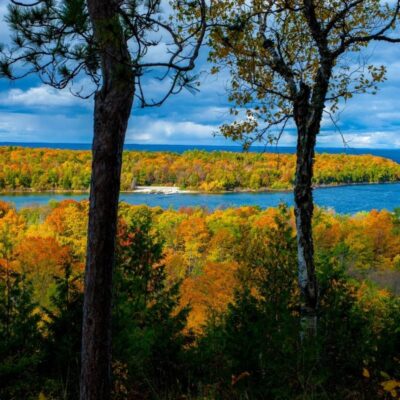
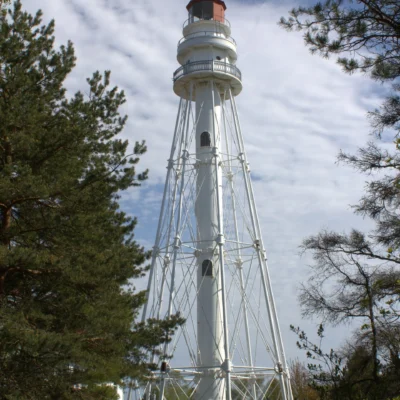
The Tower Trail climbs 1.8 miles through a cathedral of paper birch and hemlock before delivering you to the restored wooden tower that rises above the treeline (closed in 2017, it reopened in spring 2025 after restoration, per the Wisconsin DNR). On clear mornings—and early is key here—you’ll see the Sturgeon Bay Ship Canal Lighthouse blinking its rhythmic greeting, freighters sliding through the channel toward the shipyards, and the full sweep of the bay from Sherwood Point to the Michigan shore beyond.
Insider tip: Sunrise visits are transcendent, but you’ll need a Wisconsin State Park annual pass—the gate doesn’t open until 6 AM, and you want to be at the tower when the light breaks. Arrive 10 minutes before gate opening, and you’ll have the tower to yourself.
Hiking the Trails: 20 Miles of Glacial History
The trails here don’t just pass through pretty scenery—they trace the footsteps of the last ice age. Ridges and kettles left by retreating glaciers shape every loop, and the exposed limestone cliffs along the shore are the remains of an ancient tropical sea. Every hike is a geology lesson you never knew you wanted.
| Trail | Distance | The Experience |
|---|---|---|
| Tower Trail | 1.8 mi | The signature hike. Moderate climb through birch forest to the observation tower. Pack snacks for the view. |
| Ice Age Trail | 3.1 mi | Eastern terminus of Wisconsin’s 1,200-mile thru-hike. Rolling terrain, interpretive markers, profound sense of arrival (or departure). |
| Red Loop | 5.5 mi | The full park experience. Remote sections through hemlock groves where you won’t see another soul on weekdays. |
| Black Loop | 4.2 mi | Interior forest loop. Best for wildlife—deer browse along the edges at dawn, and pileated woodpeckers drum in the dead snags. |
| Green Loop | 1.5 mi | Family-friendly loop near the campground. Flat, well-maintained, perfect for little legs. |
| Nature Trail | 0.5 mi | Interpretive signs explain the ecology. Best starting point for kids and first-time visitors. |
The Ice Age Trail: A Pilgrimage’s End
If you’ve ever dreamed of thru-hiking, the Ice Age Trail’s eastern terminus offers a taste of that world. The 3.1-mile segment within Potawatomi is among the most scenic stretches of the entire 1,200-mile route—rolling through maple-beech forest, crossing glacial moraines, and finally emerging at a simple wooden marker overlooking Sturgeon Bay.
For day hikers, the significance might not hit immediately. But stand there long enough, and you’ll notice through-hikers arriving—weathered backpacks, thousand-yard stares, quiet tears. Some have been walking for two months. This unremarkable wooden post is their Katahdin, their completion. The least you can do is buy them a beer in Sturgeon Bay after.
Camping: 123 Sites, But Choose Wisely
Not all campsites are created equal. Daisy Field Campground spreads across two loops, and the difference between a mediocre trip and a memorable one often comes down to site selection.
| Site Type | Count | Price Range | The Verdict |
|---|---|---|---|
| Electric (Loop B) | 40 | $30-35/night | More open, RV-friendly, closer to showers. Good for families with gear. |
| Non-Electric (Loop A) | 83 | $23-28/night | More trees, more privacy, more tent-camping character. Sites 1-15 are the most secluded. |
| Accessible Cabin | 1 | $60-70/night | Heated, ADA-compliant, sleeps 4. Open year-round—book early for fall weekends. |
The Sites the Locals Know
- Sites 12-18 (Loop A): Tucked against the forest edge. You’ll hear owls at night.
- Sites 45-52 (Loop B): Best for RVs wanting shade without sacrificing hookups.
- Avoid sites near the entrance on summer weekends—traffic noise from late arrivals.
Campground Amenities
Modern flush toilets, hot showers (coin-operated), dump station, and a camp store selling firewood, propane, and the essentials you forgot. Ranger programs at the amphitheater on summer evenings are worth attending—the Door County night sky talks are particularly good.
🚧 January–June 2026 Campground Closure: All campsites, cabin, south shore shelter, and amphitheater are closed for road construction and water line replacement. Hiking trails remain open. Check wisconsin.gov for reopening updates.
Reservations
Book at wisconsin.goingtocamp.com. Door County summer weekends book 6-9 months ahead—set a calendar reminder for 11 months before your target date and book the moment the window opens.
Fishing Sturgeon Bay: Where the Big Ones Hide
Sturgeon Bay isn’t just the largest natural harbor on Lake Michigan—it’s one of Wisconsin’s most underrated fisheries. The park’s accessible pier puts you over productive water without needing a boat, and the variety of species makes it interesting year-round.
| Species | When | Where & How |
|---|---|---|
| Smallmouth Bass | May – Sept | Rocky drop-offs near the pier. Tube jigs and drop-shot rigs. Early morning before boat traffic. |
| Walleye | Spring & Fall | Deeper channel waters. Trolling or jigging. Best at dawn/dusk. |
| Northern Pike | Year-round | Weed edges in Sawyer Harbor. Spinnerbaits and live bait. |
| Rainbow Trout | Spring runs | Tributary mouths after ice-out. Spawn-colored flies or small spoons. |
Pro tip: The park office loans fishing gear for free—rods, reels, tackle. Perfect if you’re traveling light or introducing kids to the sport. A fish cleaning station at the boat launch means you can process your catch before heading home.
On the Water: Kayaking Beneath the Bluffs
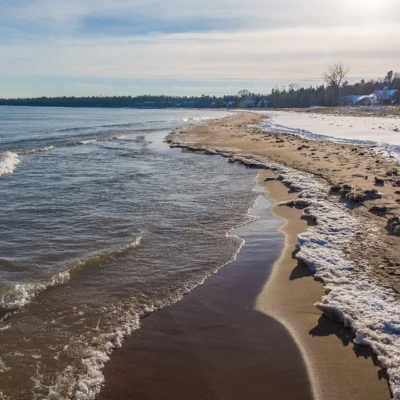
Paddling the shoreline at Potawatomi reveals a perspective you can’t get from the trails. Limestone cliffs rise 50 feet above the water, layered like ancient pages of a book. Bald eagles patrol from dead snags. And on calm mornings, the water is so still you’ll see bluegills suspended in the gin-clear shallows.
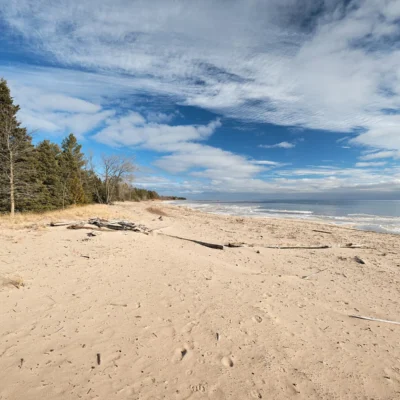
Launch from the park beach and paddle south toward Sherwood Point for the most dramatic scenery. The 2-mile paddle to the point is suitable for intermediate kayakers; beginners should stay within the protected bay. Rent from Peninsula Kayak Company in Fish Creek or Door County Adventure Center in Sturgeon Bay if you don’t have your own boat.
For Divers: Shipwrecks Await
Sturgeon Bay’s maritime history lies preserved in cold, clear water. Several schooners and steamships rest on the bottom—casualties of 19th-century storms that made this strait notorious. Local dive shops offer guided excursions; visibility can exceed 30 feet on good days.
Winter: The Secret Season
Most visitors never see Potawatomi in winter, and that’s their loss. When snow blankets the trails and ice seals the bay, the park transforms into something quieter, cleaner, almost spiritual. The crowds vanish. The only sounds are your skis slicing through fresh powder and chickadees calling from the hemlocks.
| Activity | Details |
|---|---|
| Cross-Country Skiing | 10+ miles groomed for classic and skate. The Tower Trail under snow is magical. |
| Snowshoeing | All trails open. The Red Loop’s remote sections are utterly peaceful. |
| Ice Fishing | When Sturgeon Bay freezes (typically January), the pike and panfish bite. |
| Winter Cabin | The accessible cabin is heated and open year-round. Book it as your base camp. |
When to Go: A Seasonal Guide
| Season | Weather | Crowds | The Experience |
|---|---|---|---|
| Fall (Sep-Oct) | 50-65°F | Moderate | Peak foliage. The maples along Tower Trail turn incendiary. Fewer crowds than summer, warm enough for camping. |
| Summer (Jun-Aug) | 70-82°F | High | Full Door County experience—pair with wineries, fish boils, and cherry picking. Book camping early. |
| Spring (Apr-May) | 45-65°F | Light | Wildflower bloom. Trilliums carpet the forest floor. Fishing opener brings the bass crowd. |
| Winter (Dec-Mar) | 15-35°F | Minimal | Solitude seekers’ paradise. XC skiing, ice fishing, and the heated cabin make it worthwhile. |
Beyond the Park: Door County Awaits
Potawatomi sits at Door County’s southern gateway, and the peninsula’s famous attractions stretch north for 70 miles. While you’re here:
- Peninsula State Park (25 min north) — Larger, with a golf course, lighthouse, and the famous Eagle Bluff views
- Sturgeon Bay — Historic downtown, Door County Maritime Museum, excellent bakeries, and breweries
- Cherry picking (July) and apple orchards (September) dot the peninsula
- Traditional fish boils — A Door County rite of passage. The theatrical boilover is half the experience.
Frequently Asked Questions
Is Potawatomi worth visiting compared to Peninsula State Park?
Absolutely. Peninsula gets the fame, but Potawatomi offers more solitude, better fishing access, the Ice Age Trail terminus, and an observation tower with views that rival anything on the peninsula. Visit both if you can—they’re 25 minutes apart.
Can I hike the entire Ice Age Trail from here?
You can start (or finish) here! The 1,200-mile Ice Age National Scenic Trail runs across Wisconsin, and Potawatomi is the official eastern terminus. Most thru-hikers take 8-12 weeks to complete it.
Are camping reservations really necessary?
For July-August weekends, absolutely. Sites book 6-9 months ahead. Midweek visits and shoulder seasons (May, September) offer more flexibility, but reservations are still recommended.
What fish can I catch from the pier?
Smallmouth bass are the main attraction, with northern pike and panfish also common. Walleye require deeper water, usually accessed by boat. The park loans fishing gear for free at the office.
Is the observation tower wheelchair accessible?
The tower itself has stairs. However, the accessible cabin and fishing pier are fully ADA-compliant, and several trail sections are packed gravel suitable for wheelchairs.
Can I bring my dog?
Yes, dogs are welcome on all trails and in campgrounds on a 6-foot leash. Keep them off the beach areas and out of buildings.
When does the campground open for the season?
Typically early May through late October. The accessible cabin remains open year-round. Check for 2026 construction closures before planning.
🏕️ Ready to Discover Door County’s Quieter Side?
Potawatomi offers everything Peninsula does—without the crowds. The Ice Age Trail ends here. Your adventure begins.
Explore More Wisconsin State Parks
Potawatomi State Park is one of many outstanding state parks in Wisconsin. Discover more parks in our Best State Parks in Wisconsin guide, or use our Park Finder to search by activity, location, or features.

🐾 Dogs & Pets at Potawatomi State Park
- Pets allowed? statewide rule
- Pets are welcome in most Wisconsin state park campgrounds, trails, roads and outlying areas, but must be leashed and under control at all times.
- Leash rule statewide rule
- 8 ft maximum physical leash required at all times (except in designated pet swim areas while the pet is in the water)
- Beaches & swim areas statewide rule
- Pets are not allowed on public beaches, but over 30 properties (e.g. Devil's Lake, Governor Dodge, Point Beach) have designated pet swim areas
- Cabins & lodging statewide rule
- Pets are not allowed in buildings, picnic shelters or other structures unless specifically signed as open to pets
- Statewide exceptions statewide rule
- Pets prohibited entirely at Copper Culture, Heritage Hill and Hoffman Hills State Recreation Areas; designated pet picnic areas exist at many properties
Are dogs allowed at Potawatomi State Park?
Pets are welcome in most Wisconsin state park campgrounds, trails, roads and outlying areas, but must be leashed and under control at all times. Individual parks can post stricter rules — check signage on arrival.
Rules verified July 2026 via dnr.wisconsin.gov. More: Wisconsin state parks guide · Dog rules in all 50 states compared
Park Location
Plan your gear for Potawatomi State Park
From our editorial guides, matched to this park’s activities: