🌤 Weather at Providence Canyon State Park by season
| Spring | Summer | Fall | Winter |
|---|---|---|---|
| 41–86 °F | 64–92 °F | 39–88 °F | 34–65 °F |
Each range runs from the coldest monthly average low to the warmest monthly average high in that season (1991-2020 climate normals), measured at Lumpkin 2 SE, 9 mi away, elevation 485 ft. Conditions at the park can differ from the station, especially where elevation differs — check a forecast before you go.

🏜️ Georgia’s Little Grand Canyon — 150-foot-deep canyons in 43 shades of color, man-made geological wonder, canyon floor hiking, rare wildflowers, and backcountry camping
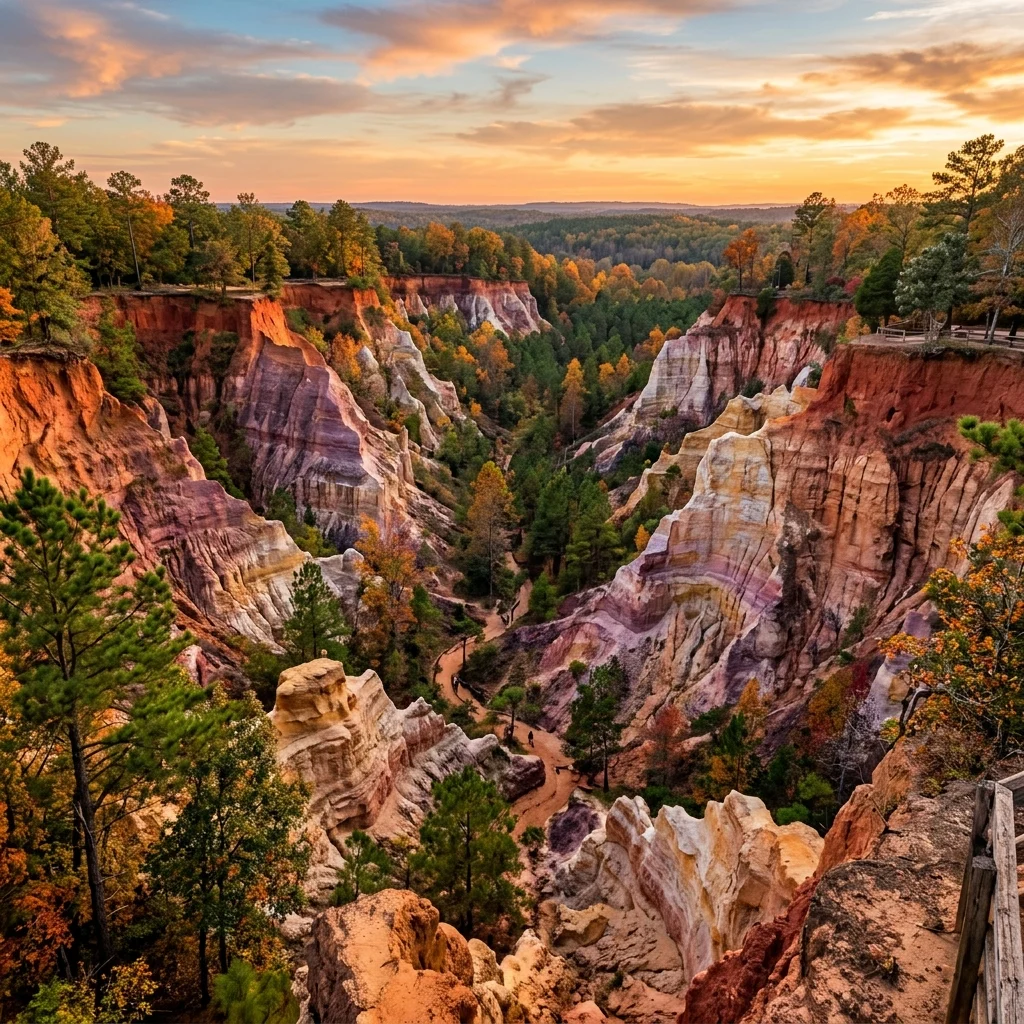
In rural southwest Georgia — far from Atlanta, far from the mountains, deep in the Coastal Plain — the earth opens into a maze of colorful canyons up to 150 feet deep. Providence Canyon is called “Georgia’s Little Grand Canyon,” but unlike its Arizona counterpart, these canyons weren’t carved over millions of years by a river. They were created in less than 200 years by poor farming practices in the 1800s — when settlers cleared the native longleaf pine forest, exposing soft, colorful sediment to rain erosion that accelerated at a stunning rate. What was flat farmland in the early 1800s is now a landscape of nine major canyons with walls displaying up to 43 different colors — reds, oranges, purples, pinks, whites, and grays from iron, manganese, and kaolin deposits in the ancient sediment.
Providence Canyon is one of the most unusual geological sites in the eastern United States — a place where human impact accidentally created something beautiful, and where nature has continued to sculpt the soft earth with every rainstorm. The park protects 1,109 acres of this improbable landscape, with trails that descend to the canyon floor, wind between towering walls of multicolored clay, and loop through the surrounding longleaf pine forest where the rare plumleaf azalea blooms in late summer.
What to Do at Providence Canyon
1. Hike the Canyon Loop Trail
The Canyon Loop Trail (White Blaze, ~2.5 miles) is the primary hiking experience. From the visitor center, the trail descends to the canyon floor where you can explore nine major canyons. The route splits at creek beds:
- Left at first creek bed: Access to Canyons 1–5
- Via second creek bed: Access to Canyons 6–9
Walking between the canyon walls is extraordinary — towering faces of multicolored clay rising 150 feet on both sides, with new colors and patterns around every bend. The trail also includes rim segments with overlooks for aerial views. Allow 2–3 hours for a thorough exploration.
2. Study the Colors
The canyon walls display up to 43 distinct shades created by mineral deposits in the ancient sediment:
| Color | Mineral Cause |
|---|---|
| Reds, Oranges, Yellows | Iron ore and limonite |
| Purples and Pinks | Manganese |
| Whites | Kaolin (high-quality clay) |
| Dark Gray | Ripley Formation (ancient sea floor) |
The colors are most vivid when the clay is wet — after rain, the walls glow with saturated color. Overcast or post-rain days are best for photography.
3. Hike the Backcountry Trail
The Backcountry Trail (Red Blaze, 7-mile loop) branches from the Canyon Loop into the surrounding forest. This is a rugged, challenging trail through longleaf pine flatwoods — a different landscape than the canyons. Six primitive backcountry campsites are available along the trail. Day hikers must begin by 2:00 PM; overnight hikers by 4:00 PM.
4. See the Plumleaf Azalea
Providence Canyon is one of the few places in the world where the plumleaf azalea (Rhododendron prunifolium) grows wild. This rare native shrub blooms in July and August — unusually late for an azalea — with orange to red flowers along the canyon rim. It’s a botanical treasure found only in a small region of Georgia and Alabama.
Visitor Information
| Detail | Info |
|---|---|
| Hours | 7 AM – 6 PM (Sep–Apr) / 7 AM – 9 PM (Apr–Sep) |
| Visitor Center | Daily, 8 AM – 5 PM |
| Entry Fee | $10/vehicle ParkPass |
| Camping | Backcountry (primitive) + Pioneer group sites |
| Location | Stewart County, GA (45 mi SW of Columbus) |
| Phone | 1-800-864-7275 (reservations) |
Best Time to Visit
| Season | Weather | Best For |
|---|---|---|
| Spring (Mar–May) | 60–85°F | Wildflowers, vivid wet colors, comfortable hiking |
| Summer (Jun–Aug) | 85–95°F | Plumleaf azalea bloom (Jul–Aug), long hours |
| Fall (Oct–Nov) | 55–75°F | Cool hiking, golden light, reduced crowds |
| Winter (Dec–Feb) | 40–60°F | Quiet, leaf-free canyon views, short hours |
💰 Trip Cost Estimator
| Expense | Cost | Notes |
|---|---|---|
| Park Entry | $10 | ParkPass per vehicle |
| Backcountry Camping | $10–15 | Primitive sites, by reservation |
| Food | $10–20 | Pack food — no services in park |
| Day Trip | $15–25 | Entry + packed lunch |
Nearby Attractions
Florence Marina State Park (15 min) on Lake Walter F. George offers full-service camping with RV hookups, a marina, and swimming — the developed camping alternative that Providence Canyon lacks. Westville Living History Village (20 min) recreates an 1850s Georgia town. Columbus, GA (45 min NE) offers the National Infantry Museum, whitewater rafting on the Chattahoochee, and urban amenities.
Frequently Asked Questions
Are these natural canyons?
Partially — the canyons were triggered by poor farming practices in the 1800s that exposed soft sediment to erosion. Once started, natural rainwater erosion rapidly carved the canyons to their current 150-foot depth. They are man-accelerated but nature-sculpted.
Can I walk on the canyon floor?
Yes — the Canyon Loop Trail descends to the canyon floor. Expect mud and wet clay, especially after rain. Wear waterproof hiking shoes or boots you don’t mind getting dirty.
Is it comparable to the real Grand Canyon?
Not in scale — Providence Canyon is 150 feet deep vs. the Grand Canyon’s 6,000+ feet. But the multicolored walls, the walking-through-canyons experience, and the unusual geology make it genuinely impressive on its own terms. It’s a different experience, not a lesser one.
When do the rare azaleas bloom?
The plumleaf azalea blooms July through August — one of the latest-blooming native azaleas in North America. Visit the canyon rim trails for the best viewing.
More parks nearby: Florence Marina State Park is a short drive away, while Kolomoki Mounds State Park lies elsewhere in the state.
🏜️ Ready for Georgia’s Little Grand Canyon?
150-foot-deep canyons. 43 shades of color. A geological wonder created in just 200 years. Providence Canyon proves that sometimes the most beautiful places are the most unexpected.
The Man-Made Grand Canyon
Unlike most canyons formed over millions of geological years, Providence Canyon is a remarkably recent creation — the result of catastrophic soil erosion caused by poor farming practices in the early 1800s. When European settlers cleared the Coastal Plain forest for cotton agriculture, they removed the root systems that had stabilized the sandy soil for millennia. Without this natural anchoring, heavy Georgia rains began cutting small gullies into the exposed earth. Within decades, these gullies had grown into massive canyons reaching depths of 150 feet, exposing vividly colored layers of pink, orange, red, white, and purple sediment deposited during the Cretaceous Period, roughly 75 million years ago. Today, the 1,109-acre park preserves nine major canyons and numerous smaller gullies, creating a landscape that has been called the most striking geological oddity east of the Mississippi River. The erosion continues today — the canyons grow by an estimated 3 to 6 feet per year, and visitors who return after several years often notice visible changes in the formations.
Wildflowers and the Plumleaf Azalea
Providence Canyon is one of only a handful of locations in the world where the rare Plumleaf Azalea (Rhododendron prunifolium) grows naturally. This endangered native species blooms in striking red-orange flowers during July and August — a time when most azalea species have long finished flowering. The unusual late-summer bloom makes Providence Canyon a destination for botanical enthusiasts during what would otherwise be the hottest and quietest period for most southeastern parks. Beyond the azalea, the park supports a diverse Coastal Plain flora including longleaf pine, turkey oak, wiregrass, and over 100 species of wildflowers that bloom from early spring through fall. The canyon microclimates — with their cool, sheltered interiors — support ferns, mosses, and shade-loving species that would not survive on the exposed ridge above.
Hiking the Canyons
The Canyon Loop Trail (2.5 miles, white blaze) is the primary route for exploring Providence Canyon’s geological wonders. The trail descends from the rim into the canyon floor, where visitors can walk among towering walls of multicolored sediment that shift in hue throughout the day as the angle of sunlight changes. The trail connects Canyons 1 through 9, each with its own distinctive color palette and formation patterns. Hikers who reach the furthest canyons (4 and 5) earn membership in the park’s “Canyon Climbers Club” — a fun motivator that encourages full exploration of the system. The canyon floors are often wet and muddy, so waterproof hiking boots are essential. For a more challenging experience, the 7-mile Backcountry Trail (red blaze) loops through the surrounding pine forest and connects to 6 primitive campsites available by reservation.
Planning Your Visit
Providence Canyon is located in rural southwest Georgia, approximately 150 miles south of Atlanta via I-85 and US-27. The nearest town, Lumpkin (population ~1,200), offers limited services. The park charges a $10 daily parking fee and is open year-round with seasonal hour variations. Spring (March through May) offers the most comfortable temperatures and peak wildflower displays, while the Plumleaf Azalea bloom in July-August draws botanical visitors despite the heat. Fall provides stunning color contrasts between the canyon walls and the surrounding hardwood canopy. Winter offers the clearest conditions for photography and the smallest crowds. Allow at least 3 hours for the Canyon Loop Trail, including time for photography at each major canyon.
Explore More Georgia State Parks
Providence Canyon State Park is one of many outstanding state parks in Georgia. Discover more parks in our Best State Parks in Georgia guide, or use our Park Finder to search by activity, location, or features.
Wildlife & Nature
Providence Canyon SP — the “Little Grand Canyon” of Georgia — features 150-foot-deep canyons carved into multicolored soils (reds, oranges, purples, pinks, and whites). Remarkably, the canyons are only about 150 years old — created by erosion from poor farming practices in the 1800s. The plumleaf azalea — found nowhere else on earth — blooms here in August. Red-tailed hawks soar above the canyon rim.

🐾 Dogs & Pets at Providence Canyon State Park
- Pets allowed? statewide rule
- Leashed dogs are welcome in Georgia State Parks, including campgrounds and most park trails, and must be accompanied by the owner at all times.
- Leash rule statewide rule
- Leash no longer than 6 feet required at all times; dogs may not be tied to trees or fences.
- Beaches & swim areas statewide rule
- Pets are not permitted in swimming areas or on beaches.
- Cabins & lodging statewide rule
- Pets are banned from lodges, yurts and group camps; designated dog-friendly cottages are available for a $50 fee per dog (maximum 2 dogs) covering the entire stay.
- Pet fees statewide rule
- No day-use pet fee; $50 per dog (max 2) per stay in dog-friendly cottages.
- Statewide exceptions statewide rule
- Dogs prohibited on certain trails at Tallulah Gorge and Panola Mountain; fenced dog park at Laura S. Walker State Park; 'Tails on Trails Club' rewards program.
Are dogs allowed at Providence Canyon State Park?
Leashed dogs are welcome in Georgia State Parks, including campgrounds and most park trails, and must be accompanied by the owner at all times. Individual parks can post stricter rules — check signage on arrival.
Rules verified July 2026 via gastateparks.org. More: Georgia state parks guide · Dog rules in all 50 states compared
Park Location
Plan your gear for Providence Canyon State Park
From our editorial guides, matched to this park’s activities: