🌤 Weather at Sielbeck Forest State Natural Area by season
| Spring | Summer | Fall | Winter |
|---|---|---|---|
| 36–77 °F | 64–89 °F | 36–82 °F | 25–48 °F |
Each range runs from the coldest monthly average low to the warmest monthly average high in that season (1991-2020 climate normals), measured at Brookport Dam 52, 9 mi away, elevation 330 ft. Conditions at the park can differ from the station, especially where elevation differs — check a forecast before you go.

Overview and Ecological Significance
Sielbeck Forest State Natural Area stands as a majestic and deeply secluded ecological sanctuary tucked away in extreme southern Illinois. Located in Massac County near the small community of Belknap, this 385-acre protected tract is managed by the Illinois Department of Natural Resources (IDNR) as a remote satellite site of the larger and more developed Mermet Lake State Fish and Wildlife Area. Unlike traditional state parks that draw crowds with paved hiking paths, sprawling campgrounds, and bustling visitor centers, Sielbeck Forest is an intentionally undeveloped and wildly natural landscape. It offers an irreplaceable and pristine glimpse into the ancient, untamed environment that dominated the region long before modern agricultural development.
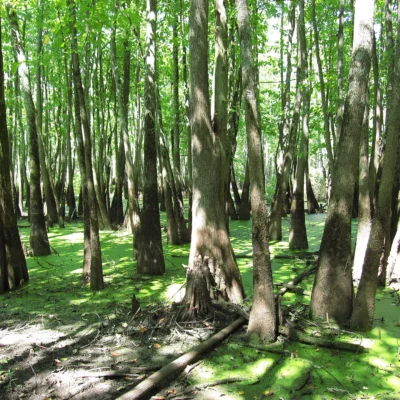
The defining characteristic of Sielbeck Forest is its towering, old-growth bottomland hardwood forest and its deep, shadowy swamplands. It is recognized by botanists and ecologists worldwide as one of the last remaining high-quality fragments of the historical Big Black Slough—a massive, interconnected wetland system that once stretched across thousands of acres in southern Illinois. Here, visitors are granted the rare privilege of standing beneath spectacular bald cypress and water tupelo trees that have stood resolute for more than two centuries. Sielbeck Forest provides a vital, undisturbed refuge for rare flora and fauna, making it an essential destination for dedicated ecological researchers, specialized wildlife photographers, and rugged outdoorsmen seeking genuine wilderness.
The History of Sielbeck Forest and Conservation Efforts
The survival of Sielbeck Forest State Natural Area through the rapid expansion of modern agriculture and the widespread logging of the 19th and 20th centuries is nothing short of miraculous. Its preservation is a powerful testament to the impact of dedicated private land stewardship and the eventual transition into public conservation. For generations, the land surrounding and including the deep swamp was owned, managed, and fiercely protected by the prominent Sielbeck family.
Led by the visionary Louie Sielbeck, the family intimately understood the rare ecological value of the old-growth bottomland forest. During eras when wetland drainage and massive timber harvests were highly incentivized and overwhelmingly common across the Midwest, the Sielbecks intentionally resisted the urge to log the massive, ancient trees or convert the watery, nutrient-rich swamps into profitable agricultural fields. Because of this family’s unwavering dedication to land preservation, the core of the Sielbeck forest remained virtually untouched by industrial hands.
Following the passing of Louie Sielbeck, the future of this ancient, silent forest was briefly cast into uncertainty. Recognizing the critical, time-sensitive need to permanently preserve this unique habitat before it could be sold to agricultural or timber developers, The Nature Conservancy (TNC)—one of the world’s leading environmental organizations—stepped in. TNC purchased the 385-acre property in 1997, a decisive and historic action that immediately halted any potential commercial development or impending timber harvesting.
A year later, in 1998, The Nature Conservancy successfully negotiated the transfer of the property to the Illinois Department of Natural Resources (IDNR), ensuring public ownership. Today, Sielbeck Forest is permanently enrolled in the prestigious Illinois Register of Land and Water Reserves. This strict legal designation ensures that the land will be protected, monitored, and managed in perpetuity not merely as public recreational land, but specifically as a highly sensitive natural area where ecological preservation strictly takes precedence over human recreational development. Furthermore, the IDNR is continually engaging in extensive land management practices, working diligently to expand the protective buffer zones around the old-growth core by actively reforesting adjacent tracts of land that were previously cleared for farming.
Detailed Ecology of the Big Black Slough
To fully appreciate the immense ecological significance of Sielbeck Forest State Natural Area, one must first understand the vast and complex history of the Big Black Slough. Historically, the Big Black Slough was a massive, naturally interconnected wetland and floodplain forest system that covered thousands upon thousands of acres across Massac, Pope, and Johnson counties. It was a dynamic, ever-changing region defined by profound seasonal flooding driven by the nearby Ohio and Cache river systems, slow-moving backwaters, and an incredible, almost tropical density of biodiversity.
Today, as a result of extensive twentieth-century land reclamation projects, levee construction, and agricultural expansion, almost all of the historic Big Black Slough has been systematically drained and permanently converted for human use. Sielbeck Forest stands today as one of the very last undisturbed, pristine remnants of this magnificent wetland ecosystem. Within its 385-acre boundary, the site is officially recognized by the Illinois Natural Areas Inventory for containing highly coveted Grade A swamp forest and Grade B and C wet-mesic floodplain forest—classifications reserved only for the highest quality, most undisturbed natural communities in the state.
Botany and Flora of the Grade A Swamp Forest
The dominant upper canopy of the Sielbeck Forest swamp is visibly breathtaking and ecologically vital. It is heavily populated by giant, ancient bald cypress (Taxodium distichum) and towering water tupelo (Nyssa aquatica). These specialized aquatic trees are ecologically adapted to sit in standing water for large portions of the year, their intricately flared bases (buttresses) providing stability in the soft mud. Some of the spectacular old-growth bald cypress specimens in Sielbeck reach nearly four feet in diameter and are securely estimated by dendrologists to be well over 200 years old, having sprouted long before Illinois even achieved statehood.
Beneath the soaring immediate canopy, the damp understory is exceptionally rich with unique, water-loving botanical specimens. Careful botanical observers navigating the muddy floor may find the rare, state-threatened American snowbell (Styrax americanus), a delicate shrub that produces beautiful, drooping white flowers in the spring. Furthermore, the understory features thick, impenetrable stands of the rare giant sedge (Carex gigantea), which thrives in the perpetually damp, deeply shaded environment of the ancient slough.
Fauna: A Refuge for Rare and Endangered Species
This deep, undisturbed swamp environment provides a critical sanctuary for a multitude of wildlife species that strictly rely on large, continuous tracts of flooded forest for their survival. Most notably, Sielbeck Forest is renowned for providing essential habitat for the swamp rabbit (Sylvilagus aquaticus). The swamp rabbit is the largest of the cottontail species and is highly dependent on the dense, brushy bottomland habitats that are becoming increasingly fragmented and rare across the American Midwest. Unlike standard cottontails, swamp rabbits are excellent swimmers and often dive into the slough waters to evade predators.
Beyond the swamp rabbit, the flooded forest supports an incredibly rich diversity of amphibians and reptiles. During the wet spring months, chorus frogs, spring peepers, and leopard frogs create a deafening symphony across the vernal pools. Several species of water snakes, turtles, and salamanders thrive in the permanent sloughs. Additionally, countless species of insects, particularly aquatic invertebrates and mosquitoes, form the robust, energetic base of a complex food web that supports the entire ecosystem, attracting fish, amphibians, and a vast array of migratory birdlife.
Navigating the Wilderness: Recreation and Accessibility
Visitors planning an expedition to Sielbeck Forest State Natural Area must drastically adjust their expectations: this is absolutely not a traditional, heavily manicured state park. Sielbeck offers no paved trails, no gravel walking paths, no visitor centers, no picnic shelters, and no modern restroom facilities. The area is intentionally left completely undeveloped to actively minimize human impact on the highly fragile, ancient ecosystem.
Route Finding and Physical Preparation
Accessing and exploring the interior of the forest requires navigating rugged, unmarked, and often treacherous terrain. Visitors must be comfortable with advanced off-trail hiking, compass or GPS route-finding, and physically dealing with challenging natural conditions. These conditions frequently include deep, suctioning mud, expanses of standing water, hidden sub-surface roots, and dense, thorny underbrush. Wearing knee-high waterproof boots or, ideally, chest waders is highly recommended, especially during the wet spring months and for several days following heavy regional rains when the slough naturally expands its watery footprint deep into the surrounding timber.
Because of the sheer density of the woods and the visually disorienting nature of a flat, flooded forest, getting momentarily turned around is common. A reliable, dedicated GPS device (not just a cellular phone, as signal can be spotty) and a traditional magnetic compass are essential tools for anyone venturing deep into the timber.
The Ethos of Leave No Trace
Because of its vital designation as a high-priority State Natural Area, visitors are expected and required to adhere strictly to the highest standards of “Leave No Trace” principles. Visitors must not disturb the native flora or fauna—this includes refraining from collecting plants, disturbing deadfall which provides crucial habitat, or leaving any form of waste behind. Every piece of trash must be packed out. The goal of every visit to Sielbeck Forest should be to leave the ancient slough exactly as pristine and undisturbed as it was upon arrival.
Hunting and Fishing at Sielbeck Forest
Despite its stringent conservation status and its sensitivity as a natural area, Sielbeck Forest does permit specific consumptive recreational activities, provided these activities align precisely with the broader ecological management goals of the site set forth by the IDNR.
Hunting the Bottomland
Hunting is the absolute primary recreational draw for human visitors to Sielbeck Forest. The dense, unforgiving timber and the rich, food-producing wetland environments make it a highly productive, if physically demanding, hunting ground for specific game species.
- Whitetail Deer: The exceptionally thick brush cover, combined with abundant natural forage like fallen acorns and wetland vegetation, makes Sielbeck an ideal environment for mature whitetail deer. It offers a challenging but highly rewarding area for both archery and firearm deer hunting. The lack of trails means hunters must work hard to scout and access their zones.
- Waterfowl: The flooded timber and interconnected sloughs naturally attract thousands of migrating waterfowl making their journey down the Mississippi Flyway. Sielbeck offers excellent, highly traditional natural-style duck hunting, allowing hunters to set decoys in the flooded timber just as hunters did a century ago.
- Small Game: The area is legally open for hunting squirrel, dove, rabbit (including the highly prized and elusive swamp rabbit), and quail. The dense undergrowth provides excellent cover for small game.
- Wild Turkey: Both the spring and fall wild turkey hunting seasons are highly active here. The tall roosting trees and dense cover produce a healthy, challenging local turkey population.
Important Regulatory Note: All hunting activities at Sielbeck Forest require strict, unyielding adherence to statewide Illinois hunting regulations as well as site-specific administrative rules. Most notably, hunters are required to utilize the IDNR Windshield Card program, vigorously reporting their harvest statistics online to aid in biological management. Because Sielbeck is administratively a satellite of Mermet Lake, visiting hunters must consult the Mermet Lake State Fish and Wildlife Area site superintendent for the absolute most current rules, specific legal boundaries, and fluctuating season dates before entering the woods with a firearm or bow.
Fishing the Ponds
There are two small, secluded ponds located strategically within the boundaries of the Sielbeck Forest State Natural Area. While these waters are absolutely not heavily managed or stocked for trophy sport fishing, they offer incredibly quiet, serene, and deeply secluded locations for dedicated anglers to cast a line without the disturbance of boat motors or crowds. Anglers can expect to catch typical Illinois warm-water species such as green sunfish, bluegill, channel catfish, and potentially some surprisingly large, unpressured largemouth bass. Bank access can be rugged, muddy, and thick with brush, so anglers must be fully prepared to hike their tackle and gear in through difficult terrain.
A Paradise for Photography and Wildlife Viewing
For dedicated nature photographers, professional biological documentarians, and avid bird watchers, Sielbeck Forest is an absolute terrestrial paradise that demands patience and rewards it with unparalleled visual drama. The sheer, awe-inspiring visual impact of 200-year-old, heavily buttressed bald cypress trees rising silently directly from the dark, tannic waters of the ancient slough provides incredible landscape photography opportunities. These scenes are particularly magical in the soft, diffused light of early dawn and late dusk, when mist frequently rolls off the swamps.
Birding in the Flyway: The bottomland hardwood forest serves as a highly critical stopover and nesting sanctuary for neotropical migratory birds traveling the Mississippi Flyway. In the spring, the thick canopy becomes audibly and visually alive with the songs and flashes of color from warblers, vireos, and thrushes. The numerous dead snags (standing dead trees) and the rotting old-growth timber provide absolutely ideal, high-rise nesting sites for various important woodpecker species, including the spectacular, crow-sized pileated woodpecker. Wood ducks are also a brilliantly colorful and incredibly common sight, skillfully navigating the maze of flooded timber.
Macro and Micro Photography: The perpetually damp, shaded, and highly humid and rotting environment of the swamp floor is utterly ideal for macro photography. Photographers can spend days documenting complex fungal blooms, ancient mosses, unique aquatic plants, and the deeply grooved, complex bark textures of the ancient cypress trees.
Necessary Preparation: Photographers, birders, and all passive recreational visitors must bring heavy-duty insect repellent and tick protection. The exact same swampy, watery conditions that support the incredible biodiversity also naturally support incredibly robust, aggressive mosquito and tick populations during all of the warmer months extending from early spring through late autumn.
Climate, Weather, and When to Visit
The climate of extreme southern Illinois greatly dictates the experience of visiting Sielbeck Forest. Positioned firmly in a humid continental zone bordering on a humid subtropical climate, the region experiences four distinct, powerful seasons that drastically alter the swamp’s accessibility and appearance.
Spring (March – May): Spring is arguably the most dynamic time to visit. Heavy spring rains cause the sloughs to swell, fully flooding the forest floor to its maximum historical extent. This water brings an explosion of life—amphibians breed, migratory birds arrive by the thousands, and the rare American snowbell blooms. However, this is also the most challenging time to navigate the deep mud and standing water.
Summer (June – August): Summers in the bottomlands are intensely hot, incredibly humid, and thick with vegetation and insects. While the dense canopy provides heavy shade, the stagnant air and high mosquito populations make hiking severely challenging. This season is generally reserved for the most dedicated researchers and local anglers.
Autumn (September – November): Fall brings immense relief. The humidity breaks, the temperatures cool, and the biting insects slowly recede. Depending on annual rainfall, the slough waters may recede, exposing the muddy, textured forest floor and making hiking significantly easier. The changing colors of the hardwood canopy mixed with the rusty-orange transition of the cypress needles create a visually stunning landscape. This is the prime season for hunting and general exploration.
Winter (December – February): Winters are generally mild compared to northern Illinois, but wet and cold. When the slough inevitably freezes over, it offers a stark, beautiful, and completely different environment. The bare trees allow for deep visibility through the normally impenetrable woods, making wildlife tracking in the light snow highly effective.
Nearby Attractions and Regional Exploration
While Sielbeck Forest itself offers a deep wilderness experience, it is situated in a region of southern Illinois that is remarkably rich in state parks, natural areas, and outdoor recreation. Visitors making the journey to Massac County frequently combine their trip to Sielbeck with explorations of the surrounding protected lands.
- Mermet Lake State Fish and Wildlife Area: The administrative parent-site of Sielbeck Forest, Mermet Lake is famous nationwide for its world-class waterfowl hunting, excellent archery events, and superb largemouth bass fishing on its massive, shallow lake.
- Ferne Clyffe State Park: Located just a short drive north, Ferne Clyffe provides a dramatic topographical contrast to Sielbeck’s flat swamps. It features massive, soaring limestone bluffs, deep, cool fern-filled canyons, and excellent, developed scenic hiking trails.
- Cache River State Natural Area: For those who wish to dive deeper into the ancient swamplands, the nearby Cache River offers some of the most spectacular, oldest bald cypress trees in the entire United States, accessible via dedicated, serene canoe and kayak trails.
- Dixon Springs State Park: Offering historic mineral springs, cascading waterfalls during the wet season, and modern camping facilities, Dixon Springs is an excellent basecamp for exploring the broader Shawnee National Forest region.
Sielbeck Forest: A Monument to Preservation
Sielbeck Forest State Natural Area is not a destination for the casual tourist seeking easy amenities and paved walkways. It is, instead, a profound, living monument to the raw, untamed ecological history of southern Illinois. Through the fierce dedication of the Sielbeck family, the rapid intervention of The Nature Conservancy, and the ongoing, careful management by the IDNR, this 385-acre fragment of the ancient Big Black Slough remains alive and protected.
For those willing to endure the mud, the insects, and the lack of trails, Sielbeck Forest offers a genuinely priceless reward. It offers the chance to stand in silence beneath 200-year-old trees, to watch the elusive swamp rabbit navigate the floodwaters, and to experience a deeply authentic, undeniably wild piece of the American Midwest that has otherwise been lost to time and progress. Sielbeck Forest demands respect from its visitors, and in return, it provides an unforgettable, world-class wilderness experience.
Frequently Asked Questions
Are there any camping facilities at Sielbeck Forest State Natural Area? No, there is absolutely no camping allowed anywhere within Sielbeck Forest. It is strictly maintained as a day-use only natural area with zero modern facilities. Visitors looking to camp should head to nearby Mermet Lake State Fish and Wildlife Area, Ferne Clyffe State Park, or Dixon Springs State Park, which offer excellent camping accommodations ranging from primitive tent sites to RV hookups.
Is there a paved or marked trail system for casual hiking? No. The area is intentionally managed to aggressively preserve its natural, undisturbed state. Exploring the forest requires rigorous off-trail hiking through rugged, unmarked, and often extremely wet and muddy terrain. Visitors must bring a GPS or compass and be prepared for difficult physical navigation through dense underbrush.
Who owned the forest before it became a publicly protected State Natural Area? The land was privately owned, revered, and protected from commercial logging for generations by the local Sielbeck family, specifically under the stewardship of Louie Sielbeck. The Nature Conservancy purchased the tract in 1997 to permanently prevent imminent logging threats and subsequently transferred ownership to the State of Illinois in 1998.
What kind of unique trees and flora are found in the forest? The site is widely renowned for containing Grade A old-growth bottomland hardwood and swamp forest. Its most striking features are the massive bald cypress and water tupelo trees, many of which are officially estimated to be over 200 years old. The understory also protects rare plants like the state-threatened American snowbell and the giant sedge.
Is hunting legally allowed in Sielbeck Forest? Yes, hunting for species such as whitetail deer, waterfowl, squirrel, dove, rabbit (including swamp rabbit), and wild turkey is biologically permitted and serves as a major recreational use of the land. However, hunters must register via the statewide IDNR Windshield Card system and strictly obey all site-specific regulations, which are actively managed and rigorously enforced by the Mermet Lake administrative office.
Keep exploring: The closest neighbors are Fort Massac State Park (a short drive away) and Mermet Lake State Fish and Wildlife Area (a short drive away).

🐾 Dogs & Pets at Sielbeck Forest State Natural Area
- Pets allowed? statewide rule
- Pets are allowed in Illinois state parks and on trails as long as they are leashed at all times.
- Leash rule statewide rule
- Leash required at all times; state code caps leash length at 10 feet
- Beaches & swim areas statewide rule
- Pets are prohibited in areas posted 'NO PETS', reserved for beach areas, concession areas and crowded campground/picnic areas (e.g. no dogs on the beach at Illinois Beach State Park)
- Cabins & lodging statewide rule
- Pets are not allowed in campground cabins
- Statewide exceptions statewide rule
- Leash rule exceptions for hunting dogs, field trials and dog training areas; pets must not be left unattended
Are dogs allowed at Sielbeck Forest State Natural Area?
Pets are allowed in Illinois state parks and on trails as long as they are leashed at all times. Individual parks can post stricter rules — check signage on arrival.
Rules verified July 2026 via dnr.illinois.gov. More: Illinois state parks guide · Dog rules in all 50 states compared
Park Location
Plan your gear for Sielbeck Forest State Natural Area
From our editorial guides, matched to this park’s activities: