
🌤 Weather at Fort Abraham Lincoln State Park by season
| Spring | Summer | Fall | Winter |
|---|---|---|---|
| 19–68 °F | 53–85 °F | 19–73 °F | 2–28 °F |
Each range runs from the coldest monthly average low to the warmest monthly average high in that season (1991-2020 climate normals), measured at Bismarck, 4 mi away, elevation 1,658 ft. Conditions at the park can differ from the station, especially where elevation differs — check a forecast before you go.

⚔️ Custer’s Last Post — Where the 7th Cavalry Rode Out to Little Bighorn and a Mandan Village Stood for 200 Years — Fort Abraham Lincoln State Park near Mandan, North Dakota, North Dakota’s first state park (1907), headquarters of Lt. Col. George Armstrong Custer and the 7th Cavalry, reconstructed Custer House, military blockhouses on Missouri River bluffs, On-A-Slant Mandan Indian Village (est. ~1575, 85 earth lodges, population 1,000–1,500), reconstructed earth lodges, museum with Lewis & Clark and frontier artifacts, scenic trails overlooking Missouri and Heart River valleys, camping, cabins — Morton County, ND
On May 17, 1876, Lt. Col. George Armstrong Custer led the 7th Cavalry out the gates of Fort Abraham Lincoln, riding west toward the Little Bighorn. His wife Libbie watched from the porch of their house on the bluffs above the Missouri River. He never came back.
Five weeks later, Custer and 268 of his men were dead on a hillside in Montana Territory — the most famous defeat in American military history. The fort they left behind became a monument to both the hubris and the tragedy of the frontier wars.
But Fort Abraham Lincoln’s history goes far deeper than Custer. Centuries before any soldier arrived, the Mandan people built a thriving village on these bluffs — 85 earth lodges housing over 1,000 people. Their story is told alongside the military story at this remarkable park.
What to See
| Feature | Details |
|---|---|
| Custer House | Reconstructed home of Lt. Col. Custer and his wife Libbie. The 7th Cavalry departed from here for the Little Bighorn in 1876. Living history tours in summer |
| Military Blockhouses | Reconstructed infantry blockhouses on the bluffs overlooking the Missouri River. Originally Fort McKeen (1872), expanded as Fort Abraham Lincoln (1873) |
| On-A-Slant Village | Reconstructed Mandan earth lodges at the site of a village established ~1575. Occupied for ~200 years until smallpox devastated the population in the late 1700s |
| Museum | Exhibits on Mandan culture, the 7th Cavalry, the Lewis and Clark Expedition (who passed here in 1804), and frontier military life |
| Military Post | Reconstructed barracks, commissary, stables, and granary — showing what life was like at a frontier cavalry post |
| Scenic Trails | Hiking and biking trails with panoramic views of the Missouri River valley and the Heart River confluence |
The Timeline
| Year | Event |
|---|---|
| ~1575 | Mandan establish On-A-Slant Village — 85 earth lodges, 1,000–1,500 people at the Missouri-Heart River confluence |
| ~1780s | Smallpox epidemic devastates the Mandan. Village abandoned |
| 1804 | Lewis and Clark pass the site on their way up the Missouri |
| 1872 | Fort McKeen established to protect Northern Pacific Railroad construction |
| 1873 | Expanded and renamed Fort Abraham Lincoln. Custer arrives with the 7th Cavalry |
| 1876 | Custer departs for the Little Bighorn. Killed with 268 men on June 25, 1876 |
| 1891 | Fort decommissioned |
| 1907 | North Dakota’s first state park established on the site |
Best Time to Visit
| Season | Best For |
|---|---|
| Summer (Jun–Aug) | ⚔️ Living history programs. Full tours of Custer House and earth lodges. Extended hours. Best weather |
| Fall (Sep–Oct) | 🍂 Missouri River valley fall color. Fewer crowds. Dramatic light on the bluffs |
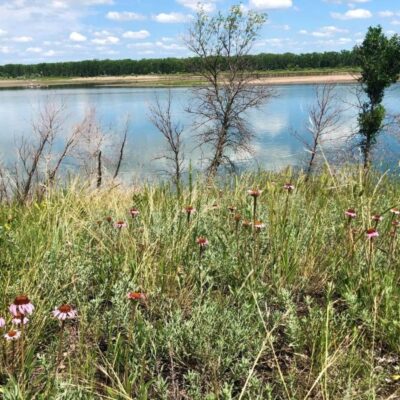
| Spring (Apr–May) | Park opening. Wildflowers on prairie. Quiet before summer season |
| Winter (Dec–Feb) | Harsh North Dakota winter. Limited access. The bluffs in snow evoke the isolation of frontier life |
Frequently Asked Questions
Did Custer really leave from here for Little Bighorn?
Yes — Fort Abraham Lincoln was Custer’s headquarters. The 7th Cavalry departed from this fort on May 17, 1876. Five weeks later, Custer and 268 men were dead at the Battle of the Little Bighorn in Montana Territory.
What were the Mandan earth lodges?
Large, dome-shaped homes built from timber and earth, 30–60 feet in diameter. The Mandan were sophisticated farmers and traders who lived in permanent villages along the Missouri. The reconstructed lodges at On-A-Slant let you step inside and understand their engineering.
Is this North Dakota’s oldest state park?
Yes — established in 1907, it’s North Dakota’s first state park.
Keep exploring: The closest neighbors are Cross Ranch State Park (within about an hour’s drive) and Lake Sakakawea State Park (elsewhere in the state).
Camping reservations: Book campsites and cabins for North Dakota state parks online at reservendparks.com.
⚔️ Where Custer Rode Out
A Mandan village 200 years old. A cavalry post where the 7th rode to its destruction. North Dakota’s first state park on the bluffs of the Missouri.
Wildlife & Nature
Fort Abraham Lincoln SP — the post from which Lt. Col. George Custer departed on his ill-fated 1876 expedition to the Little Bighorn. The park’s Missouri River bluffs, reconstructed Mandan earthlodges, and prairie support bald eagles, mule deer, and pronghorn. The On-A-Slant Mandan Village (reconstructed) dates to 1575-1781.
Nearby Attractions
Mandan — adjacent. Bismarck — across the river — state capital. Missouri River — at the park.

⛺ Camping at Fort Abraham Lincoln State Park: Campgrounds & Cabins
| Campsites | 86 sites — 51 Modern Campsites with electricity and water, $25-30/night; 15 Modern Group Campsites with electricity, water and the ability to put multiple units on one site, $25-30/night per unit; 15 Primitive Campsites with water access, $15/night; 1 Primitive Group Tent Campsite, $15/night per unit; 4 Primitive Horse Campsites with water, $15/night. Showers & flush toilets and a sewage dump station on site. |
|---|---|
| Cabins & Lodging | Two basic camping cabins (Good Boy and Sheheke), situated along the Missouri River, open seasonally, $70-85/night (two-night minimum), sleep 5 (one full bed and 3 twin beds, bunkbed style), air-conditioned with a small refrigerator. No kitchen facilities. Bedding/towels not provided; pets not allowed. |
| Pets | Pets are welcome in the campground but must stay on a leash. |
| Reservations | Book online at reservendparks.com or call 800-807-4723, up to 95 days in advance. Check-in 4:00 pm, check-out 3:00 pm. Vehicle entrance permit required: $7 daily, $35 annual, $61.25 annual family, $28 annual senior. For large groups, call the park ahead at (701) 667-6340. |
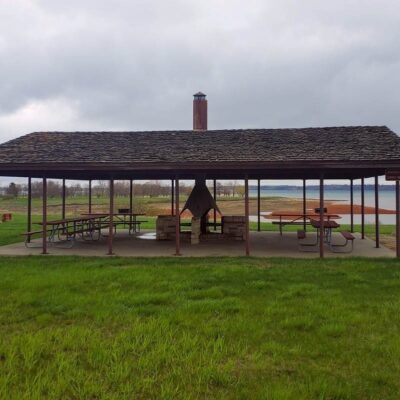
| Special sites | Primitive horse campsites with water access. Picnic shelters, playground, kayak launch; visitor center and commissary on site. |
| Season notes | Campground water and comfort station are turned off/closed on October 18. Camping cabins close November 1. |
Camping questions about Fort Abraham Lincoln State Park
Can you camp at Fort Abraham Lincoln State Park?
Yes. Fort Abraham Lincoln State Park has 86 campsites. 51 Modern Campsites with electricity and water, $25-30/night; 15 Modern Group Campsites with electricity, water and the ability to put multiple units on one site, $25-30/night per unit; 15 Primitive Campsites with water access, $15/night; 1 Primitive Group Tent Campsite, $15/night per unit; 4 Primitive Horse Campsites with water, $15/night. Showers & flush toilets and a sewage dump station on site.
How do you reserve a campsite at Fort Abraham Lincoln State Park?
Book online at reservendparks.com or call 800-807-4723, up to 95 days in advance. Check-in 4:00 pm, check-out 3:00 pm. Vehicle entrance permit required: $7 daily, $35 annual, $61.25 annual family, $28 annual senior. For large groups, call the park ahead at (701) 667-6340.
Are there cabins at Fort Abraham Lincoln State Park?
Two basic camping cabins (Good Boy and Sheheke), situated along the Missouri River, open seasonally, $70-85/night (two-night minimum), sleep 5 (one full bed and 3 twin beds, bunkbed style), air-conditioned with a small refrigerator. No kitchen facilities. Bedding/towels not provided; pets not allowed.
Are pets allowed at the Fort Abraham Lincoln State Park campground?
Pets are welcome in the campground but must stay on a leash.
Source: parkrec.nd.gov (verified July 2026). Details change seasonally — confirm when booking.
🐾 Dogs & Pets at Fort Abraham Lincoln State Park
- Pets allowed? statewide rule
- Pets are welcome in North Dakota state parks but must stay on a leash.
- Leash rule statewide rule
- Leash required; no maximum length specified on the official site
- Cabins & lodging statewide rule
- Pets are not allowed in cabins or yurts where parks state a policy (e.g. Fort Ransom State Park); no statewide pet-friendly cabin program advertised
- Statewide exceptions statewide rule
- Most parks have designated off-leash areas or dog parks (e.g. Fort Ransom's off-leash area with river access, Grahams Island's fenced dog park)
Are dogs allowed at Fort Abraham Lincoln State Park?
Pets are welcome in North Dakota state parks but must stay on a leash. Individual parks can post stricter rules — check signage on arrival.
Rules verified July 2026 via parkrec.nd.gov. More: North Dakota state parks guide · Dog rules in all 50 states compared
Park Location
Plan your gear for Fort Abraham Lincoln State Park
From our editorial guides, matched to this park’s activities: