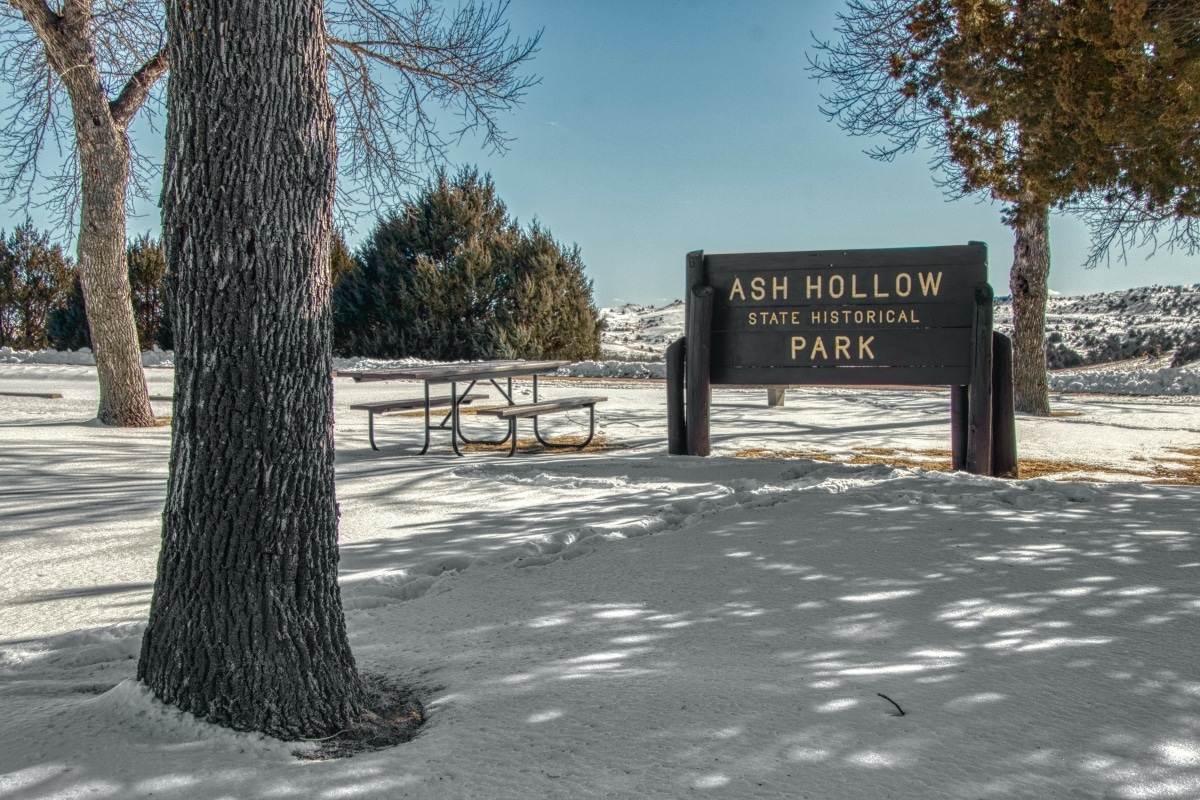
🌤 Weather at Ash Hollow State Historical Park by season
| Spring | Summer | Fall | Winter |
|---|---|---|---|
| 24–72 °F | 54–90 °F | 21–80 °F | 12–45 °F |
Each range runs from the coldest monthly average low to the warmest monthly average high in that season (1991-2020 climate normals), measured at Big Springs, 14 mi away, elevation 3,379 ft. Conditions at the park can differ from the station, especially where elevation differs — check a forecast before you go.

🏆 Oregon Trail Landmark — One of the most significant emigrant trail sites in the American West, where thousands of wagon trains descended into the North Platte Valley
There is a place in western Nebraska where you can still see, carved into the earth, the actual wheel ruts of the Oregon Trail. Not a reproduction. Not a re-creation. The real thing — grooves cut into the prairie soil by thousands of iron-rimmed wagon wheels between the 1840s and 1860s, preserved by the dry climate and the remoteness of the location. Stand at the top of Windlass Hill, look down the steep slope where emigrants had to lock their wheels and lower their wagons by rope, and you’re seeing exactly what they saw — the same terrifying descent, the same sweeping view of the North Platte River valley below, the same landscape that inspired both dread and hope in equal measure.
Ash Hollow State Historical Park preserves one of the most critical waypoints on the entire Oregon/California/Mormon Trail system. For emigrants heading west in the mid-19th century, Ash Hollow was a landmark of enormous significance: it marked the descent from the high plains into the North Platte Valley, the availability of fresh water and timber after days of dry prairie crossing, and — for many — the first real test of their wagons, their teams, and their courage. The steep descent of Windlass Hill destroyed wagons and injured livestock with alarming regularity, and the crossing was the subject of more diary entries and trail journal descriptions than almost any other single location on the trail.
But the story of Ash Hollow goes far deeper than the 1840s. The park’s archaeological record spans more than 6,000 years of human occupation, from Paleo-Indian hunters to Plains tribes to U.S. military expeditions. The caves in the hollow’s walls were used as shelters for millennia. The fossil beds of the Ash Hollow geological formation contain some of the most important Miocene-era specimens in North America. And the 1855 Battle of Ash Hollow — General William Harney’s devastating attack on a Brulé Lakota village — was a defining moment in the run-up to the Plains Indian Wars.
Table of Contents
Windlass Hill & Wagon Ruts
The most dramatic physical feature at Ash Hollow is Windlass Hill, a steep bluff that emigrants had to descend to reach the North Platte Valley. The hill drops approximately 240 feet over a short, precipitous grade — far too steep for loaded wagons to descend under normal braking. Emigrants used several techniques to survive the descent: locking all four wheels and skidding downhill, roping trees to the rear axle as a drag brake, and — as the name suggests — using windlass mechanisms (rope-and-chain systems) to lower wagons inch by inch down the steepest sections.
The wagon ruts are still visible today — deep channels worn into the hillside by the passage of thousands of wagons over two decades of heavy emigrant traffic. A marked trail leads you from the parking area to the hilltop, where interpretive signs explain the techniques emigrants used, and then down along the original trail route where you can see and walk alongside the actual ruts. It’s one of the most tangible, physical connections to the Oregon Trail that exists anywhere in the American West.
🛤️ Windlass Hill Facts
• Elevation drop: Approximately 240 feet
• Wagon ruts: Still visible after 170+ years
• Peak emigrant traffic: 1843–1869
• Estimated wagon crossings: Tens of thousands (350,000+ emigrants used the Oregon Trail system)
• Diary references: Among the most-documented locations on the entire trail
Oregon Trail History at Ash Hollow
For emigrants, Ash Hollow was more than a steep hill — it was an oasis. After crossing the arid high plains south of the South Platte River, wagon trains descended into a lush valley with abundant fresh water from Ash Hollow Spring, timber for wagon repairs, and good grass for exhausted livestock. Many emigrant parties rested here for days, making repairs, washing clothes, and gathering strength for the journey ahead.
The hollow gets its name from the groves of ash trees that filled the valley — a welcome sight after miles of treeless prairie. Emigrant journals describe Ash Hollow as “beautiful beyond description” and “a paradise after the desert.” But the descent into this paradise was so dangerous that some accounts describe wagons tumbling end-over-end down Windlass Hill, scattering their contents across the slope.
Ash Hollow Cave
Located in the limestone walls of the hollow, Ash Hollow Cave (also called the Rock Shelter) is one of the most significant archaeological sites in the central Great Plains. Excavations conducted in the 1930s and 1940s revealed evidence of human occupation spanning more than 6,000 years — from Paleo-Indian hunters who used the cave as a temporary shelter to later Plains peoples who left behind tools, projectile points, pottery fragments, and fire pits.
The cave provided shelter from the wind, protection from storms, and a commanding view of the valley below — making it an ideal campsite for anyone traveling through the region, whether they were following bison herds or the Oregon Trail. The stratified deposits inside the cave tell a continuous story of human adaptation to the Great Plains environment over six millennia.
The Battle of Ash Hollow (September 3, 1855)
In 1855, the hollow became the site of a violent military engagement that foreshadowed the larger Plains Indian Wars to come. General William S. Harney led approximately 600 U.S. Army troops against a Brulé Lakota village of Chief Little Thunder, camped near the mouth of Ash Hollow along the North Platte River. The attack — ostensibly in retaliation for the Grattan Massacre of the previous year — resulted in approximately 86 Lakota killed, many of them women and children, and 70 women and children taken prisoner.
The battle was one of the first large-scale military operations against Plains tribes and established a pattern of punitive warfare that would characterize U.S.-Native relations for the next three decades. Interpretive panels at the park provide context on both the military and Lakota perspectives of the engagement.
Fossils & Geology
The Ash Hollow Formation is a geological unit that extends across much of western Nebraska, and the rocks exposed within the park contain significant Miocene-era fossils (approximately 5–12 million years old). Ancient rhinos, camels, three-toed horses, and other creatures that inhabited the Great Plains long before the arrival of modern bison have been found in these sediments.
| Feature | Details |
|---|---|
| 🪨 Geological formation | Ash Hollow Formation (late Miocene, ~5–12 million years ago) |
| 🦏 Notable fossils | Ancient rhinos, camels, three-toed horses, turtles |
| 📐 Rock types | Sandstone, siltstone, volcanic ash layers |
| 🏔️ Landforms | Bluffs, rock shelters, eroded canyons, spring-fed hollows |
Visitor Center & Exhibits
| Feature | Description |
|---|---|
| 🏛️ Main Exhibit Hall | Oregon Trail artifacts, emigrant journals, geological displays |
| 🎬 Interpretive Film | Overview of the Oregon Trail experience and Ash Hollow’s significance |
| 🦴 Fossil Displays | Miocene specimens found in the Ash Hollow Formation |
| ⛏️ Archaeological Finds | Tools and artifacts from 6,000 years of cave occupation |
| 📚 Research Library | Emigrant diaries, trail maps, and historical documents |
Hiking & Trails
| Trail | Distance | Difficulty | Highlights |
|---|---|---|---|
| Windlass Hill Trail | 0.5 miles | Moderate (steep) | Wagon ruts, panoramic valley views, interpretive signs |
| Cave Trail | 0.3 miles | Easy | Rock shelter, archaeological site, shade |
| Spring Trail | 0.4 miles | Easy | Historic Ash Hollow Spring, emigrant campsite area |
| Bluff Loop | 1.2 miles | Moderate | Canyon views, geological exposures, wildflowers |
Visitor Information
| Detail | Information |
|---|---|
| 📍 Address | Ash Hollow State Historical Park, Lewellen, NE 69147 (US-26) |
| 📞 Phone | (308) 778-5651 |
| 🕐 Park Grounds | Year-round, sunrise to sunset |
| 🕐 Visitor Center | Memorial Day–Labor Day: Daily 9AM–5PM. Off-season: By appointment |
| 💰 Entry Fee | Nebraska State Park Vehicle Permit required ($6/day or $35/annual) |
| 🅿️ Parking | Free parking at visitor center and Windlass Hill |
| 🐕 Pets | Allowed on leash |
| ♿ Accessibility | Visitor center is accessible; trails are natural surface |
Best Time to Visit
| Season | Weather | Visitor Center | Best For |
|---|---|---|---|
| 🌸 Spring (Apr–May) | 50–75°F | By appointment | Wildflowers, comfortable hiking, green prairie |
| ☀️ Summer (Jun–Aug) | 80–95°F | Daily 9AM–5PM | Full visitor center, ranger programs, longest days |
| 🍂 Fall (Sep–Oct) | 55–80°F | Limited | Golden grasslands, ideal hiking weather, fewer visitors |
| ❄️ Winter (Nov–Mar) | 15–40°F | Closed | Solitude, photography (grounds remain open) |
The summer months offer daily access to the visitor center and ranger-led interpretive programs. Early morning visits to Windlass Hill provide the best light for photography and the most comfortable conditions for climbing the hill. Carry water and sunscreen — shade is limited on the exposed hilltop trails.
Nearby Attractions
| Destination | Distance | Highlights |
|---|---|---|
| Lake McConaughy SRA | 30 miles east | Largest reservoir in Nebraska, swimming, fishing |
| Chimney Rock NHS | 50 miles west | Most famous Oregon Trail landmark, visitor center |
| Courthouse & Jail Rocks | 60 miles west | Dramatic rock formations, emigrant waypoints |
| Scotts Bluff National Monument | 80 miles west | Oregon Trail, Mitchell Pass, summit drive |
| Fort Laramie NHS | 140 miles west (WY) | Major Oregon Trail military post, preserved fort |
Make it a road trip: Pair a visit with Lake McConaughy State Recreation Area (a short drive away) or Riverview Marina State Recreation Area (a short drive away).
Frequently Asked Questions
Can you still see Oregon Trail wagon ruts at Ash Hollow?
Yes — the wagon ruts on Windlass Hill are among the best-preserved Oregon Trail ruts in the country. They are clearly visible as deep grooves worn into the hillside by thousands of emigrant wagons between the 1840s and 1860s. A marked trail leads from the parking area to the hilltop, with interpretive signs explaining what you’re seeing. The ruts have survived because the area receives little rainfall and has never been plowed.
What is Windlass Hill?
Windlass Hill is a steep 240-foot descent on the Oregon Trail where emigrants had to lower their loaded wagons from the high plains into the North Platte Valley. The hill was so steep that wagons couldn’t simply be driven down — emigrants locked their wheels and skidded, attached drag brakes, or used windlass mechanisms (rope systems) to lower wagons slowly. Many wagons were damaged or destroyed in the attempt. The hill and its visible wagon ruts are the main attraction at Ash Hollow State Historical Park.
Is there an entrance fee?
A valid Nebraska State Park Vehicle Permit is required. Daily permits cost $6 and annual permits are $35. Permits can be purchased on-site or in advance from the Nebraska Game and Parks Commission. The visitor center and all trails are included with the permit.
When is the visitor center open?
The visitor center is open daily from 9:00 AM to 5:00 PM during the summer season (Memorial Day through Labor Day). Off-season hours are by appointment only — call (308) 778-5651 to arrange a visit. The park grounds, Windlass Hill, and the cave are accessible year-round during daylight hours regardless of visitor center hours.
What is Ash Hollow Cave?
Ash Hollow Cave is a natural rock shelter in the limestone walls of the hollow that shows evidence of human occupation spanning more than 6,000 years. Archaeological excavations revealed stone tools, projectile points, pottery fragments, and fire pits from multiple cultural periods, from Paleo-Indian hunters through later Plains peoples. The cave is accessible via a short, easy trail from the main park area.
How long should I plan for a visit?
Plan for 1.5 to 2.5 hours: approximately 45 minutes for the visitor center exhibits and film, 30–45 minutes for the Windlass Hill trail and wagon ruts, and 20–30 minutes for the cave trail. History enthusiasts and photographers should allow more time, especially for lingering at Windlass Hill, which is the emotional and visual centerpiece of the park.
Can you combine Ash Hollow with other Oregon Trail sites?
Absolutely — Ash Hollow is part of a remarkable concentration of Oregon Trail landmarks in western Nebraska. Chimney Rock (50 miles west), Courthouse and Jail Rocks (60 miles), and Scotts Bluff National Monument (80 miles) can all be visited in a 1–2 day road trip. Continuing west to Fort Laramie in Wyoming creates one of the finest Oregon Trail itineraries in the country.
🛤️ Walk the Oregon Trail at Ash Hollow
Stand where the emigrants stood, see the wagon ruts they carved, and feel the steep descent they feared. Ash Hollow State Historical Park is one of the most tangible connections to the Oregon Trail experience that exists anywhere in the American West.
🗺️ Official Park Information 🌾 Explore NebraskaExplore More Nebraska State Parks
Ash Hollow State Historical Park is one of many outstanding state parks in Nebraska. Discover more parks in our Best State Parks in Nebraska guide, or use our Park Finder to search by activity, location, or features.
Wildlife & Nature
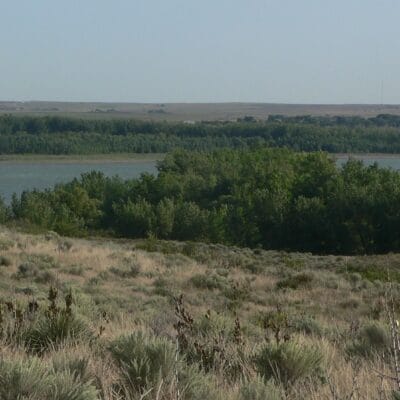
Ash Hollow SHP — a critical Oregon Trail landmark where covered wagons descended Windlass Hill — a treacherous steep descent with wagon ruts still visible today. The area has been used by humans for over 6,000 years. A prehistoric cave and Native American artifacts have been found. The hollow’s ash trees, springs, and canyon support mule deer, wild turkeys, and prairie rattlesnakes.

🐾 Dogs & Pets at Ash Hollow State Historical Park
- Pets allowed? statewide rule
- Pets are allowed in Nebraska state park areas, including campgrounds, provided they are leashed, crated or caged.
- Leash rule statewide rule
- All animals must be on a leash no longer than 6 feet, or crated or caged.
- Beaches & swim areas statewide rule
- Designated swimming beaches and pools are off-limits to all animals except service dogs.
- Cabins & lodging statewide rule
- Pets are allowed in cabins for a $25 one-time pet fee per unit; pets are not allowed in lodge rooms.
- Pet fees statewide rule
- $25 one-time pet fee per unit for pets in cabins; no day-use pet fee.
- Statewide exceptions statewide rule
- At Lake McConaughy SRA leashing is strictly enforced to protect Least Tern and Piping Plover nesting areas; pets at large may be impounded.
- Dogs & wildlife
- Keep dogs leashed on the trails — the park lies within Nebraska's prairie rattlesnake range.
Are dogs allowed at Ash Hollow State Historical Park?
Pets are allowed in Nebraska state park areas, including campgrounds, provided they are leashed, crated or caged. Individual parks can post stricter rules — check signage on arrival.
Rules verified July 2026 via outdoornebraska.gov. More: Nebraska state parks guide · Dog rules in all 50 states compared
🐻 Wildlife at Ash Hollow State Historical Park: What to Watch For — and Watch Out For
Worth watching for: Nebraska Game and Parks highlights birdwatching and wildlife viewing along the park's nine miles of trails, where a spring-fed stream and juniper-covered bluffs overlook the North Platte River. The visitor center interprets the area's geologic and paleontologic history alongside its Oregon Trail and American Indian past.
Watch out for: Ash Hollow's rocky bluffs and canyons in Garden County lie squarely in the range of the prairie rattlesnake, which Nebraska Game and Parks calls the state's most common venomous snake, found across roughly the western half of Nebraska in prairie with rocky outcrops or canyons. Game and Parks' advice: if you can't identify a snake, leave it alone and give it plenty of space.
Are there venomous snakes at Ash Hollow State Historical Park?
Yes — see above for where they occur in the park and how to behave. Sightings are a normal part of a healthy park; incidents are rare when visitors keep distance and store food properly.
Wildlife information verified July 2026 via outdoornebraska.gov.
Park Map
Plan your gear for Ash Hollow State Historical Park
From our editorial guides, matched to this park’s activities:




Top Tours & Activities in Nebraska
 from $21
 from $12
 from $20