
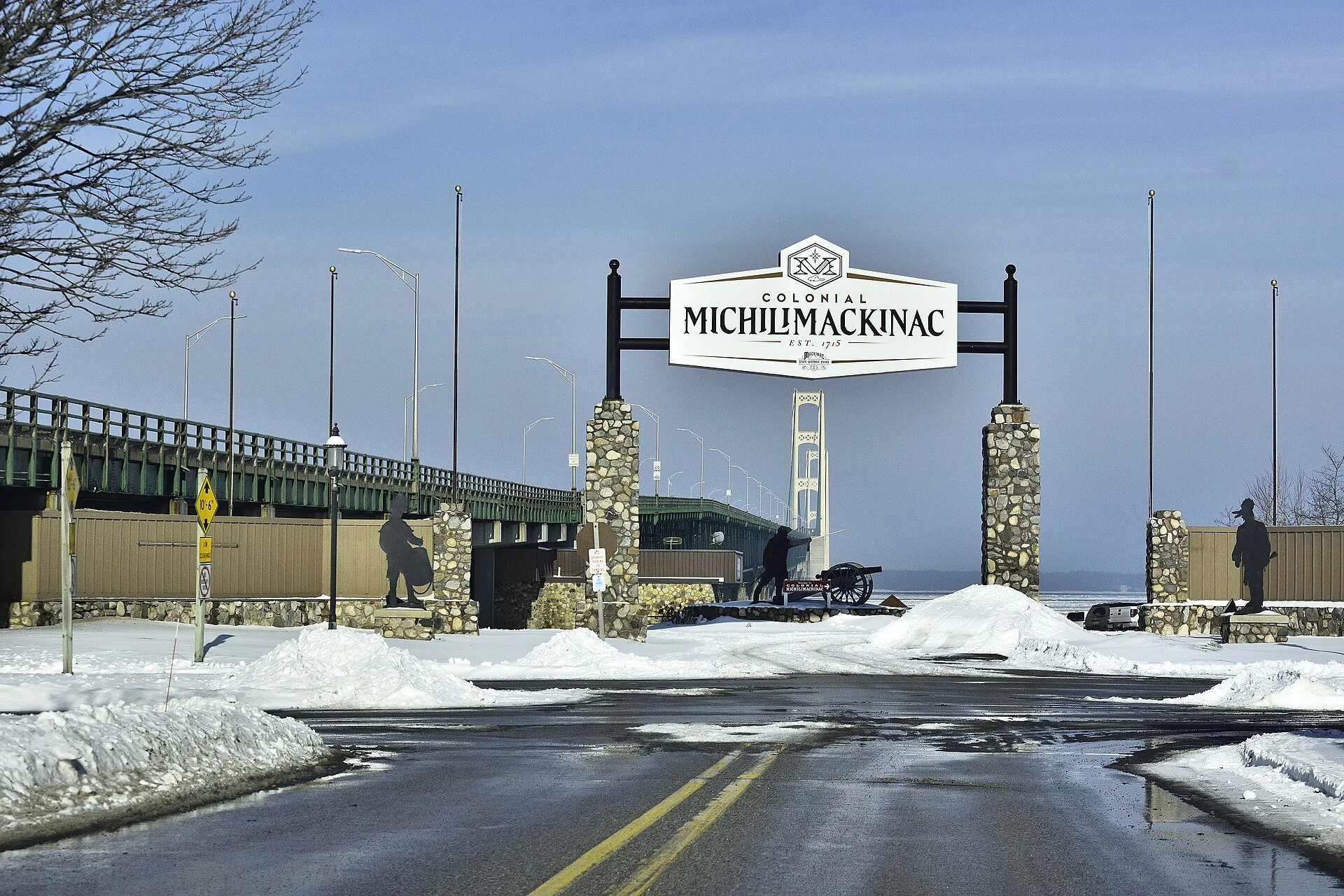
🌤 Weather at Fort Michilimackinac State Park by season
| Spring | Summer | Fall | Winter |
|---|---|---|---|
| 20–61 °F | 52–75 °F | 32–69 °F | 14–33 °F |
Each range runs from the coldest monthly average low to the warmest monthly average high in that season (1991-2020 climate normals), measured at St Ignace Mackinac Br, 4 mi away, elevation 595 ft. Conditions at the park can differ from the station, especially where elevation differs — check a forecast before you go.

⚔️ 300 Years of Living History Under the Mackinac Bridge — Reconstructed 1715 French-British fort, costumed reenactments, cannon firings, active archaeological dig, and the gateway to Mackinac Island
In 1715, French soldiers and fur traders built a wooden palisade fort at the narrowest point of the Straits of Mackinac — the strategic bottleneck connecting Lake Michigan and Lake Huron. For 65 years, Fort Michilimackinac served as a center of the fur trade, a military outpost, and a meeting ground where French, British, and Anishinaabe people negotiated the complex alliances that shaped the Great Lakes region. In 1763, Ojibwe warriors launched a famous surprise attack, using a game of bagataway (lacrosse) as cover to storm the British-held fort in one of the most dramatic episodes of Pontiac’s War.
Today, Colonial Michilimackinac stands reconstructed on its original site in Mackinaw City, directly beneath the soaring towers of the Mackinac Bridge. Sixteen reconstructed buildings — barracks, houses, a church, a blacksmith shop, the commanding officer’s quarters, and the powder magazine — surround a central parade ground where costumed interpreters demonstrate musket firing, cannon drills, hearth cooking, and 18th-century trades. Since 1959, the site has hosted one of the longest-running archaeological excavations in North America, and visitors can often watch archaeologists at work uncovering artifacts from three centuries of occupation.
What to Do at Fort Michilimackinac
1. Explore the Reconstructed Fort
Walk through 16 reconstructed buildings that recreate life at the fort during the French and British periods. Each building is furnished with period artifacts and themed exhibits: the commanding officer’s house displays fine European goods, the soldiers’ barracks show the cramped conditions of garrison life, the blacksmith shop contains working tools, and the church features the original footprint discovered through archaeology. Interpretive panels in each building explain the social dynamics, trade relationships, and cultural interactions that defined the fort.
2. Watch Living History Demonstrations
Costumed interpreters portray soldiers, merchants, voyageurs, and tradespeople throughout the day. Regular demonstrations include musket and cannon firing, hearth cooking with period recipes, candle making, woodworking, and children’s colonial games. The cannon firing is a particular highlight — the boom echoes off the Mackinac Bridge towers overhead. Check the daily schedule at the visitor center for demonstration times; most programming runs from late morning through mid-afternoon.
3. Watch Archaeology in Progress
Since 1959, Colonial Michilimackinac has been the site of one of the longest-running archaeological excavations in North America. During summer months, visitors can observe professional archaeologists and students excavating at active dig sites within the fort. The artifacts recovered — buttons, coins, ceramics, tools, food remains — tell stories that documents alone cannot. An on-site exhibit displays significant finds and explains the archaeological process.
4. Learn About the 1763 Attack
The most dramatic chapter in the fort’s history occurred on June 2, 1763, when Ojibwe warriors organized a lacrosse game outside the fort walls. As the game moved toward the gate, the warriors seized weapons hidden by nearby women and stormed the fort, capturing the British garrison in minutes. The event is commemorated through exhibits, interpretation, and occasional special reenactments. It provides essential context for understanding Indigenous resistance to British colonial expansion in the Great Lakes.
5. Visit the Museum Store & Visitor Center
The visitor center provides historical context before you enter the fort and houses a museum store with books, reproduction artifacts, and locally made goods. The orientation exhibits are worth spending 15–20 minutes with before walking the grounds — they provide the timeline and cultural context that make the fort buildings more meaningful.
6. Combine with Mackinac Island
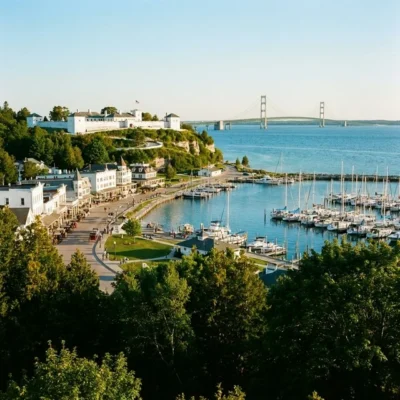
Fort Michilimackinac sits directly at the Mackinaw City ferry docks, making it a natural combination with a Mackinac Island day trip. Visit the fort in the morning, then catch a ferry to the island for Fort Mackinac (the fort the British built when they relocated from Michilimackinac in 1780–81), the Grand Hotel, and the island’s famous fudge shops. A combo ticket covering both forts is available through Mackinac State Historic Parks.
Visitor Information
| Detail | Info |
|---|---|
| 2026 Season | May 6 – October 11 |
| Hours | Seasonal — check mackinacparks.com |
| Last Admission | 1 hour before closing |
| Adults (13+) | $17.50 |
| Youth (5–12) | $10.50 |
| Under 5 | Free |
| Combo Tickets | Available with Fort Mackinac (Mackinac Island) |
| Location | Mackinaw City, MI (under the Mackinac Bridge) |
| Phone | (231) 436-4100 |
Best Time to Visit
| Season | Weather | Best For |
|---|---|---|
| Early Season (May–Jun) | 50–70°F | Smaller crowds, full programming begins |
| Peak Season (Jul–Aug) | 70–80°F | Best weather, all demonstrations, archaeology active |
| Late Season (Sep–Oct) | 45–65°F | Fall foliage, quieter, Straits views |
Plan 2–4 hours for a thorough visit. Summer weekends are busiest; weekday mornings offer the most unhurried experience. The fort is entirely outdoors — dress for weather and wear comfortable walking shoes.
💰 Trip Cost Estimator
| Expense | Per Adult | Family of 4 (2A+2C) | Notes |
|---|---|---|---|
| Fort Admission | $17.50 | $56 | Youth 5–12: $10.50 |
| Combo (+ Fort Mackinac) | $30–35 | $90–110 | Both forts + ferry needed |
| Mackinac Island Ferry | $28–30 RT | $80–100 RT | If combining with island |
| Food/Dining | $15–25 | $50–80 | Mackinaw City has many options |
| Fort Only | $35–45 | $110–140 | Fort + lunch |
| Fort + Island Combo | $75–95 | $225–300 | Both forts + ferry + meals |
Nearby Attractions
Mackinac Island — car-free island reached by ferry from Mackinaw City, featuring Fort Mackinac, the Grand Hotel, horse-drawn carriages, and world-famous fudge shops. Mackinac Bridge — the 5-mile suspension bridge connecting Michigan’s Upper and Lower Peninsulas, visible from within the fort. Historic Mill Creek Discovery Park (3 miles south) — a reconstructed 1790s sawmill with a canopy bridge and climbing wall. Headlands International Dark Sky Park (15 min) — one of the best stargazing locations in the Lower 48. Together, the Mackinaw City area offers a full weekend of history, nature, and iconic Michigan experiences.
Frequently Asked Questions
How long should I plan for a visit?
Allow 2–4 hours to explore the fort, watch demonstrations, and visit the exhibits. A quick visit can be done in 90 minutes, but you’ll miss details.
Is there a combo ticket with Mackinac Island?
Yes — Mackinac State Historic Parks offers combo tickets that include Fort Michilimackinac and Fort Mackinac on Mackinac Island. Combo tickets are available at either fort’s ticket counter. Note that ferry tickets to the island are separate.
Is it outdoors?
Yes — the fort is entirely outdoors. The reconstructed buildings provide some shelter, but plan for weather. Dress in layers for northern Michigan’s variable conditions. Wear comfortable walking shoes.
Can I see the Mackinac Bridge from the fort?
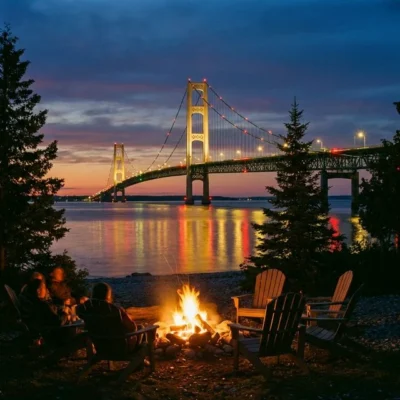
Yes — the fort sits directly beneath the bridge. The juxtaposition of an 18th-century wooden palisade fort with a 20th-century engineering marvel overhead is one of the site’s most unique visual features.
Are there reenactments every day?
Costumed interpreters are present daily during the operating season, with regular musket firings, cannon demonstrations, and hearth cooking. Special large-scale reenactment events are held on select weekends — check the Mackinac State Historic Parks calendar for dates.
Keep exploring: The closest neighbors are Dousman’s Mill (a short drive away) and Straits State Park (a short drive away).
⚔️ Ready for 300 Years of Great Lakes History?
Musket fire. Cannon smoke. A lacrosse game that changed history. Fort Michilimackinac brings the French and British colonial era to life — right under the Mackinac Bridge, steps from the ferry to Mackinac Island.
Wildlife & Nature
Fort Michilimackinac — Colonial Michilimackinac — is one of the longest-running archaeological excavations in North America (since 1959). The reconstructed 18th-century fort tells the story of the French and British fur trade. Located at the foot of the Mackinac Bridge. Peregrine falcons nest on the bridge towers. Lake whitefish run in the Straits.

🐾 Dogs & Pets at Fort Michilimackinac State Park
- Pets allowed? statewide rule
- Pets are welcome in Michigan state parks, campgrounds, harbors and state-designated trails, except designated swim beaches and other posted areas.
- Leash rule statewide rule
- Pets must always be on a 6-foot leash and under the owner's immediate control.
- Beaches & swim areas statewide rule
- Pets are prohibited in buoyed swim areas but allowed along the shoreline outside them (on a 6-ft leash, even in the water); 50+ parks have pet-friendly shoreline or designated dog beaches.
- Cabins & lodging statewide rule
- Up to two pets (cats and dogs only) allowed at ~12 parks' designated pet-friendly cabins, yurts and lodges; $10 per night per pet (cabins) or $15 (lodges); otherwise pets barred from overnight lodging.
- Pet fees statewide rule
- No day-use pet fee; pet-friendly lodging costs $10/night per pet (cabins) or $15/night per pet (lodges).
- Statewide exceptions statewide rule
- Leash laws do not apply to dogs used for hunting on land open to such use; pets may not be left unattended.
Are dogs allowed at Fort Michilimackinac State Park?
Pets are welcome in Michigan state parks, campgrounds, harbors and state-designated trails, except designated swim beaches and other posted areas. Individual parks can post stricter rules — check signage on arrival.
Rules verified July 2026 via michigan.gov. More: Michigan state parks guide · Dog rules in all 50 states compared
Park Map
Plan your gear for Fort Michilimackinac State Park
From our editorial guides, matched to this park’s activities:
Top Tours & Activities Near Mackinaw City
 from $128
 from $95
 from $12