
🌤 Weather at Mackinac Island State Park by season
| Spring | Summer | Fall | Winter |
|---|---|---|---|
| 18–59 °F | 51–76 °F | 30–68 °F | 10–32 °F |
Each range runs from the coldest monthly average low to the warmest monthly average high in that season (1991-2020 climate normals), measured at St Ignace, 5 mi away, elevation 661 ft. Conditions at the park can differ from the station, especially where elevation differs — check a forecast before you go.

America’s Car-Free Island: Where History, Natural Beauty, and Fudge Collide
Step off the ferry onto Mackinac Island and you’re stepping into another era. There are no cars here — none. Since 1898, motorized vehicles have been banned from this 3.8-square-mile jewel in the Straits of Mackinac, where the only sounds are clip-clopping horses, bicycle bells, and waves lapping against the stone shore. Mackinac Island State Park encompasses 1,800 acres — roughly 80% of the entire island — protecting a remarkable fusion of military history, geological wonders, and pristine Great Lakes nature.
This isn’t just any state park. In 1875, Mackinac Island became the second national park in the United States, right after Yellowstone. When the federal government transferred it to Michigan in 1895, it became Michigan’s first state park. Today, with its Revolutionary War-era fort, dramatic limestone formations, 70+ miles of trails, horse-drawn carriages, and world-famous fudge shops, Mackinac Island draws nearly a million visitors each year — and somehow retains the magical quality that has captivated travelers for over 150 years.
🏛️ Fort Mackinac
Fort Mackinac is the crown jewel of Mackinac Island’s history — a whitewashed military fortress perched on a limestone bluff overlooking the harbor, the Mackinac Bridge, and the sparkling Straits. Built by the British during the American Revolution in 1780, this fort has witnessed some of the most pivotal moments in Great Lakes history, including a dramatic battle during the War of 1812.
| Feature | Details |
|---|---|
| Admission | ~$15 adults / ~$10 children (includes other Mackinac State Historic Parks sites) |
| Historic Buildings | 14 original structures open for exploration |
| Demonstrations | Daily cannon and rifle firing demonstrations by costumed interpreters |
| Museum | Exhibits on military history, island life, and Native American heritage |
| Tea Room | Historic tea room with panoramic harbor views |
| Season | May 1 – October 24 (last admission 1 hour before closing) |
Don’t Miss: Fort Holmes
A short walk uphill from Fort Mackinac leads to Fort Holmes, the highest point on the island. Originally built by the British in 1812, this small earthwork fortification offers panoramic 360° views of the island, both Great Lakes, and the Mackinac Bridge. It’s free to visit and far less crowded than Fort Mackinac itself — one of the island’s best-kept secrets.
🪨 Natural Landmarks
Mackinac Island’s geological story is written in limestone — dramatic formations carved by ancient seas, glaciers, and millennia of wind and wave action. The island sits atop a massive limestone stack, and its most iconic features are accessible by foot, bike, or horse-drawn carriage.
| Landmark | Type | Height | Highlights |
|---|---|---|---|
| Arch Rock | Natural Limestone Arch | 146 ft above Lake Huron | Island’s most iconic landmark, breathtaking views, Nipissing post-glacial formation |
| Sugar Loaf | Limestone Stack | 75 ft tall | Dramatic freestanding rock tower in the island’s interior |
| Skull Cave | Limestone Cave | N/A | Culturally significant Native American landmark |
| Devil’s Kitchen | Cave Formation | N/A | Sea cave accessible by trail |
Arch Rock: The Island’s Crown Jewel
Rising 146 feet above the Lake Huron shoreline, Arch Rock is a natural limestone arch formed during the Nipissing post-glacial period thousands of years ago. This geological masterpiece is accessible from two directions: a moderate uphill walk from the lakeshore via 207 steps, or a gentle path from the interior via the Arch Rock Road. The adjacent Milliken Nature Center at Arch Rock Plaza offers exhibits explaining the island’s unique geology.
🥾 Trails & Getting Around
With over 70 miles of trails crisscrossing the island, Mackinac Island State Park is a paradise for hiking and cycling. Since no cars are allowed, trails are shared between pedestrians, cyclists, and the occasional horse — making every path feel pleasantly uncrowded and peaceful.
| Trail/Route | Distance | Difficulty | Highlights |
|---|---|---|---|
| M-185 Island Loop (Lake Shore Road) | 8.2 mi | Easy | America’s only motorless highway; circles the entire island along the waterfront |
| Fort Holmes Trail | 1.5 mi | Moderate | Leads to the island’s highest point with panoramic views |
| Arch Rock Trail (South) | 0.8 mi | Easy-Mod | Direct route to the iconic natural arch, includes 207 steps |
| Tranquil Bluff Trail | 2.5 mi | Moderate | Blufftop trail with Lake Huron views, connects to interior trails |
| Manitou Trail | 1.2 mi | Moderate | Rugged path through woods; rocky terrain, great for adventure seekers |
| British Landing Nature Trail | 0.5 mi | Easy | Interpretive walk near the historic War of 1812 landing site |
| Crooked Tree Trail | 1.0 mi | Easy | Winds through the island’s interior forest |
M-185: America’s Only Motorless Highway
The 8.2-mile M-185 — officially known as Lake Shore Road — is the only state highway in America where motorized vehicles are prohibited. The paved path circles the entire island along the waterfront, offering stunning views of the Mackinac Bridge, Round Island Lighthouse, and the Michigan mainland. It’s perfect for a leisurely bike ride (about 1 hour) or a scenic 2.5-hour walk. Horseback riders and horse-drawn carriages share the route, adding to the timeless atmosphere. Bike rentals are available at multiple shops near the ferry docks.
🐴 The Car-Free Experience
Since 1898, Mackinac Island has banned motorized vehicles — making it one of the very few places in America where you’ll never hear an engine. Getting around is part of the adventure:
| Transportation | Cost | Best For |
|---|---|---|
| Walking | Free | Downtown, trails, short distances |
| Bicycle Rental | $10–15/hour | Island loop, longer explorations |
| Horse-Drawn Carriage Tour | $30–40/person | Narrated island tour with stops at major attractions |
| Saddle Horse Rental | $55–80/hour | Trail riding through the interior |
| Horse-Drawn Taxi | Varies | Point-to-point transport with luggage |
Horse-Drawn Carriage Tours
The most iconic Mackinac Island experience is the horse-drawn carriage tour, a narrated journey that covers the island’s major landmarks including Arch Rock, Fort Mackinac, the Grand Hotel, and Surrey Hills. Tours typically last 1.5–2 hours and include a stop at Surrey Hills where you can explore the Wings of Mackinac Butterfly Conservatory. During peak summer season, carriages run continuously — just walk up to the departure point near the Arnold Ferry dock.
📜 History Timeline
| Year | Event |
|---|---|
| Pre-1600s | Ojibwa and Odawa peoples consider the island sacred — the name “Mackinac” derives from the Ojibwa word for “Great Turtle” |
| 1715 | French establish Fort Mackinac on the nearby mainland at present-day Mackinaw City |
| 1780 | British relocate the fort to Mackinac Island for a more defensible position |
| 1812 | British capture Fort Mackinac in a surprise attack during the War of 1812 |
| 1875 | Congress designates Mackinac Island as the second National Park in the US (after Yellowstone) |
| 1895 | Federal government transfers the park to Michigan, making it the state’s first state park |
| 1898 | Motorized vehicles banned from the island — a policy that stands to this day |
| 1887 | Grand Hotel opens, beginning the island’s transformation into a premier resort destination |
| Present | Nearly 1 million visitors per year; 80% of the island protected as state park |
🍫 Island Culture & Must-Do Experiences
- Mackinac Island Fudge — The island is famous for its handmade fudge, with over a dozen shops along Main Street. Watch the candy makers work on marble slabs, then choose your flavor. Visitors are affectionately called “fudgies” by locals.
- Grand Hotel — This 1887 landmark features the world’s longest porch (660 feet). Non-guests can visit for a fee; afternoon tea on the terrace is a classic experience.
- Mackinac Island Butterfly House — One of the oldest live butterfly exhibits in the United States, home to hundreds of free-flying butterflies.
- British Landing — The historic beach where British forces landed during the War of 1812 surprise attack. Today it’s a peaceful picnic area and popular biking rest stop.
- Sunset from Fort Mackinac — The views of the Mackinac Bridge silhouetted against the setting sun from the fort’s ramparts are unforgettable.
📅 Seasonal Guide
| Season | Dates | Highlights | Considerations |
|---|---|---|---|
| Spring | May | Lilac Festival (mid-June), wildflowers bloom, fewer crowds | Some businesses still opening; weather variable |
| Summer | Jun–Aug | Peak season, all attractions open, warmest water, longest days | Most crowded — ferries and trails busy; book hotels early |
| Fall | Sep–Oct | Stunning fall colors, smaller crowds, cooler temperatures | Some businesses begin closing mid-October; shorter ferry schedule |
| Winter | Nov–Apr | Snowmobiling (on ice bridge), cross-country skiing, serene solitude | Most businesses closed; limited ferry service; ~500 year-round residents only |
💰 Visitor Guide & Budget Planner
Getting There
Mackinac Island is accessible only by ferry (from Mackinaw City or St. Ignace) or small plane. Three ferry companies operate seasonal service (May–October): Shepler’s, Star Line, and Arnold Transit. The crossing takes about 15–20 minutes.
Costs
| Item | Cost | Notes |
|---|---|---|
| Ferry (Round-Trip Adult) | $29–33 | Shepler’s, Star Line, or Arnold; children discount |
| State Park Entry | Free | Open year-round, no admission fee |
| Fort Mackinac Admission | ~$15 adult / ~$10 child | Includes other Mackinac State Historic Parks sites |
| Bicycle Rental | $10–15/hour | Multiple shops near ferry docks |
| Carriage Tour | $30–40/person | 1.5–2 hour narrated tour |
| Horseback Riding | $55–80/hour | Guided trail rides through state park |
| Hotel (Mid-Range) | $150–300/night | Book well in advance for summer |
| Grand Hotel Visit (Non-Guest) | $10 | Access to porch and grounds |
| Box of Fudge | $10–25 | Half-pound to full-pound boxes |
⚠️ Rules & Tips
- No motorized vehicles — Cars, motorcycles, and motorized scooters are strictly prohibited on the island.
- Bikes on trails — Some interior trails are walking-only; check signs before riding. Mountain biking is limited to specific trails.
- Ferry schedule — Last ferries depart by early evening (varies by season). Don’t miss your boat!
- Pack light — Horse-drawn taxis transport luggage, but hauling heavy bags through downtown is cumbersome.
- Reservations essential — Summer hotels and special events book months in advance.
- Weather — Lake Huron breezes make the island cooler than the mainland. Bring layers even in summer.
- Respect the horses — Give horses right of way on all roads and trails. Don’t startle or approach working horses.
❓ Frequently Asked Questions
Why are cars not allowed on Mackinac Island?
Motorized vehicles have been banned from Mackinac Island since 1898. The ban was originally enacted because early “horseless carriages” frightened the island’s horses. The policy has remained in place ever since, creating the serene, car-free atmosphere that is now the island’s defining characteristic. Emergency and utility vehicles are the only exceptions.
How do I get to Mackinac Island?
Mackinac Island is accessible by passenger ferry from Mackinaw City or St. Ignace, Michigan. Three ferry lines operate from May through October: Shepler’s, Star Line, and Arnold Transit. The crossing takes approximately 15–20 minutes. Round-trip adult tickets cost $29–33. Small planes can also land at the island’s airport year-round.
Is there an entrance fee for Mackinac Island State Park?
No — entry to Mackinac Island State Park is completely free and open year-round. However, Fort Mackinac charges admission (~$15 adults, ~$10 children), and activities like carriage tours and bike rentals have separate fees.
How long should I spend on Mackinac Island?
A full day is sufficient to see the major highlights (Fort Mackinac, Arch Rock, island loop, fudge shops). However, an overnight stay is highly recommended to experience the magical quiet after the day-trippers leave on the last ferry. Two nights gives you time to explore interior trails, enjoy a carriage tour, and truly relax.
What is M-185?
M-185 (Lake Shore Road) is the only state highway in America where motorized vehicles are prohibited. This 8.2-mile paved route circles the entire island along the waterfront, used by cyclists, pedestrians, horseback riders, and horse-drawn carriages. A leisurely bike ride around the loop takes about 1 hour.
Can I bring my dog to Mackinac Island?
Yes, dogs are allowed on Mackinac Island and on some ferry crossings. Pets must be leashed at all times in the state park. Be mindful of the horses — keep dogs under close control near horse-drawn carriages and on shared trails. Not all hotels accept pets, so verify before booking.
Is Mackinac Island worth visiting in fall?
Absolutely. September and early October bring stunning fall colors, cooler temperatures, and significantly fewer crowds. Most attractions and restaurants remain open through mid-October. The island’s sugar maples and birches create a spectacular backdrop, especially along the interior trails and from Fort Holmes.
Explore More Michigan State Parks
Mackinac Island State Park is one of many outstanding state parks in Michigan. Discover more parks in our Best State Parks in Michigan guide, or use our Park Finder to search by activity, location, or features.
Wildlife & Nature
Mackinac Island SP — covering 80% of Mackinac Island — is one of America’s most unique state parks. The island has no motorized vehicles — transportation is by horse, bicycle, or foot. The park’s limestone cliffs, cedar forests, and shoreline support bald eagles, peregrine falcons, and great horned owls. Arch Rock — a 146-foot natural limestone arch — is the island’s iconic formation. Fort Mackinac (1780) overlooks the harbor.
Nearby Attractions
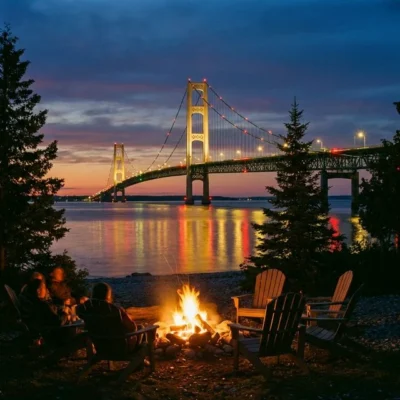
Mackinac Island — surrounding — has the Grand Hotel (world’s longest porch, 660 feet), fudge shops (16+ on the island), Fort Mackinac (1780), and horse-drawn carriages. Mackinaw City — 4 miles south by ferry. St. Ignace — 5 miles north by ferry. Mackinac Bridge — visible from the island — is 5 miles long.
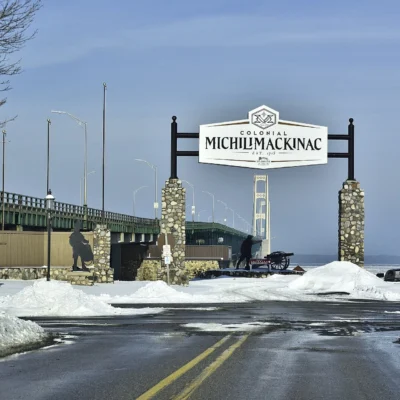
Nearby parks: If you have extra time, Straits State Park is a short drive away, and Fort Michilimackinac State Park is a short drive away.

🐾 Dogs & Pets at Mackinac Island State Park
Park policy: Mackinac Island State Park is run by the Mackinac Island State Park Commission rather than the Michigan DNR, so the statewide Michigan rules below are a guide rather than the governing rulebook here. The commission states that well-behaved pets are welcome and asks you to clean up after your pet; leashed dogs are allowed on all state park trails and inside Fort Mackinac, where a water bowl sits by the front entrance.
- Pets allowed?
- Leashed, well-behaved dogs are welcome parkwide, on all trails and inside Fort Mackinac
- Park-specific rules
- The park suggests covering your dog's ears during the cannon and rifle demonstrations at Fort Mackinac. The island's sanitation crew clears horse droppings only, so bring bags and pack out your dog's waste.
Are dogs allowed at Mackinac Island State Park?
Leashed, well-behaved dogs are welcome parkwide, on all trails and inside Fort Mackinac.
More: Michigan state parks guide · Dog rules in all 50 states compared
Park Location
Plan your gear for Mackinac Island State Park
From our editorial guides, matched to this park’s activities:
Top Tours & Activities Near Mackinaw City
 from $128
 from $95
 from $12