

🌤 Weather at Douglass Houghton Falls Scenic Site by season
| Spring | Summer | Fall | Winter |
|---|---|---|---|
| 17–61 °F | 49–75 °F | 26–66 °F | 9–28 °F |
Each range runs from the coldest monthly average low to the warmest monthly average high in that season (1991-2020 climate normals), measured at Hancock Houghton Co Airport, 4 mi away, elevation 1,095 ft. Conditions at the park can differ from the station, especially where elevation differs — check a forecast before you go.

Overview: Michigan’s Tallest Waterfall
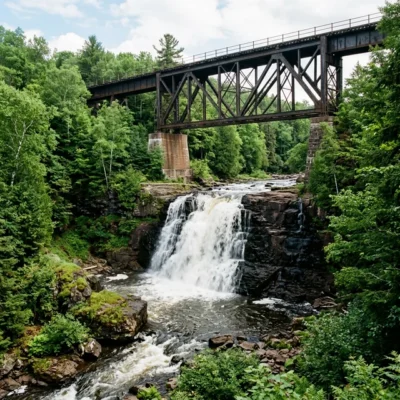
Hidden within a deeply carved, ancient gorge on the remote Keweenaw Peninsula in Michigan’s Upper Peninsula, Douglass Houghton Falls commands immediate respect. Plunging approximately 110 feet down a sheer rock face into a narrow, mist-filled chasm carved by Hammell Creek, it holds the indisputable title of the tallest waterfall in the state of Michigan. For decades, this spectacular cascade existed in a state of semi-secrecy—known to dedicated waterfall chasers and adventurous locals, but lacking any formal access, signage, or safety infrastructure. Reaching the falls required bushwhacking through dense forest and scrambling down dangerously crumbling, near-vertical gorge walls.
That era of purely wild, unsanctioned access is now transitioning. The Michigan Department of Natural Resources (DNR) is actively developing the surrounding land into the officially designated “Houghton-Douglass Falls and Veterans Memorial Scenic Site.” Phase 1 of this development—including a formal parking area, vault toilets, a pedestrian bridge spanning Hammell Creek, and an accessible paved trail to the bridge—was completed in 2025. However, the area beyond the bridge, including the descent into the gorge to view the falls from the base, remains largely undeveloped, rugged, and demanding. This duality—a partially civilized entrance transitioning into genuine, unforgiving wilderness—is precisely what makes Douglass Houghton Falls one of the most thrilling and unique natural destinations in the entire Great Lakes region.
The Namesake: Douglass Houghton and His Legacy
The falls bear a name of immense significance to Michigan’s history. Douglass Houghton (1809–1845) was Michigan’s first state geologist, a brilliant scientist, physician, and explorer who led the geological surveys that confirmed the existence of massive native copper deposits in the Keweenaw Peninsula. His reports directly triggered the great Copper Rush of the 1840s, which transformed the remote, sparsely populated Upper Peninsula into one of the wealthiest and most industrially significant mining regions in the world.
Tragically, Houghton drowned in a sudden squall on Lake Superior in 1845 at the age of just 36, cutting short a career of extraordinary scientific achievement. The falls also honor his cousin, Columbus C. Douglass, who continued surveying and developing the mineral wealth of the Copper Country. Naming this powerful, untamed cascade after these two pivotal figures is deeply fitting; the falls exist in the very heart of the wild landscape that Houghton spent his short life exploring, mapping, and interpreting for the young nation.
The Geological Formation
Douglass Houghton Falls is a product of the same ancient geological forces that created the entire Keweenaw Peninsula. The bedrock here consists of Precambrian volcanic basalts and conglomerates—some of the oldest exposed rock on the continent, dating back over a billion years. Hammell Creek, a relatively modest stream draining the forested highlands east of Lake Linden, has spent millennia exploiting weaknesses in this ancient rock, carving a spectacularly deep, narrow gorge through differential erosion.
The main drop occurs where the creek encounters a particularly resistant ledge of basalt. The water launches over this lip and free-falls roughly 110 feet into a dark, narrow plunge pool surrounded by towering, moss-covered walls. During the spring snowmelt and after heavy rains, the volume of water crashing into the gorge is thunderous and generates a constant cloud of fine mist that coats the surrounding rock and vegetation. During the drier summer months, the flow diminishes significantly, sometimes reducing to a thin, elegant veil of water that reveals the intricate geological layering of the exposed cliff face.
Accessing the Falls: What to Expect
With the completion of Phase 1 development, reaching Douglass Houghton Falls is now significantly more straightforward than it was historically—but only to a point.
The Developed Section
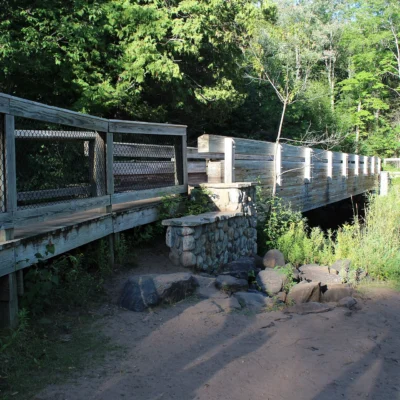
Visitors arriving at the new parking area off Highway M-26 (between Lake Linden and Laurium) will find a properly graded parking lot, vault restroom facilities, and a paved, ADA-accessible trail that leads approximately a quarter-mile through the forest to a new pedestrian bridge spanning Hammell Creek. This bridge provides a safe, elevated vantage point upstream of the falls. From here, visitors can observe the creek and the surrounding forest canopy. However, the main falls themselves are not directly visible from this bridge.
The Undeveloped Descent
To actually see and experience the full 110-foot cascade requires leaving the paved trail and navigating an undeveloped, unofficial footpath down into the gorge. This descent is steep, frequently muddy, laced with exposed tree roots, and features sections where visitors must scramble over slippery boulders and navigate along narrow ledges with significant drop-offs. There are currently no guardrails, observation platforms, staircases, or any other built safety features in this section.
This is not an exaggeration or a casual warning. The gorge walls are composed of fractured, weathered volcanic rock that can crumble underfoot. The footing near the base of the falls is perpetually wet and slippery from the constant mist. Falls and injuries have occurred here. Visitors attempting the descent must wear sturdy, waterproof hiking boots with aggressive tread, bring trekking poles if available, and exercise extreme caution at every step. Children must be closely supervised at all times. The gorge is not suitable for pets.
Best Times to Visit
Spring (April–May)
This is arguably the most dramatic time to visit. The massive spring snowmelt from the Keweenaw’s notoriously heavy winter snowpack sends enormous volumes of water through Hammell Creek, creating a thundering, full-width cascade that generates a visible mist cloud rising far above the gorge rim. The forest floor is carpeted with spring wildflowers—trillium, marsh marigold, and hepatica—and the raw energy of the falls is at its absolute peak. However, trail conditions during this period are at their worst: expect deep mud, potentially snow-covered sections, and very slippery rock surfaces.
Summer (June–August)
Water volume decreases noticeably, but the falls remain beautiful and the gorge becomes more accessible. The reduced mist allows for clearer photography of the exposed rock face. The surrounding forest is lush and green, teeming with songbirds. This is the most practical time for most visitors to safely attempt the gorge descent.
Autumn (September–October)
The Keweenaw Peninsula is renowned for its spectacular fall color display, and the hardwood forests surrounding Douglass Houghton Falls transform into a blazing palette of crimson, gold, and orange. The combination of the white cascade and the surrounding autumn color makes this one of the most photogenic waterfall settings in the entire Midwest. Peak color typically occurs in the first two weeks of October.
Winter (November–March)
In winter, the falls partially or fully freeze, creating massive, dramatic ice columns and curtains that coat the gorge walls. Experienced ice climbers occasionally attempt the frozen cascade, though this is extremely advanced and dangerous terrain. For most visitors, snow depth and road conditions may limit access during the deep winter months. Snowshoes or cross-country skis may be necessary to reach the gorge rim.
Photography Tips
Douglass Houghton Falls is a challenging but extraordinarily rewarding subject for photographers.
- Lens Selection: A wide-angle lens (14–24mm equivalent) is essential for capturing the full height of the falls from the base of the gorge. The narrow confines of the canyon make it impossible to back up far enough for a longer focal length.
- Tripod: Absolutely mandatory for the long exposures needed to create the classic silky-water effect. The gorge floor is uneven; bring a tripod with adjustable, splayable legs.
- Protection: The constant mist near the base will coat your front lens element within seconds. Bring multiple microfiber cloths and consider a rain sleeve for your camera body. A UV or clear protective filter on the lens is strongly recommended.
- Lighting: The narrow gorge receives direct sunlight only briefly, if at all. Overcast days actually produce the most even, workable light for photographing the cascade without harsh, blown-out highlights.
Nearby Attractions on the Keweenaw
Visitors making the journey to Douglass Houghton Falls are already deep into one of the most unique and historically rich regions in the United States. The surrounding Keweenaw Peninsula offers a wealth of complementary destinations.
- Quincy Mine: Located in nearby Hancock, this massive copper mine offers underground tours and surface exhibits documenting the industrial might of the Copper Country.
- Hungarian Falls: Another spectacular Keweenaw waterfall, located just a short drive away near Hubbell. Features multiple cascades in a carved sandstone gorge.
- Fort Wilkins Historic State Park: At the far tip of the peninsula in Copper Harbor, this beautifully preserved 1844 military outpost offers camping, hiking, and a dramatic Lake Superior shoreline.
- Brockway Mountain Drive: One of the highest above-sea-level roads between the Rockies and the Alleghenies, offering panoramic views of Lake Superior and the Keweenaw forests.
Frequently Asked Questions
Is Douglass Houghton Falls really the tallest waterfall in Michigan? Yes. At approximately 110 feet, it is widely recognized as the tallest single-drop waterfall in the state. Other Michigan waterfalls, such as Tahquamenon Falls, may be wider and carry much more water volume, but none match the sheer vertical height of the Douglass Houghton cascade.
Can I see the falls without doing the difficult gorge descent? Currently, no. The new pedestrian bridge provides a lovely forest walk and a view of Hammell Creek, but the main cascade is not visible from the bridge. Seeing the falls requires navigating the steep, undeveloped footpath down into the gorge. Future phases of the site’s development may include a viewing platform, but as of now, no such structure exists.
Is there an entrance fee? As of the most recent development phase, there is no entrance fee or vehicle pass required to access the Douglass Houghton Falls Scenic Site. This may change as further development phases are completed; check the Michigan DNR website for current information.
How long does the hike take? The walk from the parking area to the pedestrian bridge takes approximately 10–15 minutes on the paved trail. From the bridge, the descent into the gorge to the base of the falls and back adds approximately 30–60 minutes, depending on fitness level, trail conditions, and how long you spend at the base.
Are dogs allowed? Dogs are technically permitted on leash in the developed area and on the paved trail. However, the steep, slippery gorge descent is extremely hazardous for dogs and is strongly not recommended. There is no safe way to manage a leashed dog on the narrow, crumbling ledges.
Wildlife & Nature
Douglass Houghton Falls — Michigan’s tallest waterfall at 115 feet — cascades down a sandstone cliff face near Lake Linden in the Keweenaw Peninsula. Named for Douglass Houghton, Michigan’s first state geologist who discovered the Upper Peninsula’s copper deposits (1841). Bald eagles nest near the falls. Brook trout inhabit the pools below.
More parks nearby: F.J. McLain State Park is a short drive away.

🐾 Dogs & Pets at Douglass Houghton Falls Scenic Site
- Pets allowed? statewide rule
- Pets are welcome in Michigan state parks, campgrounds, harbors and state-designated trails, except designated swim beaches and other posted areas.
- Leash rule statewide rule
- Pets must always be on a 6-foot leash and under the owner's immediate control.
- Beaches & swim areas statewide rule
- Pets are prohibited in buoyed swim areas but allowed along the shoreline outside them (on a 6-ft leash, even in the water); 50+ parks have pet-friendly shoreline or designated dog beaches.
- Cabins & lodging statewide rule
- Up to two pets (cats and dogs only) allowed at ~12 parks' designated pet-friendly cabins, yurts and lodges; $10 per night per pet (cabins) or $15 (lodges); otherwise pets barred from overnight lodging.
- Pet fees statewide rule
- No day-use pet fee; pet-friendly lodging costs $10/night per pet (cabins) or $15/night per pet (lodges).
- Statewide exceptions statewide rule
- Leash laws do not apply to dogs used for hunting on land open to such use; pets may not be left unattended.
Are dogs allowed at Douglass Houghton Falls Scenic Site?
Pets are welcome in Michigan state parks, campgrounds, harbors and state-designated trails, except designated swim beaches and other posted areas. Individual parks can post stricter rules — check signage on arrival.
Rules verified July 2026 via michigan.gov. More: Michigan state parks guide · Dog rules in all 50 states compared
Park Location
Plan your gear for Douglass Houghton Falls Scenic Site
From our editorial guides, matched to this park’s activities:

Top Tours & Activities Near Upper Peninsula
 from $89
 from $95
 from $99