🌤 Weather at Camp Hero State Park by season
| Spring | Summer | Fall | Winter |
|---|---|---|---|
| 33–64 °F | 60–80 °F | 42–73 °F | 28–45 °F |
Each range runs from the coldest monthly average low to the warmest monthly average high in that season (1991-2020 climate normals), measured at Montauk Airport, 3 mi away, elevation 7 ft. Conditions at the park can differ from the station, especially where elevation differs — check a forecast before you go.

🔍 Where Stranger Things Began — Decommissioned Cold War radar base, WWII coastal defense bunkers, Atlantic bluff trails, legendary surf fishing, and the conspiracy theories that launched a global TV phenomenon
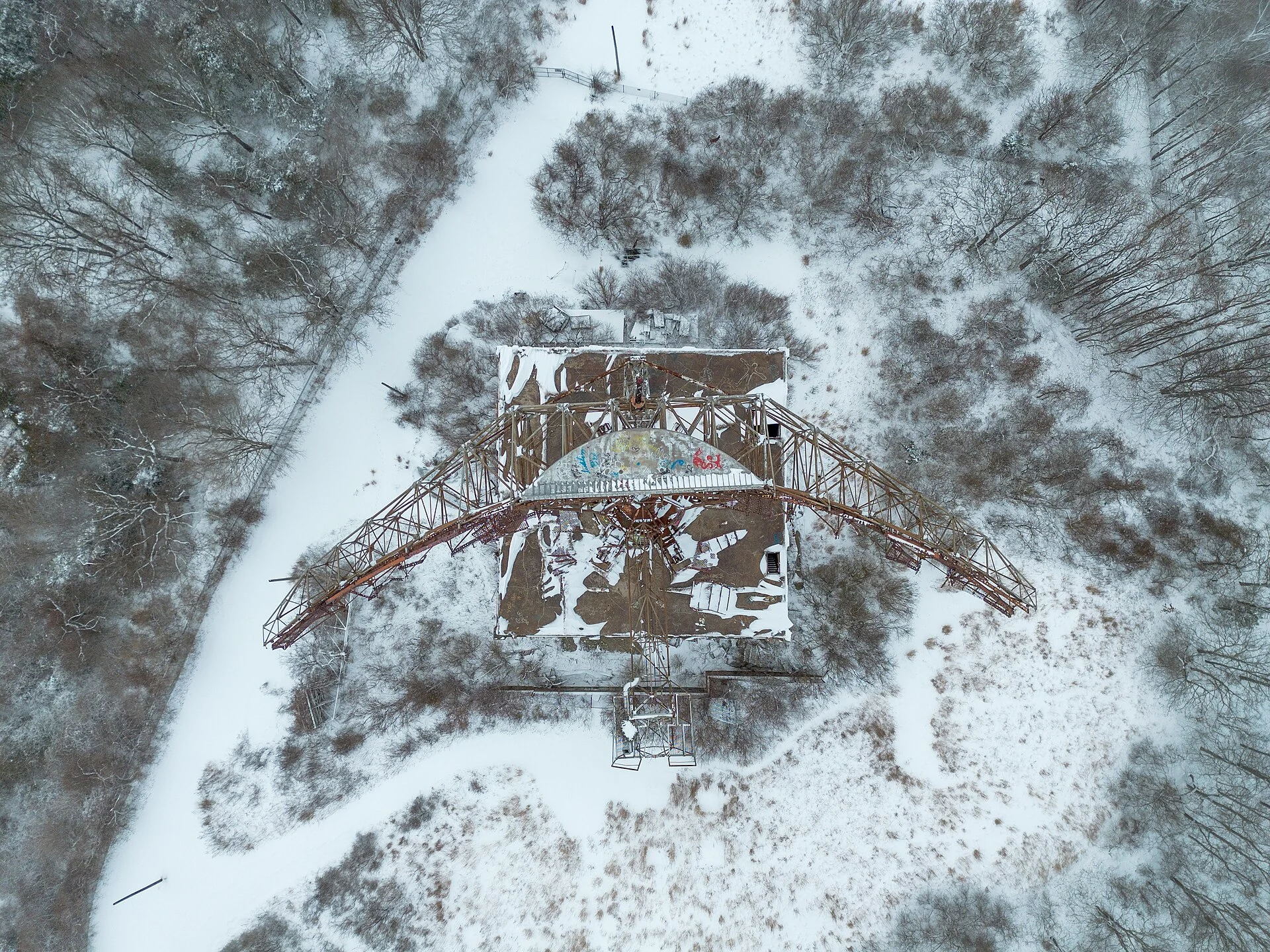
At the very tip of Long Island, where the land narrows to a windswept point and the Atlantic Ocean stretches to the horizon in every direction, stands a 415-acre park that carries more secrets than any state park in America. Camp Hero State Park in Montauk, New York, was a U.S. military installation for nearly half a century — first as a World War II coastal defense battery disguised as a fishing village, then as a Cold War Air Force radar station. When the military left in 1981, they left behind an otherworldly landscape of concrete bunkers, underground tunnels, barracks, and a massive AN/FPS-35 radar antenna tower that still looms over the eastern tip of Long Island like a sentinel from another era.
The mysterious history of the base spawned the “Montauk Project” conspiracy theories — tales of secret government experiments in time travel, mind control, and interdimensional portals. Those stories directly inspired the Duffer Brothers to create the Netflix series Stranger Things, which was originally titled “Montauk” and set at the base. Today, the park draws a fascinating mix of visitors: conspiracy enthusiasts snapping photos of the radar tower, surf fishermen chasing striped bass along some of the best shoreline on the East Coast, hikers exploring miles of bluff-top trails with panoramic ocean views, and history buffs examining the eerie remnants of a military past that most Americans never knew existed.
History: From Coastal Defense to Conspiracy
World War II: The Hidden Base
In 1942, with German U-boats prowling the waters off Long Island (and in one famous incident, landing saboteurs on a nearby beach), the U.S. Army established Camp Hero as a coastal defense installation. What made this base remarkable was its camouflage: the entire facility was disguised to look like a typical New England fishing village from the air. Gun batteries were hidden under fake buildings, the mess hall resembled a church, and barracks were designed to look like civilian houses. Battery 113 housed massive 16-inch guns capable of firing shells 25 miles out to sea — the same caliber used on battleships.
The Cold War: Radar Station and the AN/FPS-35
After the war, the Air Force took over the facility and established Montauk Air Force Station as part of the Semi-Automatic Ground Environment (SAGE) air defense network. The defining feature of this era was the AN/FPS-35 radar antenna, an enormous parabolic dish mounted on an 80-foot tower that could detect incoming Soviet bombers hundreds of miles away. The station was part of America’s first line of defense during the tensest years of the Cold War, operating continuously from the 1950s until its decommissioning in 1981.
The Montauk Project and Stranger Things
After the base closed, rumors began circulating about secret experiments allegedly conducted in underground facilities beneath the radar tower. The 1992 book The Montauk Project: Experiments in Time by Preston Nichols claimed that the base had hosted experiments involving electromagnetic mind control, teleportation, time travel, and contact with extraterrestrial life. While these claims have been thoroughly debunked by historians and scientists, they captured the public imagination and became a cornerstone of American conspiracy culture.
In 2015, the Duffer Brothers began developing a supernatural thriller series originally set at Camp Hero and titled “Montauk.” The show was eventually renamed Stranger Things and relocated to the fictional town of Hawkins, Indiana, but the core premise — a government laboratory conducting secret experiments that open a portal to another dimension — draws directly from the Montauk Project mythology. The connection has made Camp Hero a pilgrimage site for fans of the show, and the radar tower has become one of the most photographed structures on Long Island.
What to Do at Camp Hero State Park
1. Explore the Military Ruins
The remains of Camp Hero’s military infrastructure are scattered throughout the park and create an atmosphere unlike any other state park in America. While the buildings themselves are fenced off and closed to the public for safety reasons, you can observe them from the trails:
- AN/FPS-35 Radar Tower: The park’s iconic landmark, visible from multiple trail vantage points. The massive dish antenna sits atop an 80-foot concrete tower and is listed on the National Register of Historic Places
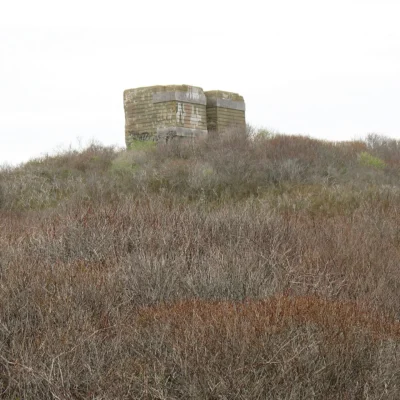
- Battery 113: The WWII gun emplacements that once housed 16-inch coastal defense guns. The massive concrete bunkers are partially visible from surrounding trails
- Barracks and Support Buildings: The disguised “village” structures, including the church-styled mess hall, are scattered throughout the wooded areas
- Underground Tunnels: While sealed from public access, the network of underground passages connecting various facilities adds to the base’s mysterious aura
| Military Feature | Era | Details |
|---|---|---|
| Battery 113 | WWII (1942) | 16-inch coastal defense guns, battleship caliber |
| AN/FPS-35 Radar | Cold War (1950s) | SAGE air defense network, National Register listed |
| Camouflage Village | WWII | Entire base disguised as fishing village from air |
| Underground Network | WWII-Cold War | Connecting tunnels, sealed from public access |
2. Hiking and Trail Exploration
Camp Hero features approximately 6 miles of trails that wind through maritime forests, open meadows, freshwater wetlands, and along dramatic coastal bluffs. The trail system connects to the adjacent Montauk Point State Park, creating opportunities for extended hikes.
| Trail | Distance | Difficulty | Highlights |
|---|---|---|---|
| Bluff Trail | 2.5 miles | Easy-Moderate | Ocean panoramas, lighthouse views, whale watching |
| Battery Loop | 1.5 miles | Easy | WWII bunkers, radar tower viewpoints |
| Paumanok Path Connection | Varies | Moderate | Links to 125-mile Long Island trail |
| Interior Forest Loop | 2 miles | Easy | Maritime forest, bird watching, deer |
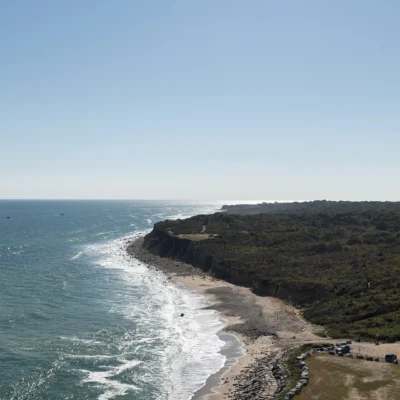
The Bluff Trail is the park’s signature experience, running along 50-foot cliffs above the Atlantic with unobstructed views of the ocean, the Montauk Point Lighthouse to the east, and — on clear days — Block Island and the Connecticut coast to the north. During fall and spring migrations, these bluffs are excellent for watching raptors, and in winter and early spring, gray whales and humpback whales can occasionally be spotted offshore.
3. Surf Fishing
Camp Hero is legendary among East Coast surf fishermen. The rocky shoreline, underwater structure from old military debris, and convergence of currents at the tip of Long Island create some of the most productive fishing on the Atlantic seaboard.
- Striped Bass: The primary target, with fish running from spring through fall. The fall run (September-November) brings trophy-sized fish exceeding 40 pounds
- Bluefish: Aggressive fighters available throughout summer and fall
- False Albacore: Fast-running tuna relatives that arrive in September and October
- 24-Hour Access: Anglers with a valid New York fishing permit can access the shoreline 24 hours a day, even when the park is otherwise closed
4. Wildlife and Nature
The park’s mix of habitats — maritime forest, grasslands, freshwater wetlands, coastal scrub, and shoreline — supports a remarkable diversity of wildlife for such a small area:
- Birding: Over 200 species recorded, including osprey, peregrine falcon, red-tailed hawk, and numerous songbird species during spring and fall migration
- Marine Life: Harbor seals haul out on nearby rocks in winter, and whales are visible offshore during migration periods
- White-tailed Deer: Common throughout the park, particularly at dawn and dusk
- Butterflies: Monarch butterfly migration staging area in September
Essential Visitor Information
| Detail | Information |
|---|---|
| Address | 1898 Montauk Highway, Montauk, NY 11954 |
| Hours | Sunrise to Sunset, year-round |
| Parking Fee | $10 (Memorial Day – Labor Day), free off-season |
| Annual Pass | Empire Pass $80/year (all NY state parks) |
| Camping | Not available (use nearby Hither Hills SP) |
| Pets | Allowed on leash (6 ft max) |
| Fishing | 24-hour access with valid NY permit |
| Swimming | Not permitted (strong currents) |
| Radar Tower Access | Fenced off — view from trails only |
Getting There
Camp Hero State Park is located at the eastern tip of Long Island, approximately 120 miles east of New York City. From the Long Island Expressway (I-495), take Exit 70 and follow Route 27 (Sunrise Highway/Montauk Highway) east to the very end. The park entrance is on the right, just before Montauk Point State Park and the lighthouse.
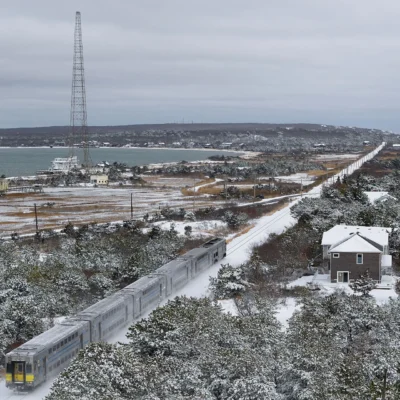
By Train: The Long Island Rail Road (LIRR) runs to Montauk station during summer season. From the station, Camp Hero is approximately 5 miles east — a taxi or ride-share is recommended. Some visitors bike the distance along the shoulder of Route 27.
Best Time to Visit
| Season | Highlights | Crowd Level |
|---|---|---|
| Spring (Apr-May) | Wildflowers, bird migration, mild weather | Low |
| Summer (Jun-Aug) | Warm trails, full facilities, fishing | High |
| Fall (Sep-Nov) | Trophy fishing, hawk migration, foliage | Moderate |
| Winter (Dec-Mar) | Harbor seals, solitude, dramatic storms | Very Low |
Fall is widely considered the best time to visit Camp Hero. The summer crowds have thinned, the light is golden and dramatic for photography, the striped bass run is at its peak, and the park’s military ruins take on an especially atmospheric quality against autumn skies. The radar tower photographed against a dramatic October sunset is one of the most iconic images on Long Island.
Nearby Attractions
- Montauk Point Lighthouse: 0.5 miles east — the oldest lighthouse in New York State (1796), museum and tower climbs available
- Hither Hills State Park: 8 miles west — oceanfront camping (168 sites), Walking Dunes, beach access
- Montauk Village: 5 miles west — restaurants, shops, fishing charter boats, nightlife
- Shadmoor State Park: 3 miles west — WWII bunkers on 99-foot bluffs, nature trails
- Deep Hollow Ranch: 4 miles west — oldest cattle ranch in the U.S. (1658), horseback riding on the beach
Frequently Asked Questions
Is Camp Hero State Park really where Stranger Things is based?
Yes and no. The Netflix series Stranger Things was originally titled “Montauk” and directly inspired by conspiracy theories about secret government experiments at Camp Hero Air Force Station. The Duffer Brothers relocated the story to fictional Hawkins, Indiana, but the core premise — a government lab opening a portal to another dimension — is drawn from the “Montauk Project” mythology associated with this base.
Can you go inside the radar tower at Camp Hero?
No. The AN/FPS-35 radar tower and all former military buildings at Camp Hero are fenced off and closed to the public for safety reasons. You can view and photograph the radar tower from multiple trail vantage points throughout the park, but entering the restricted areas is prohibited.
Is camping available at Camp Hero State Park?
No, Camp Hero is a day-use park only. The nearest camping is at Hither Hills State Park, approximately 8 miles west, which offers 168 oceanfront campsites. Reservations can be made through ReserveAmerica up to 9 months in advance, and summer weekends sell out quickly.
Is surf fishing good at Camp Hero?
Camp Hero is considered one of the best surf fishing locations on the entire East Coast. The rocky shoreline and converging currents at Long Island’s tip create exceptional conditions for striped bass, bluefish, and false albacore. Anglers with a valid New York fishing permit have 24-hour access to the shoreline year-round, even when the park is otherwise closed. The fall striped bass run (September–November) is legendary, with trophy fish regularly exceeding 40 pounds.
How do I get to Camp Hero from New York City?
Camp Hero is approximately 120 miles east of NYC. By car, take the Long Island Expressway (I-495) to Exit 70, then Route 27 (Montauk Highway) east to the end — the drive takes about 2.5–3 hours depending on traffic. In summer, the LIRR runs trains to Montauk station, from which the park is a 5-mile taxi ride east. Expect heavy traffic on summer weekends — departing early (before 7 AM) or visiting on weekdays is strongly recommended.
More parks nearby: Montauk Point State Park is a short drive away, while Shadmoor State Park lies a short drive away.

🐾 Dogs & Pets at Camp Hero State Park
- Pets allowed? statewide rule
- Pets are permitted in most state parks and campgrounds (maximum two pets per site where allowed), but policies vary by park and some parks prohibit pets entirely.
- Leash rule statewide rule
- Leash no longer than 6 ft required, pet under control at all times
- Beaches & swim areas statewide rule
- Pets are not permitted on guarded beaches, boardwalks, pools or spray-grounds
- Cabins & lodging statewide rule
- No uniform statewide rule — pets are prohibited in buildings and most cabins, but some parks designate pet-friendly cabin areas (e.g. Letchworth Cabin Area C); check with the individual park
- Statewide exceptions statewide rule
- Proof of rabies vaccination required upon request; maximum two pets per campsite; some parks (e.g. Wildwood State Park) do not allow pets at all
Are dogs allowed at Camp Hero State Park?
Pets are permitted in most state parks and campgrounds (maximum two pets per site where allowed), but policies vary by park and some parks prohibit pets entirely. Individual parks can post stricter rules — check signage on arrival.
Rules verified July 2026 via parks.ny.gov. More: New York state parks guide · Dog rules in all 50 states compared
Park Location
Plan your gear for Camp Hero State Park
From our editorial guides, matched to this park’s activities:
Top Tours & Activities Near Mystic
 from $100from $75
 from $59