🌤 Weather at Fremont Indian State Park and Museum by season
| Spring | Summer | Fall | Winter |
|---|---|---|---|
| 22–71 °F | 43–90 °F | 19–80 °F | 12–46 °F |
Each range runs from the coldest monthly average low to the warmest monthly average high in that season (1991-2020 climate normals), measured at Fremont Indian State Park, 0 mi away, elevation 5,920 ft. Conditions at the park can differ from the station, especially where elevation differs — check a forecast before you go.

🏺 Ancient Voices in the Canyon — The largest Fremont Indian archaeological site ever discovered, hundreds of rock art panels, a world-class museum, Dark Sky certified stargazing, and 15 hiking trails through Clear Creek Canyon in central Utah
Hidden in the twisting depths of Clear Creek Canyon along Interstate 70 in central Utah, Fremont Indian State Park protects the largest known Fremont Indian village ever excavated — a site that fundamentally changed our understanding of the ancient peoples who inhabited the Great Basin and Colorado Plateau for over 1,000 years. When highway construction crews cut through Clear Creek Canyon in the 1980s, they uncovered an extraordinary archaeological treasure: the remnants of Five Finger Ridge Village, a community of over 100 structures occupied between approximately 400 and 1300 AD, along with thousands of artifacts and hundreds of rock art panels scattered across the canyon walls.
Today, Fremont Indian State Park preserves this legacy with a museum housing one of the finest collections of Fremont artifacts in the world, miles of interpretive hiking trails that wind past petroglyphs and pictographs pecked and painted onto canyon walls centuries ago, two campgrounds nestled in the canyon, and some of the darkest, most pristine night skies in Utah — the park is a certified International Dark Sky Park. It is the rare place where you can walk a trail in the morning studying 1,000-year-old rock art, spend the afternoon exploring a museum of ancient tools and pottery, and end the day watching the Milky Way blaze across a sky unmarred by light pollution.
The Fremont People
The Fremont culture occupied much of present-day Utah from approximately 400 AD to 1300 AD, overlapping in time with the better-known Ancestral Puebloan (Anasazi) cultures farther south. Unlike the Ancestral Puebloans, who built large stone dwellings, the Fremont people lived in a mix of pit houses (semi-subterranean structures) and surface structures, and their lifestyle blended farming (corn, beans, squash) with continued hunting and gathering. They are distinguished by their unique pottery styles, distinctive moccasins made from the leg hides of large animals, and an extraordinarily rich tradition of rock art.
Five Finger Ridge Village
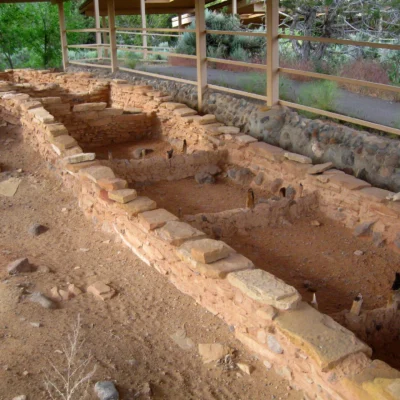
The village site discovered during I-70 construction contained over 100 structures — pit houses, granaries, and surface dwellings — making it the largest Fremont village ever found. Archaeologists recovered thousands of artifacts including pottery, tools, jewelry, and gaming pieces that are now displayed in the park museum. The village’s size suggests a significant, sustained community that thrived in the canyon’s protected microclimate for centuries.
Rock Art
The canyon walls of Clear Creek hold hundreds of individual rock art panels — both petroglyphs (images pecked into the rock surface) and pictographs (images painted onto the rock). These panels represent one of the densest concentrations of Fremont-era rock art in Utah.
| Rock Art Site | Access | Notable Features |
|---|---|---|
| Parade of Rock Art | 0.3-mile paved loop behind Visitor Center | Multiple panels, Paiute Creation Story panel |
| Court of Ceremonies | Short trail from campground | Large ceremonial panel, anthropomorphic figures |
| Five Finger Ridge | Moderate trail hike | Village overlook, scattered petroglyphs |
| Canyon Wall Panels | Various trails throughout canyon | Hunting scenes, bighorn sheep, abstract symbols |
Etiquette: Never touch, trace, or chalk rock art. The oils from human skin accelerate deterioration, and these images have survived for 700-1,000+ years only because they were left undisturbed. View and photograph from the trail — never climb to reach panels.
Hiking Trails
| Trail | Distance | Difficulty | Highlights |
|---|---|---|---|
| Parade of Rock Art | 0.3 mi | Easy (paved) | Petroglyph panels, ADA accessible |
| Discovery Trail | 0.5 mi | Easy | Canyon views, rock art |
| Centennial Trail | 1.1 mi | Easy | Canyon bottom walk, cottonwoods |
| Canyon of Wild Roses | 1.5 mi | Moderate | Side canyon, seasonal wildflowers |
| Rim Overlook Trail | 2.0 mi | Moderate | Canyon rim views, high desert landscape |
| Five Finger Ridge | 1.5 mi | Moderate | Village site overlook, petroglyphs |
Museum and Visitor Center
The park museum houses one of the most comprehensive collections of Fremont Indian artifacts in the world, including pottery, stone tools, bone implements, jewelry, figurines, and gaming pieces recovered from the Five Finger Ridge excavation. A reconstructed pithouse on the grounds demonstrates how the Fremont people built and lived in these semi-underground dwellings.
Note (2026): The museum interior exhibits are currently closed for renovations and exhibit development. The visitor center, gift shop, art gallery, and all outdoor areas (trails, rock art sites, campgrounds) remain fully open. Check with the park for reopening updates.
Dark Sky Stargazing
Fremont Indian State Park is a certified International Dark Sky Park — one of a handful of state parks in the US with this prestigious designation. The park’s location in a remote canyon, far from major cities, produces exceptionally dark and transparent skies. On moonless nights, the Milky Way stretches in brilliant detail from horizon to horizon, and thousands of stars are visible to the naked eye.
Camping
| Campground | Sites | Features |
|---|---|---|
| Sam Stowe Campground | 31 | Water, electric, fire rings, restrooms, showers |
| Castle Rock Campground | 31 | Water, electric, fire rings, restrooms |
Essential Visitor Information
| Detail | Information |
|---|---|
| Address | 3820 Clear Creek Canyon Rd, Sevier, UT 84766 |
| Hours | 9 AM–5 PM daily (summer), Mon-Sat (winter) |
| Day-Use Fee | $5 per vehicle |
| Camping | $20-$30/night |
| Phone | (435) 527-4631 |
Getting There
The park is located in Clear Creek Canyon, 21 miles southwest of Richfield, Utah, directly off Interstate 70 (Exit 17).
- From Salt Lake City: 180 miles south (~2.5 hours via I-15 and I-70)
- From Capitol Reef NP: 75 miles west (~1.5 hours)
- From Bryce Canyon NP: 100 miles northeast (~2 hours)
Best Time to Visit
| Season | Highlights | Crowd Level |
|---|---|---|
| Spring (Apr-May) | Wildflowers, mild canyon temps, stargazing | Low |
| Summer (Jun-Aug) | Full access, museum programs, camping | Moderate |
| Fall (Sep-Oct) | Cool temps, golden cottonwoods, Milky Way core | Low-Moderate |
| Winter (Nov-Mar) | Solitude, snow-dusted art panels, dark skies | Very Low |
Nearby Attractions
- Capitol Reef National Park: 75 miles east — Waterpocket Fold, scenic drives, petroglyphs
- Fishlake National Forest: Nearby — Pando aspen grove (world’s largest organism)
- Big Rock Candy Mountain: 15 miles south — colorful geological formation, hot springs
- Richfield: 21 miles — services, dining, lodging
Wildlife & Nature
Fremont Indian SP — preserves the largest known Fremont Indian village — the Five Finger Ridge Village — discovered during I-70 construction in the 1980s. Over 500 rock art panels (petroglyphs and pictographs) line Clear Creek Canyon. The park’s canyon, pinyon-juniper forest, and cliffs support mule deer, golden eagles, and mountain lions.
Frequently Asked Questions
What is the Fremont Indian culture?
The Fremont culture inhabited much of present-day Utah from approximately 400 AD to 1300 AD. They lived in pit houses and surface structures, farmed corn, beans, and squash while continuing to hunt and gather, and left behind an extraordinary legacy of rock art — petroglyphs and pictographs — on canyon walls throughout Utah. The culture is named after the Fremont River, where artifacts were first identified. Fremont Indian State Park preserves the largest Fremont village ever discovered.
Can you see petroglyphs at Fremont Indian State Park?
Yes! The park contains hundreds of rock art panels — both petroglyphs (pecked into rock) and pictographs (painted). The easiest access is the Parade of Rock Art, a 0.3-mile paved loop directly behind the Visitor Center. Additional panels are scattered along trails throughout the canyon. Never touch the rock art — oils from skin damage these ancient images.
Is Fremont Indian State Park a Dark Sky Park?
Yes! Fremont Indian State Park is a certified International Dark Sky Park. Its remote canyon location produces exceptionally dark skies — perfect for stargazing. On clear, moonless nights, the Milky Way is brilliantly visible. The campgrounds provide excellent vantage points, and the park occasionally hosts stargazing events with telescopes.
More parks nearby: Territorial Statehouse State Park Museum is within about an hour’s drive.

🐾 Dogs & Pets at Fremont Indian State Park and Museum
- Pets allowed? statewide rule
- Pets are permitted at most Utah state parks and campgrounds, on a leash and never left unattended.
- Leash rule statewide rule
- 6 ft maximum leash required at all times
- Beaches & swim areas statewide rule
- No statewide beach ban; rules vary by park - dogs are prohibited on the beach at Antelope Island, while Jordanelle has a designated area where dogs may swim off-leash
- Cabins & lodging statewide rule
- Pets are allowed in cabins and yurts at most parks (confirm with the park before reserving); additional lodging pet fees may apply
- Pet fees statewide rule
- No pet fee at standard campsites; additional fees apply for pets in cabins, yurts and cottages
- Statewide exceptions statewide rule
- Park-specific restrictions such as Antelope Island's Frary Peak Trail and Deer Creek water areas
Are dogs allowed at Fremont Indian State Park and Museum?
Pets are permitted at most Utah state parks and campgrounds, on a leash and never left unattended. Individual parks can post stricter rules — check signage on arrival.
Rules verified July 2026 via stateparks.utah.gov. More: Utah state parks guide · Dog rules in all 50 states compared
Park Location
Plan your gear for Fremont Indian State Park and Museum
From our editorial guides, matched to this park’s activities:
Top Tours & Activities Near Bryce Canyon National Park
 from $160
 from $699
 from $973