
🌤 Weather at Hart-Montague Trail State Park by season
| Spring | Summer | Fall | Winter |
|---|---|---|---|
| 25–67 °F | 53–79 °F | 32–72 °F | 19–35 °F |
Each range runs from the coldest monthly average low to the warmest monthly average high in that season (1991-2020 climate normals), measured at Montague 4 NW, 7 mi away, elevation 650 ft. Conditions at the park can differ from the station, especially where elevation differs — check a forecast before you go.

Overview: Michigan’s First Paved Rail-Trail
Running 22 miles through the scenic rural heartland of western Michigan’s Oceana and Muskegon counties, the William Field Memorial Hart-Montague Trail State Park holds a distinguished place in Michigan recreation history as one of the very first “rails-to-trails” conversions in the state. Established in 1988, the trail follows the abandoned corridor of the former Chicago & West Michigan Railroad, generously donated by local benefactor Bill Field. Today, the fully paved, asphalt-surfaced trail is widely regarded as one of the finest and most accessible cycling paths in the Lower Peninsula.
What sets the Hart-Montague Trail apart from many of Michigan’s other rail-trails is its consistently excellent surface quality. The entire 22-mile length is paved with smooth asphalt, making it suitable for road bikes, inline skates, strollers, and wheelchairs—a rarity among Michigan’s extensive trail network, where crushed limestone and gravel surfaces are far more common. Combined with the gentle, nearly flat railroad grade and the picturesque landscape of orchards, farmland, and hardwood forests, the Hart-Montague Trail delivers an exceptionally polished, comfortable riding experience.
The Legacy of Bill Field
The trail’s official name—William Field Memorial—honors the visionary local landowner and conservationist who donated the abandoned railroad right-of-way to the State of Michigan specifically for conversion into a public trail. At a time when the rails-to-trails concept was still relatively new and untested in Michigan, Field’s donation was a bold, forward-thinking act that established a template for dozens of subsequent trail conversions across the state. Without his generosity, this scenic corridor would likely have been fragmented into private parcels and lost forever to public access.
The Route: Hart to Montague
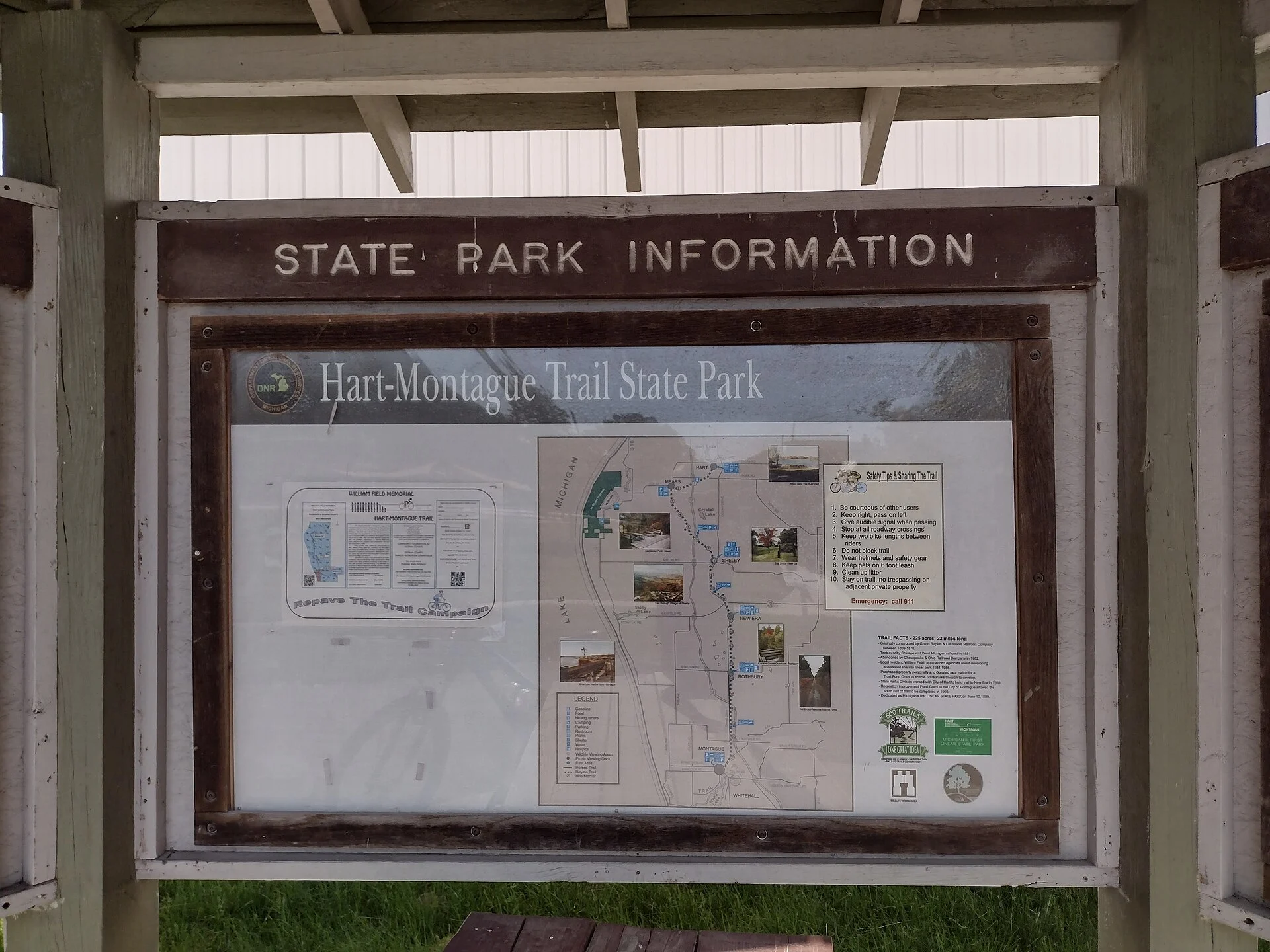
The trail runs generally north-to-south, connecting the city of Hart in Oceana County to the city of Montague in Muskegon County. Along the way, it passes through or near several small communities that provide rest stops, refreshments, and local character.
Hart (Northern Terminus)
The trail begins at John Gurney Park in Hart, a pleasant municipal park with parking, restrooms, and picnic facilities. Hart is the county seat of Oceana County, known for its position in the heart of Michigan’s asparagus-growing region. The town offers basic services including restaurants and convenience stores within easy reach of the trailhead.
Mears and Silver Lake
South of Hart, the trail passes near the community of Mears, gateway to the famous Silver Lake Sand Dunes. While the dunes themselves are not directly on the trail, a short detour provides access to one of Michigan’s most dramatic natural landscapes—a massive expanse of open sand dunes bordering Lake Michigan where off-road vehicles and dune buggies share the terrain with hikers and swimmers.
Shelby
The small agricultural village of Shelby sits roughly at the trail’s midpoint and makes an ideal turnaround or rest stop for riders not attempting the full 22-mile one-way trip. The village features a few local eateries and the surrounding countryside is dominated by cherry and apple orchards that create spectacular spring blossom displays.
New Era and Rothbury
Continuing south, the trail passes through the tiny communities of New Era and Rothbury. Rothbury is notable as the home of the Double JJ Resort and the site of the annual Electric Forest music festival, one of the largest electronic music events in the Midwest. During festival weekends, the trail and surrounding roads experience significantly increased traffic.
Montague (Southern Terminus)
The trail’s southern end arrives in Montague, a charming community on the White Lake Channel near Lake Michigan. Montague is home to the world’s largest weathervane—a massive 48-foot structure featuring a replica of a Great Lakes schooner—and offers waterfront dining, shops, and access to the White Lake area’s beaches and boating facilities.
Trail Surface and Accessibility
The Hart-Montague Trail’s fully paved asphalt surface is its single greatest asset. The pavement is maintained in generally excellent condition, with periodic resurfacing ensuring a smooth, crack-free ride. The consistently flat grade—never exceeding the gentle inclines characteristic of former railroad corridors—makes the trail genuinely accessible to riders of virtually all ages and fitness levels, from young children on training wheels to elderly cyclists on comfort bikes.
The paved surface also makes the Hart-Montague Trail one of the few Michigan trails that is genuinely accessible to wheelchair users and visitors using adaptive cycling equipment for the full length of the corridor.
The Agricultural Landscape
The western Michigan countryside through which the Hart-Montague Trail passes is one of the most agriculturally productive regions in the state. The lake-moderated climate creates ideal growing conditions for a remarkable diversity of fruit crops.
- Asparagus: Oceana County is one of the top asparagus-producing counties in the nation. In late April and May, the fields flanking the trail are actively harvested.
- Cherries and Apples: The orchards surrounding Shelby and New Era produce cherries (both tart and sweet varieties) and apples. The spring blossom season (typically late April through mid-May) transforms the trail corridor into a fragrant, pink-and-white tunnel.
- Christmas Trees: Michigan is a leading producer of Christmas trees, and numerous tree farms are visible from the trail, their perfectly symmetrical rows of fraser fir and blue spruce creating distinctive geometric patterns across the rolling landscape.
Seasonal Guide
Spring (April–May)
Fruit tree blossom season makes spring the most visually spectacular time on the Hart-Montague Trail. The orchards flanking the route create tunnels of delicate pink and white flowers. Trail surfaces are clean and dry after winter maintenance.
Summer (June–August)
Peak season. Long daylight hours, warm temperatures, and the proximity to Lake Michigan beaches make summer the most popular riding period. Expect increased traffic on weekends, particularly the section nearest to South Haven and Montague.
Autumn (September–October)
The hardwood forests along the corridor produce beautiful fall color. The apple and cherry harvest is underway, and several roadside farm stands near the trail offer fresh produce and cider. Cooler temperatures and thinner crowds make autumn ideal for longer rides.
Winter (November–March)
The trail is open for snowmobiling from December 1 to March 31 on designated sections. Cross-country skiing and fat-tire biking are possible but the paved surface may be snow-covered and icy. Winter conditions are not maintained for non-motorized use.
Practical Information
Vehicle Pass
A Michigan Recreation Passport ($15 residents, $42 non-residents) or daily pass is required for parking at designated trailheads.
Bike Rentals
Several outfitters in the Montague and Silver Lake areas offer bike rentals during the summer season.
Frequently Asked Questions
Is the entire Hart-Montague Trail paved? Yes. The full 22-mile length is paved with asphalt, making it one of the few fully paved state park trails in Michigan. Road bikes, inline skates, strollers, and wheelchairs can use the entire trail.
Is the trail flat? Essentially yes. As a former railroad corridor, the grade is extremely gentle throughout. There are no significant hills. This makes it highly accessible for riders of all fitness levels.
Can I ride from the Hart-Montague Trail to the beach? The trail itself does not terminate directly at a Lake Michigan beach. However, from the Montague trailhead, it is a short ride to White Lake and nearby beach access. From Mears (near the midpoint), a detour leads to Silver Lake and its famous sand dunes.
Are there restrooms along the trail? Restrooms are available at the Hart trailhead (John Gurney Park) and at several communities along the route. The more remote mid-trail sections do not have facilities.
Are dogs allowed? Dogs are permitted on leash. Owners must clean up after pets.
Wildlife & Nature
Hart-Montague Trail — a 22.5-mile paved rail-trail through western Michigan — passes through farmland and forest. White-tailed deer and wild turkeys frequent the corridor. Red-tailed hawks hunt from perches along the trail.
Nearby Attractions
Silver Lake Sand Dunes — near Hart. Montague — southern terminus. Pentwater — 10 miles north.
Keep exploring: The closest neighbors are Duck Lake State Park (a short drive away) and Charles Mears State Park (within about an hour’s drive).
Camping reservations: Book campsites and cabins for Michigan state parks online at midnrreservations.com.

🐾 Dogs & Pets at Hart-Montague Trail State Park
- Pets allowed? statewide rule
- Pets are welcome in Michigan state parks, campgrounds, harbors and state-designated trails, except designated swim beaches and other posted areas.
- Leash rule statewide rule
- Pets must always be on a 6-foot leash and under the owner's immediate control.
- Beaches & swim areas statewide rule
- Pets are prohibited in buoyed swim areas but allowed along the shoreline outside them (on a 6-ft leash, even in the water); 50+ parks have pet-friendly shoreline or designated dog beaches.
- Cabins & lodging statewide rule
- Up to two pets (cats and dogs only) allowed at ~12 parks' designated pet-friendly cabins, yurts and lodges; $10 per night per pet (cabins) or $15 (lodges); otherwise pets barred from overnight lodging.
- Pet fees statewide rule
- No day-use pet fee; pet-friendly lodging costs $10/night per pet (cabins) or $15/night per pet (lodges).
- Statewide exceptions statewide rule
- Leash laws do not apply to dogs used for hunting on land open to such use; pets may not be left unattended.
Are dogs allowed at Hart-Montague Trail State Park?
Pets are welcome in Michigan state parks, campgrounds, harbors and state-designated trails, except designated swim beaches and other posted areas. Individual parks can post stricter rules — check signage on arrival.
Rules verified July 2026 via michigan.gov. More: Michigan state parks guide · Dog rules in all 50 states compared
Park Location
Plan your gear for Hart-Montague Trail State Park
From our editorial guides, matched to this park’s activities:


Top Tours & Activities Near Grand Rapids
 from $36
 from $24
 from $80