🌤 Weather at Lakeport State Park by season
| Spring | Summer | Fall | Winter |
|---|---|---|---|
| 24–63 °F | 55–78 °F | 32–72 °F | 16–35 °F |
Each range runs from the coldest monthly average low to the warmest monthly average high in that season (1991-2020 climate normals), measured at Lexington Wtp, 10 mi away, elevation 622 ft. Conditions at the park can differ from the station, especially where elevation differs — check a forecast before you go.

Overview: Lake Huron Shoreline and the Port Huron Statement
Stretching across 565 acres along the Lake Huron shoreline in St. Clair County—approximately 10 miles north of Port Huron—Lakeport State Park provides a substantial outdoor recreation destination for the communities at the base of Michigan’s Thumb region. The park is divided into two distinct units (north and south) separated by the village of Lakeport and connected by a pedestrian overpass over M-25, offering over a mile of Lake Huron shoreline, 250 modern campsites, and a surprisingly significant piece of American political history embedded in its origins.
The southern unit of the park was formerly a United Auto Workers (UAW) retreat—one of the labor union’s educational facilities where, in June 1962, a group of student activists led by Tom Hayden completed the “Port Huron Statement,” widely regarded as the founding manifesto of the American New Left and one of the most influential political documents of the 1960s counterculture. Today, most visitors come for the beach and camping rather than political history, but the connection adds an unexpected layer of cultural significance.
Lake Huron Shoreline
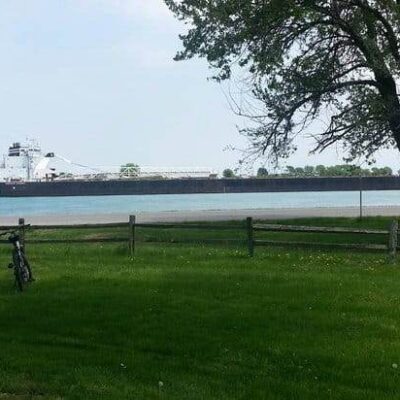
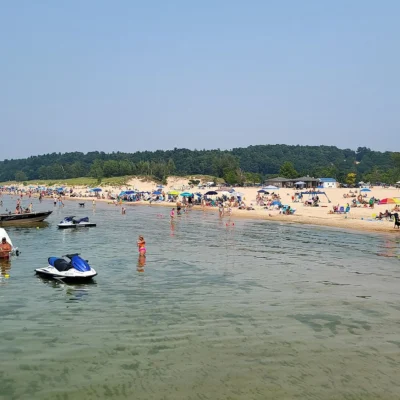
Lakeport’s mile-plus Lake Huron shoreline is characteristically rocky—a mix of sand, gravel, and cobblestone typical of this section of the Lake Huron coast. Water shoes are recommended for comfortable entry, though sandy sections exist. The lake offers warm summer swimming temperatures by late June, and the east-facing shoreline provides beautiful sunrise views.
- Buoyed Swimming Area: A designated swimming zone with seasonal lifeguard coverage
- Rockhounding: The rocky shoreline produces Petoskey stones, fossils, and interesting geological specimens
- Sunrise: The east-facing orientation makes this a rare Michigan state park for sunrise—rather than sunset—watching
250 Campsites: Two Units
North Campground
The larger of the two campgrounds, with modern sites featuring electrical hookups, picnic tables, fire rings, modern restrooms with showers, a camp store, and playground facilities. Pull-through sites accommodate large RVs.
South Campground
The former UAW retreat property, now a campground with its own character. Modern amenities in a slightly different setting from the north unit.
Cabins
Mini cabins and camper cabins provide sheltered overnight options for visitors who prefer a roof without the full hotel experience.
The Port Huron Statement Connection
In June 1962, approximately 60 student activists gathered at the UAW’s Port Huron retreat (now the park’s south unit) for the founding convention of Students for a Democratic Society (SDS). The 25,700-word “Port Huron Statement” drafted during this meeting—principally by Tom Hayden—articulated a vision of “participatory democracy” that became the intellectual foundation for the 1960s student movement, anti-war activism, and the broader New Left. While no formal historical markers currently interpret this history within the park, the connection remains significant for anyone interested in the intersection of place and political history.
Seasonal Guide
Spring (April–May)
Campground opens. Lake Huron cold. Rocky shoreline at its best for rockhounding after winter storms.
Summer (June–August)
Peak season. Swimming, camping, sunrise watching. Reserve well in advance for weekends.
Autumn (September–October)
Fall color. Lake Huron still swimmable through mid-September. Campground quieter. Sunrise colors intensified by autumn atmospheric conditions.
Winter (November–March)
Day-use area typically closed. Winter beach walks. Ice formations along the rocky shoreline.
Frequently Asked Questions
What is the Port Huron Statement? A 1962 political manifesto drafted at a UAW retreat on the park’s current south unit, regarded as the founding document of the American New Left. It was principally authored by Tom Hayden during an SDS convention held at the site.
Is the beach sandy? Partially. The shoreline is characteristically rocky with sand, gravel, and cobblestone sections. Water shoes are recommended for comfortable entry.
Can I see Petoskey stones here? Yes. The rocky Lake Huron shoreline yields fossils and interesting geological specimens for beachcombers.
Wildlife & Nature
Lakeport SP — on Lake Huron in the Thumb region — has a sandy beach and forested campground. Bald eagles and osprey fish along the shoreline. Monarch butterflies stage for migration along the lake. Walleye and perch are caught from the shore.
Nearby Attractions
Port Huron — 15 miles south — has the Blue Water Bridge to Canada. Lexington — 10 miles north — has the charming harbor town. Fort Gratiot Lighthouse — 10 miles south — is Michigan’s oldest lighthouse.
Make it a road trip: Pair a visit with W.C. Wetzel State Recreation Area (within about an hour’s drive) or Algonac State Park (within about an hour’s drive).

🐾 Dogs & Pets at Lakeport State Park
- Pets allowed? statewide rule
- Pets are welcome in Michigan state parks, campgrounds, harbors and state-designated trails, except designated swim beaches and other posted areas.
- Leash rule statewide rule
- Pets must always be on a 6-foot leash and under the owner's immediate control.
- Beaches & swim areas statewide rule
- Pets are prohibited in buoyed swim areas but allowed along the shoreline outside them (on a 6-ft leash, even in the water); 50+ parks have pet-friendly shoreline or designated dog beaches.
- Cabins & lodging statewide rule
- Up to two pets (cats and dogs only) allowed at ~12 parks' designated pet-friendly cabins, yurts and lodges; $10 per night per pet (cabins) or $15 (lodges); otherwise pets barred from overnight lodging.
- Pet fees statewide rule
- No day-use pet fee; pet-friendly lodging costs $10/night per pet (cabins) or $15/night per pet (lodges).
- Statewide exceptions statewide rule
- Leash laws do not apply to dogs used for hunting on land open to such use; pets may not be left unattended.
Are dogs allowed at Lakeport State Park?
Pets are welcome in Michigan state parks, campgrounds, harbors and state-designated trails, except designated swim beaches and other posted areas. Individual parks can post stricter rules — check signage on arrival.
Rules verified July 2026 via michigan.gov. More: Michigan state parks guide · Dog rules in all 50 states compared
Park Location
Plan your gear for Lakeport State Park
From our editorial guides, matched to this park’s activities: