
🌤 Weather at Deception Pass State Park by season
| Spring | Summer | Fall | Winter |
|---|---|---|---|
| 40–62 °F | 52–70 °F | 41–67 °F | 37–51 °F |
Each range runs from the coldest monthly average low to the warmest monthly average high in that season (1991-2020 climate normals), measured at Whidbey Island Nas, 3 mi away, elevation 47 ft. Conditions at the park can differ from the station, especially where elevation differs — check a forecast before you go.

🌊 Washington’s Most-Visited State Park — Over 3 million annual visitors, an iconic 1935 bridge spanning a dramatic tidal narrows with whirlpool currents, 38+ miles of trails through old-growth forest, 300+ campsites across 3 campgrounds, tide pools at Rosario Beach, and whale-watching opportunities between Fidalgo and Whidbey Islands
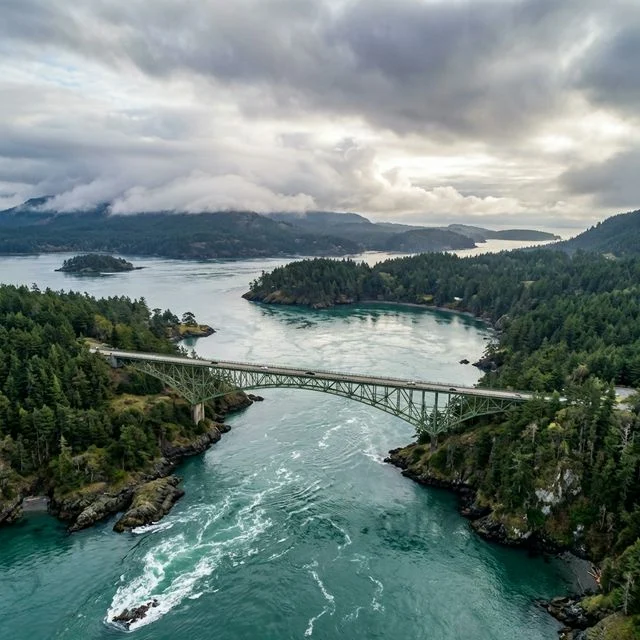
Where the waters of the Strait of Juan de Fuca collide with Skagit Bay in a violent, churning narrows between two of Washington’s most beautiful islands, a 1935 steel bridge arches 180 feet above the chaos — and below it, one of the most dramatic tidal phenomena on the Pacific Coast plays out twice daily. Deception Pass State Park is Washington’s most-visited state park, drawing over 3 million visitors annually to a landscape that compresses an astonishing diversity of Pacific Northwest ecosystems into 4,134 acres spanning both Fidalgo Island and Whidbey Island.
The park’s centerpiece is the Deception Pass Bridge, built by the Civilian Conservation Corps in 1935 — a National Historic Place that remains one of the most photographed structures in Washington State. From the pedestrian walkways, visitors look straight down into the narrows where tidal currents can exceed 8 knots, creating standing waves and whirlpool patterns that have swallowed boats and commanded respect from mariners since Captain George Vancouver named the pass in 1792 after realizing what he’d thought was a peninsula was actually an island.
But Deception Pass is far more than a bridge viewpoint. The park encompasses 38+ miles of hiking and biking trails winding through old-growth Douglas fir forests, along wave-battered sea cliffs, around freshwater Cranberry Lake, and down to tide pool beaches where sea stars, anemones, and hermit crabs populate the intertidal zone. Three campgrounds provide over 300 sites for tents and RVs. Bald eagles nest in the old-growth canopy. Harbor seals haul out on the rocks below the bridge. And from late spring through fall, orca whales are spotted in the waters offshore — making this one of the most ecologically rich state parks in the Pacific Northwest.
The Bridge and the Pass
| Feature | Details |
|---|---|
| Bridge | Deception Pass Bridge — built 1935 by CCC |
| Height | 180 feet above the water |
| Listing | National Register of Historic Places |
| Tidal Currents | Up to 8+ knots — standing waves, whirlpools |
| Pedestrian Access | Sidewalks on both sides — walk across for views |
| Named By | Captain George Vancouver, 1792 |
Campgrounds — 300+ Sites
| Campground | Location | Best For | Notes |
|---|---|---|---|
| Cranberry Lake | Whidbey Island | Largest, most popular | Near freshwater lake, beach access |
| Bowman Bay | Fidalgo Island | Quieter, more secluded | Near CCC Interpretive Center |
| Quarry Pond | Fidalgo Island | RVs, year-round | Open all seasons |
Reservations: Highly recommended — book up to 9 months in advance through Washington State Parks. Summer weekends sell out months ahead.
Trails — 38+ Miles
| Trail | Distance | Difficulty | Highlights |
|---|---|---|---|
| Rosario Head Trail | 0.5 miles | Easy | Tide pools, sea life, ocean views |
| Lighthouse Point Trail | 1.5 miles RT | Moderate | Bridge views, rocky coastline |
| Goose Rock Summit | 3.5 miles RT | Moderate-Strenuous | Highest point — panoramic 360° views |
| North Beach Trail | Varies | Easy | Sandy beach, driftwood, sunset views |
| Cranberry Lake Loop | 2 miles | Easy | Freshwater lake, forest canopy |
Wildlife
- Bald Eagles: Nesting pairs in old-growth canopy — frequently seen soaring above the bridge
- Harbor Seals: Haul out on rocks below the bridge and along Bowman Bay
- Orca Whales: Spotted from headlands (late spring through fall) — Southern Resident and transient pods
- Tide Pool Life: Sea stars, anemones, hermit crabs, chitons (Rosario Beach)
- Shorebirds: Great blue herons, cormorants, oystercatchers
Beaches
| Beach | Type | Best For |
|---|---|---|
| West Beach | Sandy, driftwood | Sunset views, beachcombing |
| North Beach | Sandy | Swimming (cold!), picnics |
| Rosario Beach | Rocky | Tide pools, marine education |
Water Activities
| Activity | Details |
|---|---|
| Kayaking | Bowman Bay, Cornet Bay — guided tours available |
| Boating | Cornet Bay boat launch ($7 fee) |
| Fishing | Cranberry Lake (freshwater) and saltwater from shore |
| Jet Boat Tours | Through the narrows — experience the currents up close |
Essential Visitor Information
| Detail | Information |
|---|---|
| Park Size | 4,134 acres — two islands |
| Hours | Summer: 6:30 AM-dusk; Winter: 8 AM-dusk |
| Parking | Discover Pass required ($45/year or $10/day) |
| Visitors | 3+ million annually |
Getting There
- From Seattle: 80 miles north (~1 hour 30 minutes via I-5 and SR-20)
- From Anacortes: 10 miles south (~15 minutes)
- From Bellingham: 50 miles south (~1 hour)
- From Vancouver, BC: 90 miles south (~2 hours including border crossing)
Geology: Where Two Waterways Collide
Deception Pass is a geological marvel — a narrow tidal strait where the waters of the Strait of Juan de Fuca are forced through a gap barely 500 feet wide between Whidbey and Fidalgo Islands. During tidal exchanges, the entire volume of Skagit Bay drains through this constriction, creating tidal currents exceeding 8 knots — powerful enough to generate standing waves, whirlpools, and upwellings visible from 180 feet above on the bridge.
The islands themselves are composed of Jurassic-age metamorphic rocks — some of the oldest exposed bedrock in the Puget Sound region, dating back 150-200 million years. The dramatic cliffs and headlands were further sculpted by Pleistocene glaciers that carved the Puget Sound basin. Goose Rock — the highest point on Whidbey Island at 484 feet — is a glacially polished knob of resistant metamorphic rock that provides 360-degree panoramic views of the San Juan Islands, Mount Baker (10,781 ft), Mount Rainier, and the Olympic Mountains.
CCC Legacy: Building a Park from Wilderness
The development of Deception Pass State Park was fundamentally shaped by the Civilian Conservation Corps (CCC) during the Great Depression. Two CCC camps were established in 1933 — one at Cornet Bay and another near Rosario Beach — housing young men who transformed undeveloped forest and shoreline into the park infrastructure that visitors use today.
CCC enrollees built trails, roads, kitchen shelters, restrooms, and bathhouses in the distinctive “parkitecture” style of the era — using native stone and timber to create structures that blend with the landscape. They also prepared the roadways for the Deception Pass Bridge, which opened in 1935 and was listed on the National Register of Historic Places. The CCC Interpretive Center at Bowman Bay — housed in a restored CCC-built bathhouse — preserves photographs, memorabilia, and stories of the “Tree Army” who built Washington’s most beloved park.
Rosario Beach Tide Pools: A Living Marine Classroom
The Rosario Beach tide pools on Fidalgo Island are among the most accessible and biodiverse intertidal areas in the Pacific Northwest. The rocky shoreline reveals an extraordinary underwater world during low tide:
| Tidal Zone | Species | Notes |
|---|---|---|
| High intertidal | Barnacles, limpets, periwinkle snails | Exposed longest — most heat-tolerant |
| Mid intertidal | Sea stars (ochre, sunflower), mussels, hermit crabs | Predator-prey dramas visible daily |
| Low intertidal | Green anemones, chitons, nudibranchs, sea urchins | Only visible during lowest tides |
| Subtidal | Kelp forests, lingcod, giant Pacific octopus | Explored by experienced divers |
⚠️ Tide Pool Etiquette: A marked, roped-off trail system protects the fragile intertidal ecosystem at Rosario Beach. Stay on designated paths. Do not remove or touch any marine life. Pets are prohibited in the tide pool area. Check tide tables before visiting — the best tide pooling is during minus tides (lowest tides of the month).
Marine Wildlife: Whales, Seals & Seabirds
The nutrient-rich upwellings created by Deception Pass’s powerful tidal currents fuel a productive marine food web that supports an extraordinary diversity of marine wildlife:
| Species | When to See | Where to Look |
|---|---|---|
| Orca whales (Bigg’s/transient) | April-September | West Beach, North Beach, Rosario Head |
| Orca whales (Southern Residents) | Summer (increasingly rare) | Rosario Strait, visible from headlands |
| Gray whales | March-May (migration) | West-facing shorelines |
| Humpback whales | Summer-Fall | Rosario Strait |
| Harbor seals | Year-round | Rocks below bridge, Bowman Bay |
| California/Steller sea lions | Spring and Fall | Rocks and buoys near the pass |
| Bald eagles | Year-round (nesting pairs) | Old-growth canopy, soaring above bridge |
| Great blue herons | Year-round | Shorelines, Cornet Bay |
| Black oystercatchers | Year-round | Rocky shorelines |
💡 Whale Watching Tip: Check the Orca Network sighting reports before your visit. Bigg’s (transient) orcas are now more frequently seen than Southern Residents in these waters. Best viewing is from elevated headlands — Rosario Head and Lighthouse Point offer the widest sightlines. Bring binoculars and patience.
Nearby Attractions
| Attraction | Distance | Highlights |
|---|---|---|
| Anacortes | 10 miles north | San Juan Islands ferry terminal, shops, restaurants |
| San Juan Islands | Ferry from Anacortes | Friday Harbor, whale watching, Lime Kiln Point SP |
| La Conner | 15 miles east | Art galleries, Skagit Valley tulip fields (April) |
| Whidbey Island | South of park | Ebey’s Landing NHR, Coupeville, Fort Casey SP |
| Mount Baker | 60 miles east | Volcanic peak (10,781 ft), skiing, hiking |
| Larrabee State Park | 25 miles north | Washington’s first state park, Chuckanut Drive |
| Skagit Valley tulips | 20 miles east | Tulip Festival every April — millions of blooms |
Why is Deception Pass the most visited state park in Washington?
Deception Pass draws over 3 million visitors annually because it combines an iconic bridge, dramatic tidal currents, 38+ miles of trails, old-growth forests, tide pools, three campgrounds, freshwater and saltwater beaches, and whale-watching — all within 90 minutes of Seattle. The bridge itself is one of the most photographed structures in Washington, and the park’s diversity of ecosystems (from intertidal zones to old-growth canopy) makes it suitable for everything from casual sightseeing to multi-day camping.
Can you see whales at Deception Pass?
Yes! Orca whales (both Southern Resident and transient pods) are spotted from headlands and beaches at Deception Pass, primarily from late spring through fall. Harbor porpoises and Dall’s porpoises are also present year-round. The best vantage points are Rosario Head, Lighthouse Point, and the bridge itself. For a closer encounter, guided kayak tours and jet boat tours operate seasonally from Bowman Bay and Cornet Bay.
Do you need a Discover Pass for Deception Pass?
Yes. A Washington State Discover Pass is required for vehicle parking at Deception Pass State Park. A day pass costs $10, or you can purchase an annual pass for $30 that covers all Washington state parks. Passes can be purchased online, at the park entrance, or at many sporting goods stores. Walking and biking into the park is free.
What is the best time to visit Deception Pass?
July through September offers the best weather with the least rain and warmest temperatures. However, this is also the busiest period — arrive before 10 AM on summer weekends to secure parking. Spring (April-May) brings wildflowers, migrating gray whales, and fewer crowds. Winter is quiet but atmospheric — dramatic storms and fog create moody landscapes, and the Quarry Pond campground stays open year-round.
How far in advance should I book camping?
For summer weekends (June-September), book as early as possible — reservations open 9 months in advance and popular sites sell out quickly. Midweek stays have better availability. The Quarry Pond campground on Fidalgo Island is the least crowded option. Cranberry Lake campground is the largest and most popular, with sites closest to the beaches and trails.
Can you kayak through Deception Pass?
Kayaking through the actual narrows of Deception Pass is extremely dangerous and should only be attempted by expert paddlers who understand tidal current navigation — currents exceed 8 knots during peak tidal exchange. However, Bowman Bay and Cornet Bay offer protected, calm-water kayaking that is suitable for all skill levels. Guided kayak tours are available seasonally.
What is Goose Rock and how hard is the hike?
Goose Rock is the highest point on Whidbey Island at 484 feet, offering 360-degree panoramic views of the San Juan Islands, Mount Baker, Mount Rainier, and the Olympic Mountains. The hike is approximately 3.5 miles round-trip and rated moderate-strenuous, with steady elevation gain through old-growth forest. It is the most rewarding trail in the park for panoramic photography.
Explore More Washington State Parks
Deception Pass State Park is one of many outstanding state parks in Washington. Discover more parks in our Best State Parks in Washington guide, or use our Park Finder to search by activity, location, or features.
Keep exploring: The closest neighbors are Rosario Beach Marine Laboratory (a short drive away) and Skagit Island Marine State Park (a short drive away).

⛺ Camping at Deception Pass State Park: Campgrounds & Cabins
| Campsites | Not broken down by type on park page. Amenities list includes accessible campsites, double campsites, showers, fire pit, trailer dump. No RV length limit stated. |
|---|---|
| Cabins & Lodging | Deception Pass Cabins mentioned as a rental option; no counts, capacity, or amenity details stated. |
| Reservations | washington.goingtocamp.com; (360) 675-3767; [email protected]. Discover Pass required: Annual $45 / One-day $10. |
| Season notes | Winter hours 8:00 a.m.-Dusk. Winter Schedule page referenced for seasonal closures; specific dates not stated on this page. |
Camping questions about Deception Pass State Park
Can you camp at Deception Pass State Park?
Not broken down by type on park page. Amenities list includes accessible campsites, double campsites, showers, fire pit, trailer dump. No RV length limit stated.
How do you reserve a campsite at Deception Pass State Park?
washington.goingtocamp.com; (360) 675-3767; [email protected]. Discover Pass required: Annual $45 / One-day $10.
Are there cabins at Deception Pass State Park?
Deception Pass Cabins mentioned as a rental option; no counts, capacity, or amenity details stated.
Source: parks.wa.gov (verified July 2026). Details change seasonally — confirm when booking.
🐾 Dogs & Pets at Deception Pass State Park
- Pets allowed? statewide rule
- Pets are allowed in most Washington state parks but must be under physical control on a leash at all times.
- Leash rule statewide rule
- 8 ft maximum leash required; pets must be under physical control
- Beaches & swim areas statewide rule
- Pets are not permitted on designated swim beaches
- Cabins & lodging statewide rule
- Pets are not allowed inside vacation houses but are permitted in designated pet-friendly cabins and yurts (e.g. Grayland Beach, Seaquest, Ike Kinswa — Cape Disappointment does NOT allow pets in its yurts), typically up to two pets, with a pet fee
- Pet fees statewide rule
- No day-use pet fee; $15 per night pet fee in pet-friendly cabins/yurts
- Statewide exceptions statewide rule
- Director-designated off-leash areas are exempt from the leash rule and are conspicuously posted
Are dogs allowed at Deception Pass State Park?
Pets are allowed in most Washington state parks but must be under physical control on a leash at all times. Individual parks can post stricter rules — check signage on arrival.
Rules verified July 2026 via parks.wa.gov. More: Washington state parks guide · Dog rules in all 50 states compared
Park Location
Plan your gear for Deception Pass State Park
From our editorial guides, matched to this park’s activities:
Top Tours & Activities Near San Juan Islands
 from $175
 from $29
 from $260