
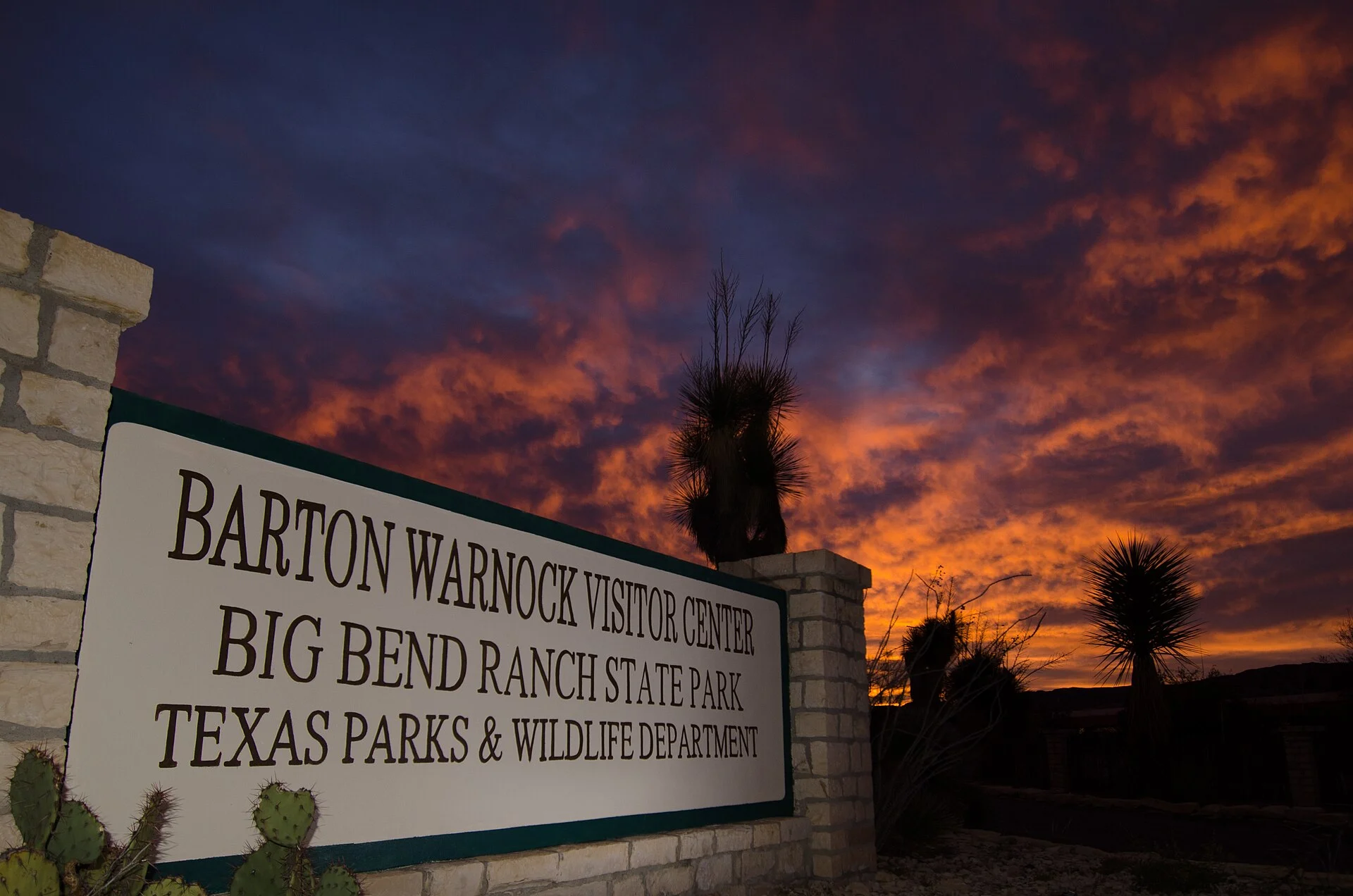
🌤 Weather at Barton Warnock Visitor Center by season
| Spring | Summer | Fall | Winter |
|---|---|---|---|
| 45–98 °F | 73–102 °F | 43–95 °F | 33–74 °F |
Each range runs from the coldest monthly average low to the warmest monthly average high in that season (1991-2020 climate normals), measured at Lajitas, 0 mi away, elevation 2,403 ft. Conditions at the park can differ from the station, especially where elevation differs — check a forecast before you go.

🌵 The Gateway to Texas’s Largest State Park — Where the Chihuahuan Desert Meets the Rio Grande — Barton Warnock Visitor Center near Lajitas, Brewster County, Texas, eastern gateway to Big Bend Ranch State Park (311,000 acres — Texas’s largest), Chihuahuan Desert ecology exhibits, 2.5-acre desert botanical garden with 30+ cactus species, Rio Grande geology displays, named for Dr. Barton Warnock (botanist), near Terlingua ghost town — Brewster County, TX
Big Bend Ranch State Park is 311,000 acres of Chihuahuan Desert wilderness — the largest state park in Texas. The Barton Warnock Visitor Center is its eastern gateway, perched on the Rio Grande near the old mining town of Lajitas.
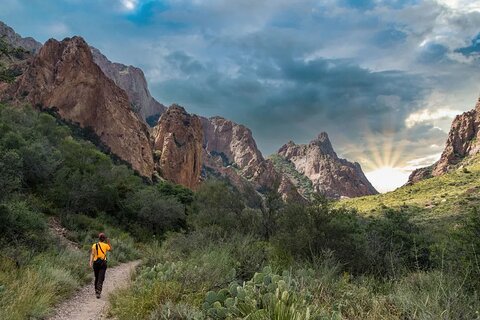
Before you drive into 311,000 acres of desert, canyons, and volcanic geology, you need to understand what you’re entering. The visitor center’s exhibits decode the Chihuahuan Desert — its geology, ecology, and human history. The 2.5-acre botanical garden outside brings the desert down to walking scale: over 30 species of cactus, desert shrubs, and native plants, labeled and interpreted, growing in the same soil and sunlight as the wilderness beyond.
What to See
| Feature | Details |
|---|---|
| Desert Botanical Garden | 2.5 acres of labeled Chihuahuan Desert plants — prickly pear, ocotillo, lechuguilla, creosote, candelilla, and 30+ species of cactus. Self-guided walking paths through the living desert |
| Geology Exhibits | 560 million years of Big Bend geology — from ancient seas to volcanic eruptions to the cutting of the Rio Grande canyons. Rock specimens, fossils, and cross-section diagrams |
| Desert Ecology | How plants and animals survive in 100°F+ heat with less than 10 inches of annual rainfall. Adaptation strategies — from cactus water storage to kangaroo rat kidneys |
| Human History | 12,000 years of human presence — from Paleo-Indian hunters to Comanche raiders to Anglo ranchers and mercury miners. The desert has always been inhabited |
| Big Bend Ranch Gateway | Information, permits, maps, and conditions for Big Bend Ranch State Park. This is the eastern entry point for the River Road (FM 170) — one of the most scenic drives in America |
The Chihuahuan Desert
| Metric | Value |
|---|---|
| Total Area | 200,000 square miles across Texas, New Mexico, Arizona, and Mexico — the largest desert in North America |
| Rainfall | Less than 10 inches annually. Most falls in summer monsoon thunderstorms |
| Temperature Range | Summer highs 100–110°F. Winter lows can drop below freezing. The desert swings 50+ degrees in a single day |
| Biodiversity | The Chihuahuan is the most biologically diverse desert in the Western Hemisphere — more species of cactus than any other North American desert |
| Big Bend Ranch | 311,000 acres — larger than some eastern states’ entire park systems. Texas’s largest state park |
Best Time to Visit
| Season | Best For |
|---|---|
| Fall (Oct–Nov) | 🍂 Perfect desert weather. 70–85°F days, cool nights. Clear skies. Best hiking conditions. River Road at its finest |
| Spring (Feb–Apr) | 🌸 Desert wildflowers and cactus blooms (March–April). Moderate temperatures. Big Bend peak season |
| Winter (Dec–Jan) | Cool to cold. Possible freezing nights. Excellent for midday hiking. Fewer visitors than spring |
| Summer (May–Sep) | Extreme heat (100°F+). Dawn-only activities. Monsoon storms July–September. Not for casual visitors |
Frequently Asked Questions
Do I need a permit for Big Bend Ranch?
Yes — you need a day-use permit or camping permit. The Barton Warnock Visitor Center sells permits and provides current trail and road conditions. The visitor center staff can help you plan your route into the park’s 311,000 acres.
What is FM 170 (River Road)?
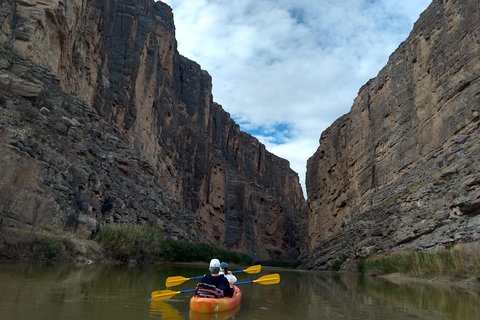
One of the most scenic drives in Texas — and possibly America. FM 170 follows the Rio Grande through the desert from Lajitas to Presidio. The Barton Warnock Center is at the eastern end. The road passes through dramatic canyons, past volcanic formations, and alongside the river.
Who was Barton Warnock?
Dr. Barton Holland Warnock was a botanist who spent decades studying the plants of the Big Bend region. His research documented hundreds of species and became the foundation for understanding Chihuahuan Desert ecology in Texas. The visitor center and its botanical garden honor his life’s work.
Nearby state parks: If you have extra time, Big Bend Ranch State Park is within about an hour’s drive, and Fort Leaton State Historic Site is within about an hour’s drive.
Camping reservations: Book campsites and cabins for Texas state parks online at texasstateparks.reserveamerica.com.
🌵 311,000 Acres of Desert. This Is the Front Door.
The largest state park in Texas. 560 million years of geology. 30+ species of cactus in 2.5 acres. And the Rio Grande carving its way through it all. Start here.
Wildlife & Nature
Barton Warnock VC — the eastern gateway to Big Bend Ranch State Park. The center’s Chihuahuan Desert garden, Rio Grande, and desert terrain support roadrunners, javelinas, and golden eagles. The desert garden showcases over 400 species of Chihuahuan Desert plants.
Nearby Attractions
Lajitas — adjacent. Big Bend Ranch SP — at the center. Big Bend NP — 30 miles east.

🐾 Dogs & Pets at Barton Warnock Visitor Center
- Pets allowed? statewide rule
- Pets are welcome at almost all Texas State Parks on trails and in campgrounds, but must be on leash, in a car, or in a crate at all times and may not be left unattended.
- Leash rule statewide rule
- 6 ft maximum leash required at all times
- Beaches & swim areas statewide rule
- Pets are not allowed in the water or on land around designated swim areas
- Cabins & lodging statewide rule
- Pets are not permitted in any state park buildings, including motels, cabins, screened shelters and group facilities
- Statewide exceptions statewide rule
- Several parks restrict dogs in specific areas (Big Bend Ranch, Enchanted Rock, Government Canyon, Hueco Tanks); proof of current rabies vaccination required
Are dogs allowed at Barton Warnock Visitor Center?
Pets are welcome at almost all Texas State Parks on trails and in campgrounds, but must be on leash, in a car, or in a crate at all times and may not be left unattended. Individual parks can post stricter rules — check signage on arrival.
Rules verified July 2026 via tpwd.texas.gov. More: Texas state parks guide · Dog rules in all 50 states compared
Park Location
Plan your gear for Barton Warnock Visitor Center
From our editorial guides, matched to this park’s activities:
Top Tours & Activities Near Big Bend National Park
 from $199
 from $155
 from $14