Blue Licks State Park
🏆 Researched by State Park Experts — Based on Kentucky Department of Parks data, verified battlefield records, and Robertson County historical archives for this 148-acre Revolutionary War heritage site
On August 19, 1782—ten full months after Lord Cornwallis surrendered at Yorktown and the American Revolution was supposedly over—the bloodiest fifteen minutes in Kentucky frontier history unfolded on a hillside above the Licking River. A force of 182 Kentucky militiamen, ignoring the urgent warnings of Daniel Boone himself, charged across a shallow ford into a textbook ambush set by 50 British Rangers and 300 Shawnee, Wyandot, and Mingo warriors. By the time the smoke cleared, 77 Kentuckians lay dead on the field, including Boone’s own son Israel, who died in his father’s arms during the desperate retreat.
Blue Licks Battlefield State Resort Park preserves the ground where this last major battle of the Revolutionary War played out—a 148-acre site that weaves together millennia of human history with the natural salt springs that drew mammoths, bison, Native Americans, and eventually Kentucky’s first European settlers to this bend in the Licking River. The park combines a Pioneer Museum filled with mastodon bones and frontier artifacts, six hiking trails that trace buffalo migration routes and battlefield positions, a comfortable resort lodge, and a 51-site campground along the river. It’s a place where you can stand on the exact hillside where Boone watched his son die, then walk a trail where mammoth bones still erode from Pleistocene-era deposits—all within an afternoon.
What makes Blue Licks particularly compelling is how many layers of history converge in one small space. The mineral springs that made this site strategically important to Native Americans for thousands of years are the same springs that attracted the massive herds of buffalo whose migration trails became the roads that brought settlers—and ultimately soldiers—to this crossing. Every trail in the park connects to a different chapter of that story, and the Pioneer Museum ties them all together with surprising depth and accessibility.
The Battle of Blue Licks: August 19, 1782
The story of the battle begins four days earlier, on August 15, 1782, when a combined force of British Rangers under Captain William Caldwell and approximately 300 Native American warriors attacked Bryan Station, a fortified settlement near present-day Lexington. The attack failed to take the station, and the raiders retreated northward along an obvious trail—too obvious, as Daniel Boone immediately suspected. The Kentucky militia, gathered from several counties, pursued the retreating force to the banks of the Licking River at the Blue Licks salt springs.
On the morning of August 19, Boone surveyed the terrain and warned his fellow officers that the enemy trail was suspiciously clear—a classic setup for an ambush on the wooded ridge across the river. He urged caution and suggested waiting for reinforcements under Colonel Benjamin Logan, who was a day’s march behind. But Major Hugh McGary, stung by accusations of cowardice at a previous engagement, spurred his horse into the ford shouting “Them that ain’t cowards, follow me!”—a moment of reckless bravado that effectively forced the entire militia to follow or face dishonor.
The Kentuckians crossed the river and advanced up the slope in a rough line of battle. The ambush sprung exactly as Boone had predicted. The combined British and Native American force, concealed in the brush along the ridgeline, unleashed devastating fire from three sides. The battle lasted barely fifteen minutes. Seventy-seven Kentuckians were killed and six captured—a casualty rate exceeding 40 percent. Among the dead was Israel Boone, Daniel’s 23-year-old son, shot through the neck during the chaotic retreat back across the Licking River. According to accounts, Boone carried his dying son partway down the hill before being forced to leave the body and flee for his own life.
The Battle of Blue Licks is officially recognized as the last major engagement of the American Revolutionary War and the deadliest day in Kentucky’s frontier history. The defeat galvanized Kentuckians and prompted General George Rogers Clark to launch a retaliatory expedition into Ohio in November 1782, burning Shawnee towns along the Great Miami River and effectively breaking Native American military power in the region for a generation.
Pioneer Museum
The park’s Pioneer Museum is small but remarkably well-curated, packing thousands of years of regional history into a single building. The museum opens with a short orientation video that provides historical context for the battle and the broader significance of the Blue Licks salt springs, then flows through chronologically arranged exhibits that span from the Pleistocene to the early 19th century.
The most visually striking exhibit features mastodon and mammoth bones recovered from the salt spring deposits—tangible evidence that enormous ice age megafauna were drawn to the same mineral licks that later attracted buffalo herds and human settlers. The paleontological displays are complemented by Native American artifacts including projectile points, pottery, and tools that document thousands of years of habitation around the springs.
The Revolutionary War section features a detailed diorama of the battle, period weapons, and artifacts recovered from the battlefield. Interpretive panels reconstruct the engagement minute by minute, and a large map shows the routes of both the retreating Native American/British force and the pursuing Kentucky militia. The museum also explains the salt-making process that made the Blue Licks springs commercially valuable to early settlers—Daniel Boone was captured here in 1778 while making salt for the Boonesborough settlement, leading to his famous winter captivity among the Shawnee.
| Museum Detail | Information |
|---|---|
| Hours | Wed–Sat: 9 AM – 5 PM; Sun: 9 AM – 3:30 PM |
| Closed | Monday, Tuesday; November 1 – March 15 (seasonal closure) |
| Admission | Small fee; children under 6 free |
| Highlights | Mastodon bones, battle diorama, salt-making exhibits, frontier weapons |
Hiking Trails
Blue Licks offers six trails totaling just under five miles—short distances that pack in an extraordinary amount of natural and historical interest. Each trail connects to a different aspect of the park’s layered story, from ancient buffalo migration routes to battlefield positions and rare botanical preserves.
| Trail | Distance | Difficulty | Highlights |
|---|---|---|---|
| Blue Licks Heritage Trail | 2.0 mi | Easy–Moderate | Reconstructed trade fort, Short’s Goldenrod preserve, springs history, most comprehensive park trail |
| River Trail | 1.0 mi (loop) | Easy | Licking River access, site where Boone was captured in 1778, riparian habitat |
| Indian Run Loop | 0.8 mi | Easy | Native plants, fungi, woodland wildflowers in spring |
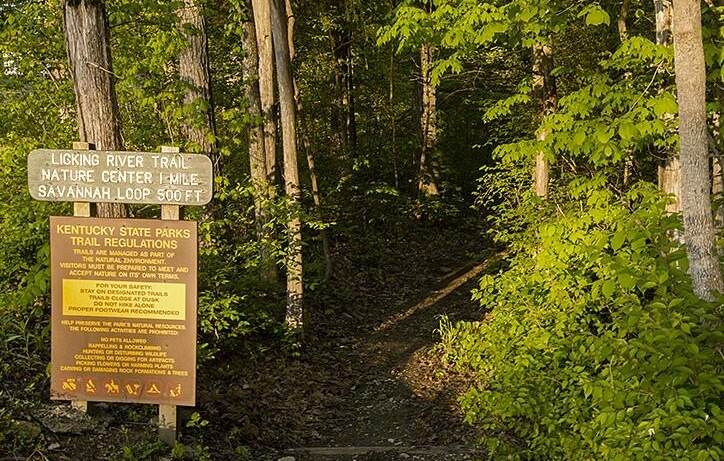
| Savannah Loop | 0.5 mi | Easy | Open grassland habitat, birding, wildflowers |
| Buffalo Trace Trail | 0.2 mi | Easy | Ancient buffalo path, fossils visible in exposed bedrock |
| Battlefield Monument Trail | 0.3 mi | Easy | Battle monument, burial ground, interpretive markers |
The Blue Licks Heritage Trail is the park’s signature hike and the best way to experience the full story of the Blue Licks springs. This 2-mile route passes through a nature preserve that is home to Short’s Goldenrod (Solidago shortii), a federally endangered wildflower found nowhere else on Earth. The trail also features a reconstructed frontier trade fort and interpretive panels that trace the history of the springs from prehistoric times through the salt-making era. Allow 1.5 to 2 hours for an unhurried walk with time to read interpretive signs.
The Buffalo Trace Trail, while the shortest in the park at just 0.2 miles, may be the most evocative. This path follows the worn remains of an ancient buffalo trace—a migration route trampled so deeply into the bedrock over millennia that the groove is still visible today. Fossils can be spotted in the exposed limestone along the trail, connecting you to the same geological forces that created the mineral springs.
Camping & Accommodations
Blue Licks Battlefield operates as a full-service State Resort Park, offering a range of overnight options from rustic camping to comfortable lodge rooms. The campground occupies a scenic position along the Licking River, while the lodge sits on the ridge overlooking the battlefield.
| Accommodation | Details | Season | Price Range |
|---|---|---|---|
| Campground | 51 sites, electric/water hookups, tent and RV | Mid-March – Mid-November | $28–38/night |
| Lodge Rooms | 32 rooms, 2 suites, Hidden Waters Restaurant | Year-round | $85–145/night |
| Cottages | 2 rental cottages, pet-friendly | Year-round | $130–180/night |
The campground features a central service building with heated restrooms and showers, a dump station, playground, and picnic shelters. Each site includes a picnic table and fire ring. Note that water hoses and extension cords up to 50 feet may be needed, as some utility connections are not immediately adjacent to camping pads. Golf carts require a $25 weekly or $100 annual permit. Pets are allowed ($10 per booking) but must be leashed and are not permitted on trails crossing the nature preserve or archaeological areas.
The Hidden Waters Restaurant in the lodge is a genuine highlight—it serves Kentucky Proud-sourced country cooking, with a buffet that draws locals from surrounding counties. The fried catfish and country ham are regional favorites. Breakfast, lunch, and dinner are served daily during season; call ahead for winter hours.
Best Time to Visit: A Seasonal Guide
| Season | Weather | Crowds | Best For |
|---|---|---|---|
| Spring (Apr–May) | 55–75°F, occasional rain | Low to Moderate | Wildflowers (including Short’s Goldenrod), birding, comfortable hiking, museum opens mid-March |
| Summer (Jun–Aug) | 80–90°F, humid | Moderate to High | Full campground and lodge operations, miniature golf, Licking River canoeing, longest days |
| Fall (Sep–Oct) | 55–75°F, crisp | Moderate | Battle anniversary events (August 19), fall foliage on Licking River bluffs, ideal hiking weather |
| Winter (Nov–Mar) | 30–45°F, occasional snow | Very Low | Lodge open year-round, solitude, no camping or museum |
The park holds its annual Battle of Blue Licks Commemoration on or near August 19, featuring reenactments, wreath-laying ceremonies at the battlefield monument, and living history demonstrations. This is the most atmospheric time to visit, though the August heat and humidity can be intense. Fall offers the most comfortable combination of mild weather, autumn foliage along the Licking River valley, and reduced crowds.
Photography Guide
📸 Best Photo Opportunities & Settings
• Battlefield Monument: Best in early morning or golden hour when low-angle light creates dramatic shadows across the stone monument and surrounding burial ground. A wide-angle lens captures both monument and the wooded ridge where the ambush occurred. 16-35mm, f/8.
• Licking River from River Trail: Dawn mist rising from the water creates ethereal conditions, especially in fall when the bluffs are framed by autumn color. A polarizing filter cuts glare and saturates the foliage. 24-70mm, f/11.
• Buffalo Trace Fossils: Get close with a macro or close-focusing lens to capture fossil details in the bedrock. Mid-morning light provides even illumination without harsh shadows. 50-100mm macro, f/5.6–8.
• Short’s Goldenrod Blooms: This federally endangered wildflower blooms in late summer/early fall. Use a longer focal length to isolate individual blooms against a blurred background. 85-200mm, f/2.8–4.
• Pioneer Museum Diorama: No flash. Use a fast lens and high ISO (800-1600). The battle diorama photographs well from slightly below eye level. 35-50mm, f/2.8.
Budget Planning
| Expense | Day Visit | Camping Weekend | Lodge Weekend |
|---|---|---|---|
| Park Entry | Free | Free | Free |
| Museum Admission | $5–8/person | $5–8/person | $5–8/person |
| Camping/Lodge | — | $56–76 (2 nights) | $170–290 (2 nights) |
| Meals (Hidden Waters) | $15–25 | $60–100 | $80–130 |
| Miniature Golf | $5 | $5 | $5 |
| Gas (from Lexington) | $20–30 | $20–30 | $20–30 |
| Estimated Total | $45–70 | $145–220 | $280–465 |
Blue Licks is one of the most budget-friendly state resort parks in Kentucky. There is no park entry fee—you pay only for camping, lodging, museum admission, and food. The Hidden Waters Restaurant offers excellent value for Kentucky country cooking, and the campground rates are among the most affordable for a full-service facility with hookups and heated facilities. Families can easily fill a full day with the museum, trails, miniature golf, and river access without spending more than $30-40 beyond lodging.
Wildlife & Nature
Despite its modest 148-acre footprint, Blue Licks sits within a corridor of the Licking River valley that supports surprisingly diverse wildlife. The park’s mix of open grassland (maintained to replicate the historical savannah habitat), mature hardwood forest, and riparian river habitat creates multiple ecological niches within walking distance of each other.
| Species | Best Season | Where to Look | Notes |
|---|---|---|---|
| 🦌 White-tailed Deer | Year-round | Forest edges, Heritage Trail, campground at dusk | Abundant throughout the park; most active dawn/dusk |
| 🦅 Red-tailed Hawks | Year-round | Open grasslands, soaring above river bluffs | Often seen hunting over Savannah Loop area |
| 🐦 Pileated Woodpeckers | Year-round | Mature forest along Heritage Trail | Listen for distinctive drumming; crow-sized birds |
| 🦃 Wild Turkey | Spring–Fall | Forest edges, campground road at dawn | Males displaying in April–May |
| 🌼 Short’s Goldenrod | Aug–Sep | Heritage Trail nature preserve | Federally endangered, found ONLY at Blue Licks and a few nearby sites |
| 🐢 Box Turtles | Apr–Oct | Trails after rain, Heritage Trail | Eastern box turtles common; watch trail carefully |
The park’s most ecologically significant resident is Short’s Goldenrod (Solidago shortii), a federally endangered plant discovered by botanist Charles Short in 1840 and endemic to the Blue Licks area and a handful of nearby locations in Robertson and Fleming counties. The Heritage Trail passes through the nature preserve where this rare wildflower grows, blooming with bright yellow flowers in late summer and early fall. This single-species distinction makes Blue Licks one of the most botanically significant sites in Kentucky’s state park system.
Safety & Hazards
| Hazard | Risk Level | Prevention |
|---|---|---|
| 🌡️ Heat & Humidity | High (summer) | Kentucky summers are hot and humid; carry water, take breaks in shade or lodge. Heat index can exceed 100°F Jul–Aug |
| 🪲 Ticks | High (Apr–Oct) | Stay on trail, use DEET or permethrin, do full body checks after hiking. Lone star and deer ticks present |
| 🐍 Copperheads | Low to Moderate | Watch step on rocky trail sections, especially Buffalo Trace Trail. Most active May–October |
| 🌊 Licking River | Moderate | No lifeguards; river levels can change rapidly after rain. Check conditions before canoeing |
| 🌿 Poison Ivy | Moderate | Common along trail edges; “leaves of three, let it be.” Stay on maintained paths |
Nearby Attractions
| Attraction | Distance | Drive Time | Highlights |
|---|---|---|---|
| Maysville, KY | 24 mi | 30 min | Kentucky Gateway Museum Center, Ohio River, historic downtown, Rosemary Clooney Museum |
| Lexington, KY | 48 mi | 55 min | Horse farms, Keeneland, Kentucky Horse Park, University of Kentucky |
| Old Washington | 22 mi | 30 min | Historic village, Underground Railroad sites, frontier-era buildings |
| Covered Bridges (Fleming Co.) | 15–25 mi | 20–35 min | Historic covered bridges including Goddard Bridge and Ringo’s Mill Bridge |
| Augusta, KY | 30 mi | 40 min | Ohio River ferry town, historic architecture, Baker-Bird Winery |
Visitor Information
| Detail | Information |
|---|---|
| Address | 10299 Maysville Rd (Hwy 68), Mt. Olivet, KY 41064 |
| Phone | (859) 289-5507 |
| Park Hours | Dawn to dusk daily, year-round |
| Museum Hours | Wed–Sat 9 AM – 5 PM, Sun 9 AM – 3:30 PM (closed Mon–Tue; seasonal Nov–Mar) |
| Campground Season | Mid-March – Mid-November |
| Lodge | Year-round, 32 rooms + 2 suites |
| Entry Fee | Free (museum has separate small admission fee) |
| Pets | Allowed in campground and lodge ($10/booking); leash required; restricted on nature preserve trails |
Frequently Asked Questions
What happened at the Battle of Blue Licks?
The Battle of Blue Licks, fought on August 19, 1782, was the last major battle of the American Revolutionary War. A force of 182 Kentucky militiamen—including the legendary Daniel Boone—pursued a retreating British and Native American raiding party to the Licking River crossing at the Blue Licks salt springs. Despite Boone’s warnings of an ambush, the militia crossed the river and was devastated by a combined force of 50 British Rangers and 300 Native American warriors. Seventy-seven Kentuckians were killed in roughly fifteen minutes of fighting, including Boone’s 23-year-old son Israel. The defeat prompted General George Rogers Clark’s retaliatory expedition into Ohio later that year.
Is Blue Licks Battlefield State Park worth visiting?
Absolutely. Blue Licks offers a unique combination of Revolutionary War history, natural history (mastodon fossils, mineral springs), rare botany (the federally endangered Short’s Goldenrod), and comfortable resort amenities including a lodge, restaurant, and campground. The Pioneer Museum punches well above its weight for a small-park facility, and the trails—while short—connect to fascinating geological and historical features. It’s an especially compelling destination for anyone interested in frontier history, Daniel Boone, or the lesser-known western theater of the Revolutionary War.
Can you camp at Blue Licks Battlefield State Park?
Yes. The park operates a 51-site campground with electric and water hookups, suitable for both tents and RVs, open from mid-March through mid-November. Facilities include heated restrooms and showers, a dump station, playground, and fire rings at each site. Rates run approximately $28–38 per night. Reservations are recommended, especially for weekends and holidays. The park also has a 32-room lodge and two rental cottages for visitors who prefer indoor accommodations year-round.
What is Short’s Goldenrod and why is it important?
Short’s Goldenrod (Solidago shortii) is a federally endangered wildflower that exists in the wild at only a handful of locations in Robertson and Fleming counties, Kentucky—making Blue Licks Battlefield State Park one of the most important conservation sites for this species. Discovered by botanist Charles Short in 1840, this plant blooms with bright yellow flowers in late summer and early fall. The Heritage Trail passes through the nature preserve where it grows, making Blue Licks one of the few places in the world where you can see this extremely rare plant in its natural habitat.
How long does it take to visit Blue Licks Battlefield State Park?
A thorough day visit—including the Pioneer Museum, all six trails, and lunch at the Hidden Waters Restaurant—takes 4 to 5 hours. If you’re primarily interested in the museum and the main Heritage Trail, allow 2 to 3 hours. Overnight stays at the campground or lodge allow time to canoe the Licking River, explore at a relaxed pace, and catch wildlife activity at dawn and dusk.
Are pets allowed at Blue Licks Battlefield State Park?
Yes, pets are welcome in the campground, lodge, and cottages (up to two pets per room/cottage, $10 per booking fee). Pets must be kept on a leash at all times. However, pets are not permitted on trails that cross the nature preserve or archaeological areas, including portions of the Heritage Trail. The River Trail and campground loop are pet-friendly alternatives.
What is the closest major city to Blue Licks Battlefield State Park?
Lexington, Kentucky, is the closest major city, approximately 48 miles (55 minutes) southwest via Highway 68. Maysville, a smaller city on the Ohio River with its own historical attractions, is 24 miles (30 minutes) northeast. Cincinnati, Ohio, is approximately 75 miles (1.5 hours) north. The park’s location in rural Robertson County means services are limited nearby—fuel up and stock supplies before arriving.
⚔️ Ready to Walk the Battlefield?
Stand where Daniel Boone fought, explore 10,000 years of human history at the Blue Licks salt springs, and discover one of the world’s rarest wildflowers—all in a single Kentucky park.