Blue Mounds State Park
🦬 Minnesota’s Bison Prairie — Watch a free-roaming bison herd graze across 1,800-year-old Sioux Quartzite bluffs. One of the last intact tallgrass prairies in the Midwest, plus 13 miles of trails through wildflower meadows. Verified with Minnesota DNR January 2026.
There’s a place in southwest Minnesota where ancient pink rock rises from endless prairie grass, where a herd of bison roams free for the first time in 150 years, and where the horizon stretches so far you might forget you’re still in the Midwest. Blue Mounds State Park isn’t the Minnesota of 10,000 lakes—it’s something older, wilder, and far more unexpected.
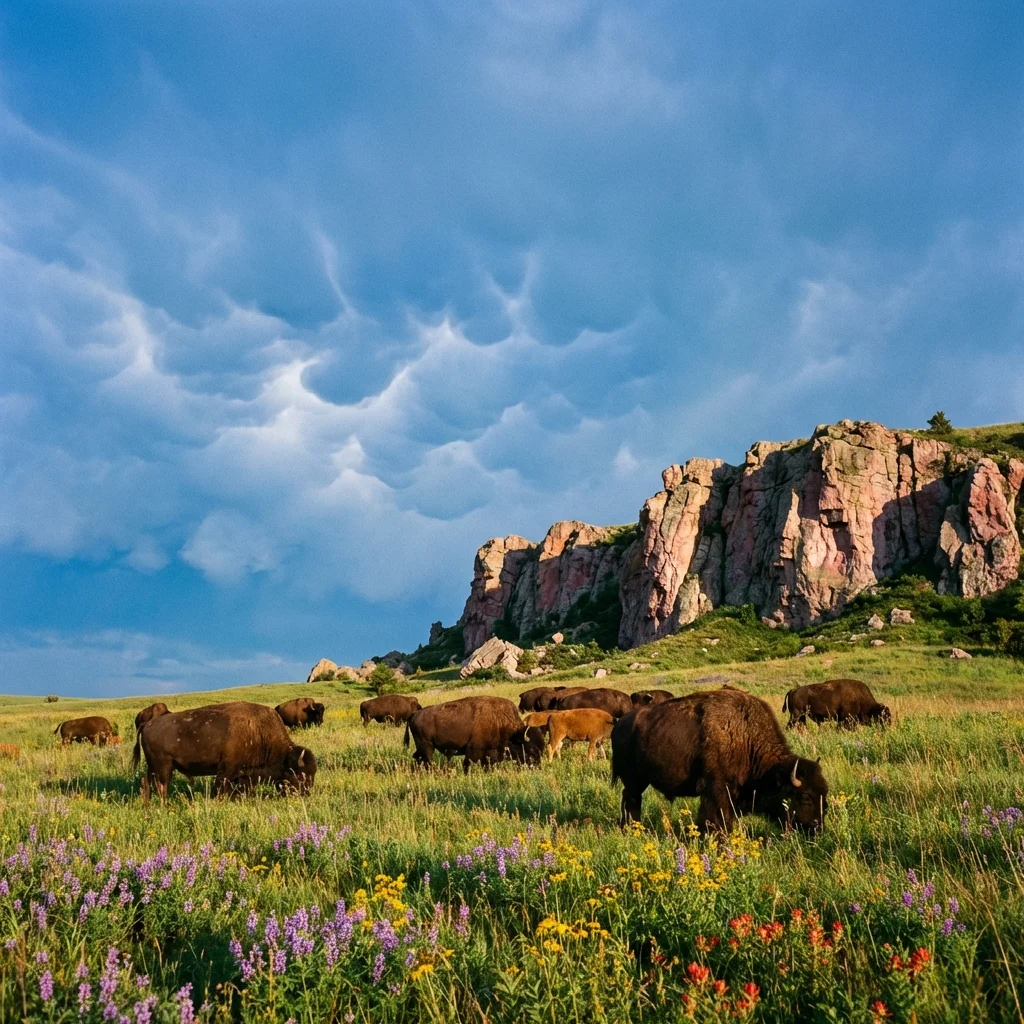
The park gets its name from the Sioux Quartzite cliffs that glow blue-purple when viewed from a distance in certain light. These 1.6-billion-year-old rock formations were sacred to the Dakota people and remain one of the most striking geological features in the Upper Midwest. Rising 100 feet above the surrounding prairie, the rock face catches sunrise and sunset light in ways that photographers travel hours to capture.
But the cliffs aren’t the only draw. Blue Mounds is home to one of Minnesota’s few bison herds—descendants of the millions that once roamed these plains. The herd, typically 50-100 animals, grazes within a fenced preserve visible from multiple viewpoints throughout the park. It’s one of the few places in America where you can watch bison in something approaching their natural habitat without leaving the car.
Why Visit Blue Mounds State Park?
- 🦬 Free-Roaming Bison Herd — 50-100 bison in a prairie preserve, visible from overlooks and trails
- 💎 1.6-Billion-Year-Old Quartzite Cliffs — Pink-purple Sioux Quartzite rising 100 feet above prairie
- 🌸 Native Tallgrass Prairie — One of the last intact prairies in Minnesota, with 200+ wildflower species
- 🌅 Mystery Alignment — 1,250-foot rock alignment pointing to sunrise on equinoxes
- 🥾 13 Miles of Trails — Hiking, biking, and winter skiing across prairie and bluffs
- 🏕️ Modern Campground — 73 sites with electric hookups, showers, and flush toilets
- 🧗 Rock Climbing — One of the few state parks in Minnesota with designated climbing areas
Best Things to Do at Blue Mounds State Park
1. Watch the Bison Herd
The bison herd at Blue Mounds is the park’s marquee attraction. Descendants of wild bison that once numbered 30-60 million across North America, this herd of 50-100 animals roams a fenced preserve within the park. Unlike zoo exhibits, these bison live in semi-wild conditions—grazing on native prairie grass, raising calves, and behaving much as their ancestors did centuries ago.
The best viewing spots include the Bison Drive (a 1.5-mile paved loop) and the overlooks along the Upper Mound Trail. Early morning and late afternoon offer the best light and activity—bison are most active during cooler parts of the day.
Safety reminder: Bison are wild animals weighing up to 2,000 pounds. Stay at least 100 yards away and never approach on foot. Use binoculars or a telephoto lens for close-up photos.
2. Hike the Mound Trail to the Cliffs
The Upper Mound Trail leads to the park’s most dramatic scenery—the Sioux Quartzite cliffs that give Blue Mounds its name. This moderate 2-mile loop climbs from the campground to the top of the bluff, where views stretch across the prairie in every direction.
The quartzite here is among the oldest exposed rock in North America, formed 1.6 billion years ago when ancient mountains eroded and the sediments compressed into this distinctive pink-purple stone. Native Americans quarried the rock for tools, and evidence of their presence dates back thousands of years.
In spring and summer, the prairie surrounding the cliffs explodes with wildflowers—purple coneflower, black-eyed Susan, blazing star, and dozens of other species that evolved alongside the bison.
3. Discover the Mystery Rock Alignment
One of Blue Mounds’ most intriguing features is a 1,250-foot stone alignment that points directly to sunrise on the spring and fall equinoxes. No one knows who built it or why, but theories range from Native American calendars to 19th-century surveyor markers.
The alignment is accessible via a short trail from the interpretive center. Visiting on or near the equinox (around March 20 and September 22) lets you witness the sunrise phenomenon firsthand—though it draws crowds.
4. Explore the Tallgrass Prairie
Minnesota was once covered in tallgrass prairie, but over 99% has been converted to farmland. Blue Mounds preserves one of the state’s largest remaining fragments—over 200 species of native wildflowers, grasses, and forbs that support pollinators, ground-nesting birds, and small mammals.
The Lower Mound Trail loops through the heart of the prairie, offering seasonal displays that change dramatically from April through October. Peak wildflower season is typically July through August, when purple coneflowers and blazing stars create a sea of color.
5. Rock Climb the Quartzite Walls
Blue Mounds is one of the few Minnesota state parks that allows rock climbing. The Sioux Quartzite offers routes ranging from beginner-friendly cracks to challenging overhangs. Climbers must register at the park office and follow designated climbing areas.
The rock is solid but can be slippery when wet. Bring your own gear—there are no rentals nearby. Spring and fall offer the best conditions; summer can be brutally hot on the exposed south-facing walls.
6. Bike the Trails
Several trails at Blue Mounds are open to mountain biking, including the Western Loop Trail (3.5 miles) and connecting routes. The terrain is mostly prairie and rolling hills—not technical, but scenic and family-friendly.
The park also connects to the Blue Mounds Trail, a paved recreational path leading toward the town of Luverne. It’s a pleasant out-and-back for road bikes or casual riders.
All Trails at Blue Mounds State Park
The park offers 13 miles of trails across prairie, woodland, and bluffs:
| Trail | Distance | Difficulty | Highlights |
|---|---|---|---|
| Upper Mound Trail | 2.0 mi loop | Moderate | Quartzite cliffs, panoramic prairie views |
| Lower Mound Trail | 2.5 mi loop | Easy | Tallgrass prairie, wildflowers, bird watching |
| Bison Drive | 1.5 mi paved | Easy | Bison viewing, accessible by car or foot |
| Western Loop Trail | 3.5 mi | Easy-Mod | Mountain biking allowed, prairie views |
| Eagle Rock Trail | 1.2 mi | Moderate | Climbs to overlook, connects to Upper Mound |
| Mound Creek Trail | 1.0 mi | Easy | Riparian habitat, shaded creek walk |
Trail tip: For the best single hike, combine the Upper Mound Trail with Eagle Rock for about 3.5 miles of the park’s most dramatic scenery—cliffs, overlooks, and bison viewing all in one loop.
Camping at Blue Mounds State Park
Blue Mounds offers a modern campground with 73 sites, including electric hookups, showers, and flush toilets. The campground sits on the lower slopes of the mound, sheltered by trees but within walking distance of the prairie trails.
| Site Type | Sites | Electric | Price |
|---|---|---|---|
| Electric Sites (50A) | 40 | Yes | $31 + fees |
| Electric Sites (30A) | 33 | Yes | $27 + fees |
| Rustic Sites | 14 | No | $21 + fees |
| Cart-In Sites | 6 | No | $15 + fees |
Each site includes a picnic table and fire ring. The campground has modern restrooms with showers, a dump station, and drinking water. Sites are shaded but not heavily wooded—bring sun protection.
Reservations: Book through reservemn.usedirect.com. Summer weekends fill up fast, especially around July 4th and during peak wildflower season.
Best Time to Visit Blue Mounds State Park
| Season | Weather | Crowds | Best For |
|---|---|---|---|
| 🌸 Spring (Apr-May) | 45-65°F | Low-Mod | Equinox alignment, bird migration, calving season |
| ☀️ Summer (Jun-Aug) | 70-90°F | High | Peak wildflowers (July-Aug), bison active, full programs |
| 🍂 Fall (Sep-Oct) | 50-70°F | Moderate | Equinox alignment, bison rut, prairie grass colors |
| ❄️ Winter (Nov-Mar) | 10-35°F | Very Low | Cross-country skiing, snowshoeing, solitude |
Pro tip: Visit during the fall equinox (September 22) for the rock alignment spectacle. Arrive before sunrise and be prepared for crowds—it’s the park’s most popular day.
Fees and Hours
| Fee Type | Price |
|---|---|
| Daily Vehicle Permit | $7 |
| Annual State Park Pass | $35 |
| Second Vehicle (Annual) | $26 |
Hours: Open daily 8:00 AM to 10:00 PM. The interpretive center has seasonal hours—typically open weekends in spring/fall and daily during summer.
Getting There
Blue Mounds State Park 1410 161st Street Luverne, MN 56156 Phone: (507) 283-6050 Official DNR Page
From Sioux Falls, SD: 30 miles east via I-90 (about 30 minutes) From Minneapolis: 220 miles southwest via US-169 and I-90 (about 3.5 hours) From Omaha: 240 miles north via I-29 and I-90 (about 3.5 hours)
Blue Mounds vs. Blue Mound: What’s the Difference?
Confused? You’re not alone. There are TWO similarly-named parks:
| Feature | Blue Mounds (Minnesota) | Blue Mound (Wisconsin) |
|---|---|---|
| Location | Luverne, MN (SW corner) | Blue Mounds, WI (near Madison) |
| Main Attraction | Bison herd, quartzite cliffs | Observation towers, highest point S-WI |
| Geology | Sioux Quartzite (1.6 billion years) | Dolomite/limestone (Driftless Area) |
| Wildlife | 🦬 Bison herd | Deer, turkeys (no bison) |
| Swimming | No pool | Yes (summer pool) |
| Size | 1,853 acres | 1,153 acres |
Quick rule: Looking for bison? → Minnesota. Looking for observation towers? → Wisconsin.
Safety Information
Emergency Contacts
- Park Office: (507) 283-6050
- Emergency (911): Rock County dispatch
- Nearest Hospital: Sanford Luverne Medical Center (~5 min)
| Hazard | Risk | Prevention |
|---|---|---|
| 🦬 Bison | Moderate | Stay 100+ yards away; never approach or feed |
| 🌡️ Heat Exposure | High (summer) | No shade on prairie trails; carry water, wear sun protection |
| 🐍 Snakes | Low | Bull snakes common but harmless; watch where you step |
| ⚡ Lightning | Moderate | Exposed prairie—seek shelter if storms approach |
Frequently Asked Questions
Are the bison dangerous?
They can be. Bison are wild animals weighing up to 2,000 pounds and can run 35 mph. Stay at least 100 yards away, remain in your vehicle on the Bison Drive, and never approach on foot. Use binoculars or telephoto lenses for close views.
Can I pet or feed the bison?
Absolutely not. Feeding or approaching bison is illegal and extremely dangerous. Multiple visitors have been injured by bison at parks nationwide. Respect their space.
What is the rock alignment?
A 1,250-foot line of rocks that points directly to sunrise on the spring and fall equinoxes. Its origin is unknown—possibly Native American, possibly 19th-century surveyors. The mystery adds to its appeal.
Is this the same as Blue Mound State Park in Wisconsin?
No! Blue Mounds (with an S) is in Minnesota and features bison and quartzite cliffs. Blue Mound (no S) is in Wisconsin and features observation towers. They’re about 250 miles apart.
Are dogs allowed?
Yes, on trails but not in the bison range. Dogs must be leashed (6 ft max). The bison can become agitated by dogs—keep pets out of the viewing areas.
When is the best time to see wildflowers?
Late July through August is peak wildflower season. Purple coneflowers, blazing stars, and black-eyed Susans create a colorful prairie tapestry. Spring (May-June) offers pasque flowers and early bloomers.
Is rock climbing allowed?
Yes, in designated areas. Register at the park office before climbing. The Sioux Quartzite offers routes for various skill levels, but bring your own gear—no rentals nearby.
🦬 Experience Minnesota’s Wild Prairie
Blue Mounds State Park offers something you won’t find anywhere else in Minnesota—bison roaming across ancient pink cliffs, tallgrass prairie stretching to the horizon, and a geological mystery aligned with the stars. It’s the Midwest’s best-kept secret.
Explore more: All Minnesota State Parks | Wildlife Watching | Parks with Unique Wildlife | Blue Mound State Park (Wisconsin)