Exploring Devil’s Lake State Park: Wisconsin’s Outdoor Oasis
Billion-Year-Old Bluffs Rising 500 Feet Above Wisconsin’s Most Dramatic Lake
In Sauk County, Wisconsin, a 360-acre lake sits cradled between two towering quartzite bluffs that tell a geological story spanning 1.6 billion years. Devil’s Lake State Park — Wisconsin’s largest and most visited state park — draws over 3 million visitors annually to hike among ancient rock formations, scramble over fields of tumbled boulders, and swim in waters framed by some of the oldest exposed rock in North America.
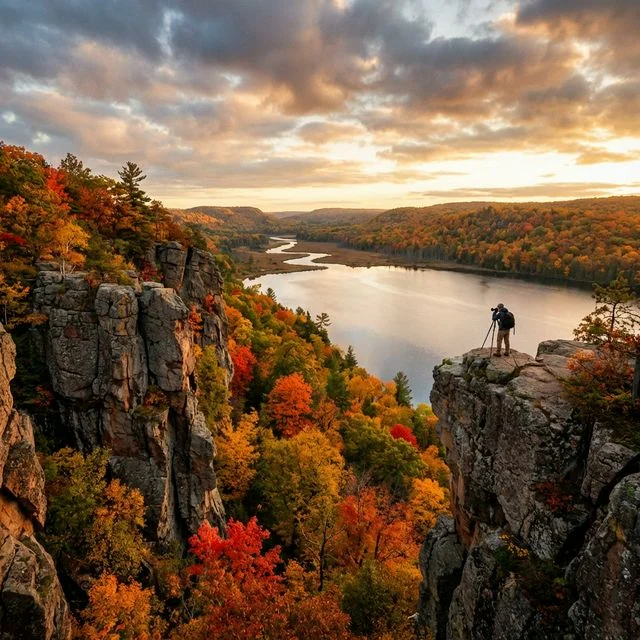
The Baraboo Range surrounding Devil’s Lake was once higher than the Rocky Mountains. What remains today are the resilient quartzite cores — rock so hard that 1.6 billion years of erosion have merely sculpted rather than destroyed them. The result is a landscape unlike anything else in the Midwest: dramatic 500-foot cliffs dropping to crystal-clear water, natural arches weathered from ancient stone, and boulders balanced impossibly on narrow ledges.
Ancient Quartzite: A Geology You Can Touch
Devil’s Lake’s bluffs are composed of Baraboo quartzite, formed when ancient rivers deposited sand into shallow seas approximately 1.6 billion years ago during the Precambrian era. Immense heat and pressure transformed that sand into sandstone, and eventually into quartzite — one of the hardest rocks on Earth. The distinctive purple hue comes from iron mixed with the original sand that oxidized over the eons.
The Baraboo Range is one of the oldest rock outcrops in North America, and Devil’s Lake sits in a gap within this ancient range. The lake itself was created roughly 12,000 years ago when the Wisconsin Glacier deposited terminal moraines — walls of glacial debris — at both ends of the gap, plugging an ancient river valley and trapping water between the bluffs.
Throughout the park, you’ll encounter geological signatures of this dramatic history. The Fold, near the north shore entrance, displays dramatically bent layers of quartzite and phyllite that reveal the immense tectonic forces that shaped this landscape. The massive talus slopes at the base of the cliffs — fields of shattered quartzite boulders — were created by thousands of years of freeze-thaw cycles during glacial periods.
Devil’s Doorway & Balanced Rock: Icons of Deep Time
Two formations have become symbols of Devil’s Lake. Devil’s Doorway, perched on the East Bluff, is a natural arch carved from the quartzite by eons of weathering — a window of ancient stone framing views of the forest below. Reaching it requires a moderately strenuous hike up the East Bluff Trail, but the payoff is one of Wisconsin’s most photographed natural formations.
Balanced Rock, also on the East Bluff, is exactly what it sounds like: a massive quartzite boulder perched impossibly on a narrow ledge, defying gravity through the luck of glacial placement. Both formations are accessible from the East Bluff Trail and represent the power of geological processes operating over incomprehensible timescales.
29 Miles of Trails: From Lakeside Strolls to Bluff Scrambles
Devil’s Lake offers over 29 miles of hiking trails ranging from paved, accessible paths to challenging bluff climbs. The park also contains approximately 11 miles of the 1,200-mile Ice Age National Scenic Trail, connecting Devil’s Lake to the broader Wisconsin landscape.
The Devil’s Lake Loop (approximately 5 miles) is the signature hike, circling the entire lake and climbing both bluffs. The East Bluff Trail is the most popular route, rewarding hikers with views of Devil’s Doorway and Balanced Rock. The West Bluff Trail is considered more challenging, with rock scrambles and exposed sections that offer dramatic views down to the lake.
The Tumbled Rocks Trail on the west end is paved and accessible, winding through spectacular boulder fields at the base of the bluffs. The CCC Trail and Grottos Trail offer quieter alternatives through forested areas rich with wildflowers in spring.
Rock Climbing Capital of the Midwest
The hard quartzite bluffs make Devil’s Lake one of the premier rock climbing destinations in the Midwest, with over 1,500 documented climbing routes across both bluffs. Routes range from beginner-friendly top-roping to multi-pitch traditional climbs with difficulties from 5.0 to 5.14.
The East Bluff is the more popular climbing area, with a wide variety of crack, face, and chimney climbs. The West Bluff tends to be taller and more exposed, attracting experienced climbers. Bouldering on the talus fields is also popular, with hundreds of documented boulder problems.
Climbing is permitted year-round without permits, though the park asks climbers to avoid nesting areas during peregrine falcon breeding season (typically March through July) when posted.
Practical Guide: Planning Your Visit
Getting There
Devil’s Lake State Park is located just south of Baraboo, about 40 miles north of Madison and 190 miles northwest of Chicago. The main entrance is on State Highway 123. GPS address: S5975 Park Rd, Baraboo, WI 53913.
Fees & Hours
A Wisconsin State Park vehicle sticker is required ($28/year for residents, $38/year for non-residents, or $8/$11 for daily admission). The park is open year-round from 6:00 AM to 11:00 PM.
Camping
The park offers 407 campsites across three campgrounds: Quartzite Campground (northern shore), Northern Lights Campground, and Ice Age Campground. Sites range from electric to non-electric, with showers and modern restroom facilities available. Reserve well in advance — summer weekends can book out months ahead.
Swimming & Water Activities
Two sandy beach areas on the north and south shores offer swimming (no lifeguards). Canoes, kayaks, and paddleboards are popular on the lake. No motorized boats are permitted, keeping the water clear and quiet.
Crowd Warning
Devil’s Lake is extremely popular. From May through October, parking lots regularly fill before 9:00 AM on weekends and holidays. Arrive early or visit on weekdays. The south shore area tends to be less crowded than the north shore.
Frequently Asked Questions
How difficult are the bluff trails at Devil’s Lake?
The East Bluff Trail is moderately strenuous — expect rocky steps, some scrambling, and about 500 feet of elevation gain. The West Bluff Trail is harder, with more exposed rock scrambles. The Tumbled Rocks Trail is paved and accessible for wheelchairs and strollers. Allow 2–3 hours for a full bluff trail, or 4–5 hours for the complete lake loop.
Is Devil’s Lake good for swimming?
Yes — the clear, spring-fed lake is one of the best swimming spots in Wisconsin. Two sandy beach areas on the north and south shores provide access. Water temperatures are comfortable from June through September. There are no lifeguards, so swim at your own risk. The water is exceptionally clear due to the quartzite bedrock.
Can I rock climb at Devil’s Lake without a guide?
Yes — climbing is free and permit-free year-round. However, the quartzite can be polished and slippery, requiring good footwork. Top-roping from established anchors is the most common style. If you’re new to climbing, hiring a local guide service is strongly recommended. Check for seasonal raptor closures before planning your route.
When is the best time to visit Devil’s Lake?
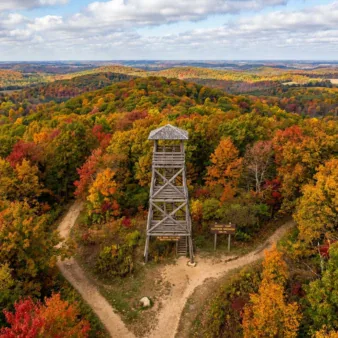
Late September through mid-October offers spectacular fall color — the bluffs draped in gold, orange, and crimson are iconic Wisconsin scenery. Spring (May–June) brings wildflowers and fewer crowds. Summer offers swimming but massive crowds. Winter is quiet and beautiful, with cross-country skiing and snowshoeing available.
What else is near Devil’s Lake State Park?
The town of Baraboo is home to the historic Circus World Museum (the original winter quarters of the Ringling Brothers). Wisconsin Dells, America’s “waterpark capital,” is just 15 miles north. The International Crane Foundation near Baraboo offers world-class birding. And Natural Bridge State Park, featuring Wisconsin’s largest natural arch, is a 20-minute drive south.