Fort Phil Kearny
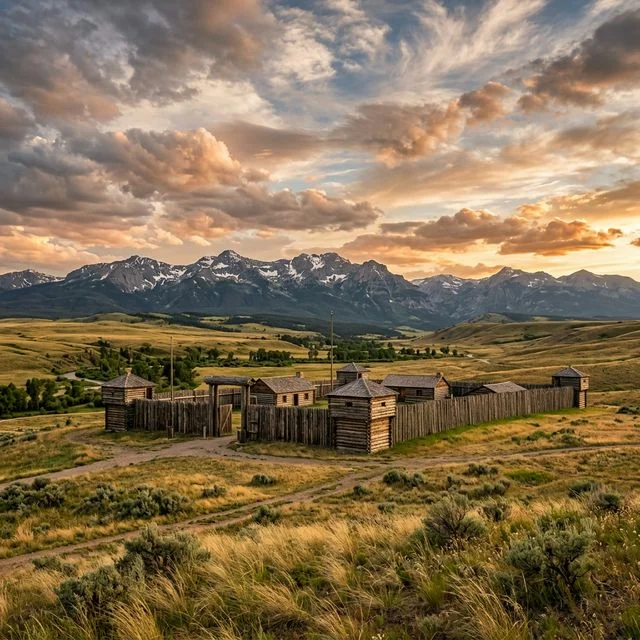
Standing sentinel along the haunted trace of the Bozeman Trail at the foot of Wyoming’s mighty Bighorn Mountains, Fort Phil Kearny State Historic Site preserves one of the most dramatic and consequential chapters in the history of the American West. Built in 1866 and abandoned just two years later, this isolated military stockade was the epicenter of Red Cloud’s War—a conflict so fierce, so relentless, that it became the only Indian War in American history where the United States government formally sued for peace and agreed to the Native Americans’ terms.
Today, the thousand-acre site stands as a silent, windswept memorial to the soldiers, civilians, and the Lakota, Cheyenne, and Arapaho warriors who clashed here. With a world-class interpretive center, the preserved grounds of the fort, and access to two of the most significant battle sites on the Great Plains, Fort Phil Kearny offers an unforgettable encounter with frontier history.
Table of Contents
The Bozeman Trail and Red Cloud’s War
In the 1860s, the discovery of gold in Montana drew a flood of prospectors along the Bozeman Trail, which cut directly through the most prized hunting grounds of the Lakota Sioux, Northern Cheyenne, and Arapaho nations. To protect this vital corridor, the U.S. Army constructed three stockaded forts: Fort Reno, Fort Phil Kearny, and Fort C.F. Smith. Fort Phil Kearny, completed in 1866 under the command of Colonel Henry B. Carrington, was the largest and most strategically important.
The response from the Native tribes was immediate and unrelenting. Under the leadership of the great Oglala Lakota chief Red Cloud, a coordinated campaign of sustained warfare—raids, ambushes, and sieges—made Fort Phil Kearny the most dangerous posting on the frontier. Soldiers reported that they were virtually imprisoned within the stockade walls, unable to gather wood or water without armed escort.
The Fetterman Fight
The conflict reached its devastating climax on December 21, 1866, in what became known as the Fetterman Fight—or, from the Native perspective, the “Battle of the Hundred-in-the-Hands.” Captain William J. Fetterman, disobeying orders not to pursue beyond Lodge Trail Ridge, led 80 soldiers into a masterfully planned ambush orchestrated by Lakota warriors including a young decoy named Crazy Horse. All 81 men, including Fetterman, were killed, making it the U.S. Army’s worst defeat on the Great Plains until the Battle of the Little Bighorn ten years later.
The Wagon Box Fight
Seven months later, on August 2, 1867, the Wagon Box Fight took place near the fort. A small detachment of soldiers, armed with newly issued breech-loading Springfield rifles, took shelter behind a corral of wagon boxes and held off a force of hundreds of Lakota and Cheyenne warriors for hours. Though the army claimed a decisive victory, the relentless pressure of Red Cloud’s War ultimately proved too costly. In 1868, the U.S. government signed the Treaty of Fort Laramie, abandoning the Bozeman Trail forts. As the last soldiers marched away, Red Cloud’s warriors set Fort Phil Kearny ablaze.
The Interpretive Center
The on-site Interpretive Center serves as the gateway to understanding this fraught period in American history. Inside, visitors will find a to-scale diorama of the fort as it appeared in 1866, detailed exhibits on the Indian Wars, military life on the frontier, and the perspectives of both the soldiers and the Native peoples who fought here. The center provides essential context that brings the silent landscape outside to vivid, tragic life.
Exploring the Grounds
A self-guided walking tour of the fort site is available year-round. Corner posts and interpretive signs mark the locations of original buildings, while reconstructed sections of the wooden stockade wall demonstrate the fort’s defenses. The Fetterman and Wagon Box battle sites are also managed by the state and are open from sunrise to sunset, offering a haunting walk across terrain that remains largely unchanged since 1866.
Essential Visitor Information
- Location: 528 Wagon Box Road, Banner, Wyoming 82832. Approximately 15 miles north of Buffalo, just off Interstate 90.
- Interpretive Center: Generally open May 1 through September 30, with specific hours varying by month. Admission fees apply for adults; children under 18 enter free.
- Grounds: The fort grounds and battle sites are accessible year-round from sunrise to sunset.
- Preservation: The Fort Phil Kearny / Bozeman Trail Association actively works to preserve and promote the site.
FAQ: Fort Phil Kearny
What happened at Fort Phil Kearny?
Can you visit the Fetterman battlefield?
Is Fort Phil Kearny open in winter?