🌤 Weather at Monadnock State Park by season
| Spring | Summer | Fall | Winter |
|---|---|---|---|
| 22–68 °F | 55–82 °F | 29–73 °F | 13–37 °F |
Each range runs from the coldest monthly average low to the warmest monthly average high in that season (1991-2020 climate normals), measured at Jaffrey Silver Ranch Airpark, 7 mi away, elevation 1,030 ft. Conditions at the park can differ from the station, especially where elevation differs — check a forecast before you go.
The park itself ranges from about 1,190 to 2,400 ft in elevation — higher ground runs cooler than the figures above.

Monadnock State Park — 5,000+ acres in Jaffrey — protects Mount Monadnock (3,165 ft), the most-climbed mountain in North America and the third most-climbed in the world after Mount Fuji and Mount Tai. Over 125,000 hikers reach the bare rocky summit annually via 40+ miles of trails, drawn by panoramic views spanning all six New England states, the Berkshires of Massachusetts, and on the clearest days, the skyline of Boston — 60 miles to the southeast.
The word “monadnock” has entered the geological lexicon — a monadnock (also called an inselberg) is an isolated hill or mountain rising above a surrounding plain, resistant to the erosion that leveled the landscape around it. Mount Monadnock’s summit — composed of resistant schist and quartzite — has withstood 400 million years of erosion, fires, and ice to become the iconic peak that defines southwestern New Hampshire’s skyline.
The Summit Experience
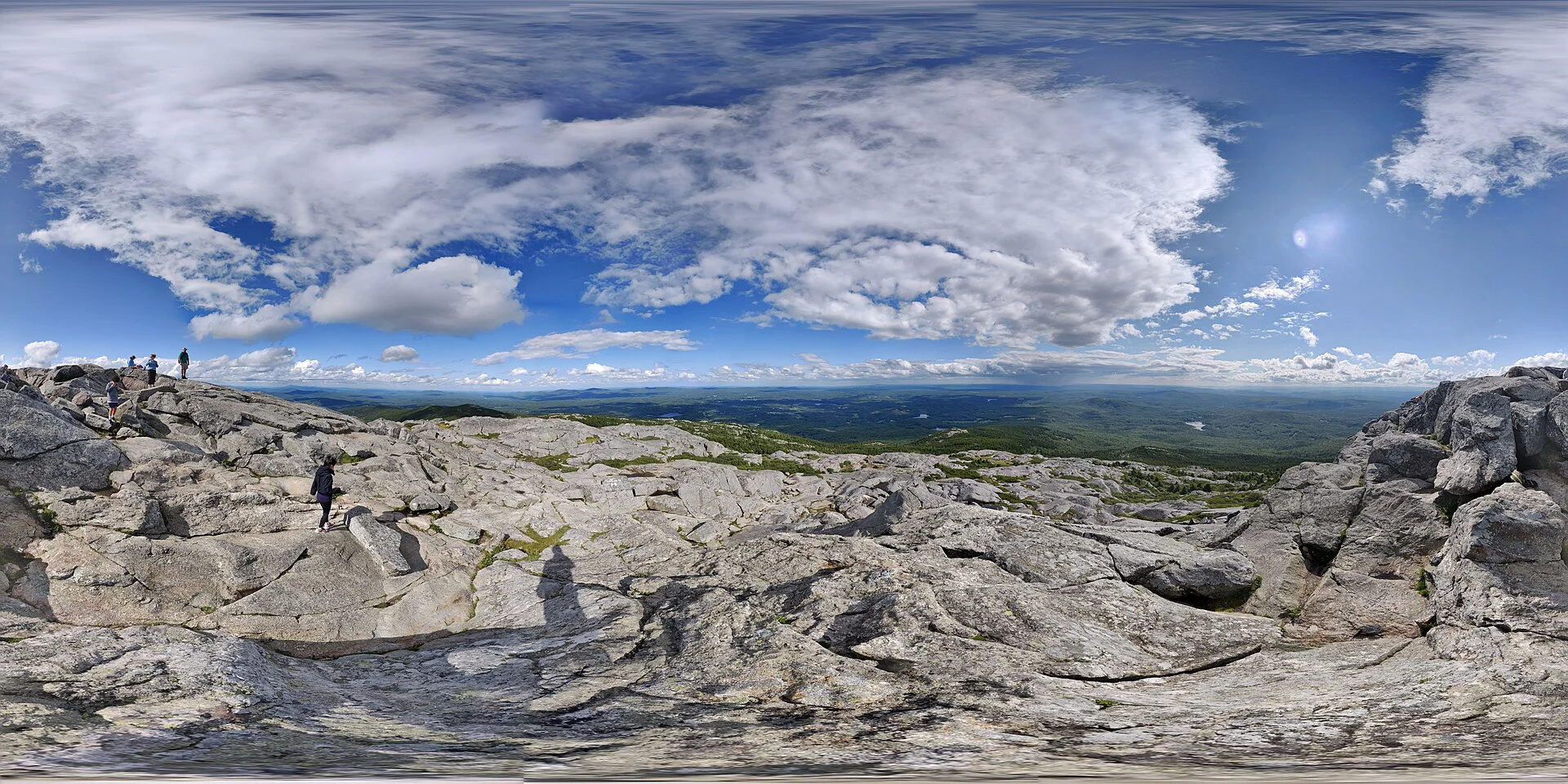
Mount Monadnock’s bare granite summit — exposed by extensive forest fires in the early 1800s (some set deliberately to drive out wolves) and subsequent soil erosion — provides an above-treeline experience unique at this elevation in southern New England. The summit is a tilted expanse of schist bedrock dotted with cairns and painted blazes, offering 360-degree views in every direction.
On the clearest days, the panorama extends to:
- Northeast: Mount Washington and the Presidential Range (100+ miles)
- Southeast: Boston skyline, Atlantic Ocean (60+ miles)
- West: Green Mountains of Vermont
- South: Wachusett Mountain, Massachusetts
- Northwest: Mount Sunapee and Mount Kearsarge
The summit has inspired writers and artists for centuries — Ralph Waldo Emerson wrote his poem “Monadnoc” (1847) after climbing, and Henry David Thoreau made four recorded ascents between 1844 and 1860, documenting the mountain’s natural history in his journals.
Hiking Trails
Mount Monadnock offers 40+ miles of trails ranging from family-friendly half-day hikes to rugged rock scrambles.
| Trail | Distance (RT) | Elev. Gain | Difficulty | Best For |
|---|---|---|---|---|
| 🥾 White Dot Trail | 3.8 mi | 1,700 ft | Moderate-Strenuous | Most popular, shortest to summit |
| 🥾 White Cross Trail | 4.0 mi | 1,700 ft | Moderate | Slightly easier alternative to White Dot |
| 🥾 Pumpelly Trail | 8.6 mi | 1,950 ft | Strenuous | Longest, most scenic ridge traverse |
| 🥾 Marlboro Trail | 4.4 mi | 1,900 ft | Moderate-Strenuous | Less crowded, west-side approach |
| 🥾 Dublin Trail | 4.8 mi | 1,600 ft | Moderate | Scenic, north approach through forest |
| 🥾 Birchtoft Trail | 3.5 mi | 1,500 ft | Moderate | Quiet, wooded approach |
The White Dot Trail — the most popular route — ascends the south face from the park headquarters, offering dramatic open rock scrambles in the upper section with increasingly expansive views. The trail is well-marked but steep and rocky — proper footwear is essential. Most hikers complete the round trip in 3-4 hours.
The Pumpelly Trail — the longest and most scenic route — traverses the entire ridge from Dublin Road, offering miles of above-treeline hiking along the summit ridge with views on both sides. This is the connoisseur’s route, less crowded and more rewarding than the popular south-side trails.
⚠️ Crowd Warning: Mount Monadnock attracts 125,000+ hikers annually. The park frequently fills to capacity on fall foliage weekends (late September-mid October), peak summer weekends, and holidays. Arrive before 9 AM or expect to be turned away. The parking lot holds approximately 125 cars.
Geology
Mount Monadnock is composed of Littleton Formation schist and quartzite — metamorphic rocks approximately 400 million years old (Devonian period). These resistant rocks have survived the erosion that leveled the surrounding landscape, creating the isolated peak that geologists named a “monadnock” — a term now used worldwide for any isolated erosional remnant standing above a peneplain.
The summit’s bare rock was not always exposed. Before the early 1800s, the mountain was forested to the summit. Between 1800 and 1820, extensive fires — some deliberately set by local farmers to drive out wolves and clear timber — burned the summit and upper slopes, destroying the thin soil layer. Without soil, the forest could not regenerate, leaving the bare schist bedrock exposed. This human-caused deforestation created the “above-treeline” experience that draws hikers today — an ecological accident that became a geological landmark.
Camping
| Camping | Details |
|---|---|
| 🏕️ Gilson Pond Campground | 21 tent sites, remote/primitive (no hookups), seasonal |
| 👥 Group Sites | Reservable for organized groups |
The Gilson Pond Campground — on the east side of the mountain — offers primitive tent camping in a quiet forest setting. No hookups, no showers — bring everything you need. The campground provides easy access to the Pumpelly Trail and other east-side trails, avoiding the crowds at the main parking lot.
History & Cultural Significance
Mount Monadnock has been a beacon for hikers, artists, and writers since the early 19th century. The mountain — visible from 50+ miles in every direction — has appeared in more paintings, poems, and essays than perhaps any other peak in the Northeast.
Key historical figures associated with Monadnock:
- Ralph Waldo Emerson — wrote “Monadnoc” (1847) and made multiple ascents
- Henry David Thoreau — climbed four times (1844-1860), documented natural history
- Mark Twain — visited and commented on the views
- Rudyard Kipling — lived in nearby Brattleboro, VT and saw Monadnock daily
- Abbott Henderson Thayer — painted Monadnock hundreds of times from Dublin
The mountain was also the inspiration for the Society for the Protection of New Hampshire Forests (1901), one of the earliest land conservation organizations in America, which began its work protecting Monadnock from development.
Wildlife & Nature
Monadnock State Park — 5,000+ acres in Jaffrey — protects Mount Monadnock (3,165 ft), the most-climbed mountain in North America with 125,000+ hikers annually. The bare summit — exposed by 19th-century fires — provides 360-degree views spanning all six New England states and the Boston skyline (60 miles). The mountain’s northern hardwood forest transitions through spruce-fir stands to bare schist summit. Peregrine falcons nest on the cliffs — a major conservation success story. Dark-eyed juncos and white-throated sparrows sing near the summit. Black bears inhabit the mid-elevation forest. Broad-winged hawks stream past during September migration. Red efts (juvenile newts) carpet the trails after summer rains. Wild turkeys and ruffed grouse inhabit the lower forest.
Nearby Attractions
Jaffrey — 3 miles east — has a classic New England town center with a white-steepled meetinghouse. Peterborough — 10 miles north — inspired Thornton Wilder’s Pulitzer Prize-winning play “Our Town” (1938) and has the Peterborough Players (oldest professional summer theater in the US). Rhododendron State Park — 10 miles northwest in Fitzwilliam — preserves the largest stand of wild Rhododendron maximum north of the Alleghenies (blooms mid-July). Dublin Lake — 5 miles north — has the classic Monadnock reflection view that has inspired artists for 200+ years. Cathedral of the Pines — 5 miles south in Rindge — is a national memorial outdoor cathedral honoring fallen service members. Miller State Park — 10 miles northeast on Pack Monadnock — is NH’s oldest state park (1891) and a hawk migration watch site.
Is Mount Monadnock really the most-climbed mountain in North America?
Yes! Mount Monadnock receives over 125,000 hikers annually, making it the most-climbed mountain in North America and the third most-climbed in the world (after Mount Fuji in Japan and Mount Tai in China). Its accessibility, dramatic summit views, and proximity to the Boston metro area drive this remarkable visitation.
Which trail should I take to the summit?
The White Dot Trail (3.8 miles RT, 1,700 ft gain) is the most popular and shortest route — plan 3-4 hours. For a less crowded experience, try the Marlboro Trail (west side) or the Pumpelly Trail (east side, 8.6 miles, the most scenic ridge traverse). All trails are rocky — wear sturdy hiking boots.
Why is the summit bare rock if it’s only 3,165 feet?
The summit was forested until the early 1800s, when extensive fires — some set deliberately by farmers to drive out wolves — burned away the thin summit soil. Without soil, the forest couldn’t regenerate, leaving exposed schist bedrock. This human-caused deforestation accidentally created the “above-treeline” experience that attracts hikers today.
What does “monadnock” mean?
The word “monadnock” — derived from an Abenaki word meaning “mountain that stands alone” — has entered the geological lexicon as a technical term for any isolated hill or mountain rising above a surrounding eroded plain. Mount Monadnock is the type locality for this geological concept, used in textbooks worldwide.
Make it a road trip: Pair a visit with Mount Monadnock State Park (a short drive away) or Dublin Lake Scenic Area (a short drive away).
🏔️ Climb America’s Most-Hiked Mountain
Where Emerson and Thoreau found inspiration — 3,165 feet of pure New Hampshire granite with views of six states. Arrive early on weekends to secure parking!
Location & Getting There
Monadnock State Park is located at 116 Poole Road, Jaffrey, NH 03452. From Boston (75 miles), take Route 2 west to Route 119 west to Route 124 west, then follow signs to the park. From Keene (20 miles northwest), take Route 101 east to Route 124 east. GPS coordinates: 42.8612, -72.1084. The park entrance fee is $4/adult, $2/child (6-11).
Quick Facts
- Summit Elevation: 3,165 feet
- Acreage: 5,000+ acres
- Annual Hikers: 125,000+
- Trail Miles: 40+
- Coordinates: 42.8612, -72.1084
- Activities: Hiking, Camping, Rock Climbing, Snowshoeing, Cross-Country Skiing
- Fee: $4/adult, $2/child (6-11)
- Pets: Not allowed (due to sensitive summit habitat)
Best Time to Visit
Late May through October is the prime hiking season. Late September through mid-October brings spectacular fall foliage — but expect maximum crowds and early lot closures. June offers wildflowers and fewer crowds. Winter provides snowshoeing and cross-country skiing (trails are not groomed). The park is open year-round.
Explore More New Hampshire State Parks
Monadnock State Park is one of many outstanding state parks in New Hampshire. Discover more parks in our Best State Parks in New Hampshire guide, or use our Park Finder to search by activity, location, or features.

🐾 Dogs & Pets at Monadnock State Park
- Pets allowed? statewide rule
- Many NH state parks allow pets year-round, but policies vary by park and some parks prohibit pets entirely.
- Leash rule statewide rule
- Standard or retractable leash not greater than 6 feet required; animals may not be left unattended.
- Beaches & swim areas statewide rule
- Pets are prohibited at beaches and designated swim areas seasonally from May 1 through September 30.
- Cabins & lodging statewide rule
- Pets are permitted at 13 campgrounds (including Bear Brook, Coleman, Greenfield, Lake Francis, Milan, Mollidgewock, Moose Brook, Pawtuckaway, Pillsbury, Sunapee and Umbagog); cabin/yurt rules vary by park — check before booking.
- Statewide exceptions statewide rule
- Monadnock, North Hampton State Beach, Odiorne Point and most of Rhododendron State Park prohibit pets year-round; Crawford Notch, Franconia Notch and Mount Washington allow pets only on hiking trails and designated dog-walk areas.
Are dogs allowed at Monadnock State Park?
Many NH state parks allow pets year-round, but policies vary by park and some parks prohibit pets entirely. Individual parks can post stricter rules — check signage on arrival.
Rules verified July 2026 via nhstateparks.org. More: New Hampshire state parks guide · Dog rules in all 50 states compared
Park Location
Plan your gear for Monadnock State Park
From our editorial guides, matched to this park’s activities:

Top Tours & Activities Near Manchester
 from $48
 from $50
 from $20