Minneapolis is the outdoor recreation capital of the Upper Midwest — a city of ten thousand lakes surrounded by some of Minnesota’s most spectacular natural landscape. Within an easy drive, the region transitions from urban lakes and greenways to dramatic river bluffs, ancient glacial geology, and vast hardwood forests. Here are the 5 best state parks near Minneapolis for hiking, camping, swimming, and unforgettable natural beauty.
1. Fort Snelling State Park
Best for: Historic battlefield hiking, river confluence, bald eagle watching
Entry Fee: $7 daily permit or $35 annual pass
Fort Snelling State Park occupies one of the most historically significant and scenically dramatic locations in the entire Twin Cities area. The park sits at the confluence of the Mississippi and Minnesota Rivers — the junction of two of America’s great waterways, a spot sacred to the Dakota people for centuries before European contact. From Pike Island, a loop trail allows you to stand at the literal point where the rivers meet, watching the dark water of the Minnesota merge with the broader Mississippi in a genuinely moving natural spectacle.
The park’s trail network — 18 miles in total — extends through floodplain forest, restored prairie, and river bottomland. White-tailed deer, wild turkeys, great blue herons, and bald eagles are commonly encountered. The pike Island trails (1-mile, 2-mile, and 3-mile loops) offer accessible options for all fitness levels. In summer, Snelling Lake has a swimming beach and boat launch. What makes Fort Snelling truly special is its accessibility: it borders the MSP airport perimeter and is served by light rail — you can arrive car-free and step directly into wilderness.
2. Afton State Park
Best for: Prairie hiking, St. Croix River bluffs, swimming beach
Entry Fee: $7 daily permit or $35 annual pass
If you want sweeping vistas and challenging trail hiking without leaving the metro area, Afton State Park delivers. Set above the dramatic bluffs of the St. Croix River near Hastings, Afton is characterized by rolling hills, deep ravines, and beautifully restored oak savanna — a landscape that feels genuinely wild despite its proximity to the Twin Cities.
The hiking here is notably strenuous by Minnesota standards: trails climb abruptly from the river bottom to the bluff tops, rewarding the effort with panoramic views across the blue St. Croix to the Wisconsin shoreline. The park’s swimming beach at river level provides a perfect cooldown after a ridge-top hike. Afton is equally popular in winter — the undulating terrain makes it a top Nordic skiing destination in the Twin Cities region. Year-round camper cabins make it a comfortable four-season destination, and the fall foliage (peaking mid-October) transforms the oak savannas into a spectacular show of gold and russet.
3. William O’Brien State Park
Best for: Canoeing the St. Croix River, family camping, wildlife watching
Entry Fee: $7 daily permit or $35 annual pass
Just under an hour northeast of Minneapolis near the historic village of Marine on St. Croix, William O’Brien State Park offers a quintessential Minnesota outdoor experience. Spanning 1,653 acres of rolling wooded hills, wetlands, and riparian forest along the St. Croix River, the park is particularly beloved for its paddling: gentle St. Croix currents make it one of the finest canoe and kayak destinations accessible from the Twin Cities, ideal for families and beginners.
The park’s 12 miles of hiking trails range from easy forest walks to the challenging Prairie Overlook Trail, which climbs through restored prairie to a ridge with sweeping views of the St. Croix River Valley. Wildlife watching is exceptional year-round: bald eagles nest along the river, white-tailed deer are ubiquitous, and fall migration brings spectacular concentrations of warblers and raptors. Camping is excellent with electric sites, cart-in sites, canoe-in sites along the river, and comfortable year-round camper cabins. William O’Brien is also the park with the most family programming — naturalist-led hikes and campfire programs run throughout the summer.
4. Interstate State Park
Best for: Glacial potholes geology, rock climbing, dramatic gorge views
Entry Fee: $7 daily permit or $35 annual pass
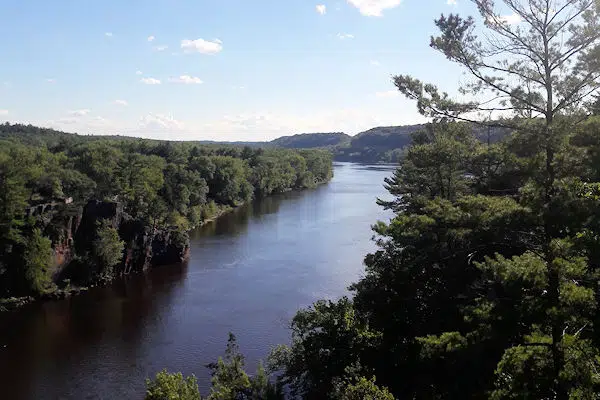
Prepare for geological wonder at Interstate State Park, where the St. Croix River has cut a dramatic gorge through some of the most ancient exposed basalt bedrock in North America. The park sits precisely on the Minnesota-Wisconsin state border in Taylors Falls — hence “Interstate” — and the scenery is unlike anything else in the Upper Midwest.
The undisputed highlight is the Glacial Potholes Area: perfectly cylindrical holes drilled deep into the ancient basalt by swirling glacial meltwater thousands of years ago. The potholes are enormous — some stretching 60 feet deep — and visitors can walk right up to them on a short, accessible path. The towering basalt cliffs above the St. Croix attract rock climbers from across the Midwest, and the river views from the ridge trail are among the most dramatic in Minnesota. The park is small (298 acres) but extraordinarily scenic — go early on summer weekends to beat the crowds at this popular destination.
5. Nerstrand Big Woods State Park
Best for: Maple-basswood forest hiking, Hidden Falls, rare wildflowers
Entry Fee: $7 daily permit or $35 annual pass
An hour south of Minneapolis, Nerstrand Big Woods State Park preserves one of Minnesota’s most ecologically precious landscapes: a surviving fragment of the vast maple-basswood forest that once covered hundreds of square miles of south-central Minnesota. Stepping into the “Big Woods” — with its enormous sugar maples, basswoods, and ironwoods forming a dense, cathedral-like canopy — feels like stepping into a forest from a different era.
The park’s crown jewel is Hidden Falls, a charming waterfall cascading over limestone ledges into a peaceful glen. A short, accessible trail leads directly to the falls, making it a favorite for families. Nerstrand is internationally famous among botanists for its extraordinary spring wildflower display, including the endemic Minnesota dwarf trout lily — a small plant found nowhere else on Earth except in this valley, blooming briefly in late April. When autumn arrives, the Big Woods canopy ignites in brilliant gold and orange, arguably the finest fall foliage display within reach of the Twin Cities.
Annual Pass Tip: A Minnesota State Parks annual vehicle permit costs just $35 and grants unlimited access to all 75 Minnesota state parks for a full year — outstanding value for anyone planning multiple visits. Check if your local library lends state park passes for free day trips.

✍️ About the Author
The State Parks Team is a group of outdoor enthusiasts, researchers, and travel writers dedicated to showcasing America's state parks. Drawing on collective experience visiting parks in all 50 states, the team creates detailed guides, curated park lists, and practical tips to help visitors make the most of their state park adventures. Our mission: making America's state parks accessible and enjoyable for everyone.