ʻIolani Palace State Monument

👑 America’s Only Royal Palace — The sole official royal residence in the United States, home to Hawaiʻi’s last monarchs, with electricity before the White House
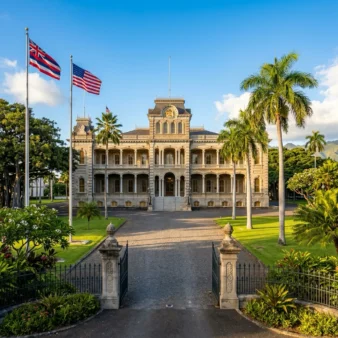
In the heart of downtown Honolulu, surrounded by modern high-rises and government buildings, stands a palace. Not a metaphorical palace or a historic home grandly renamed — an actual royal palace, built by a king, lived in by a queen, and the only one of its kind in the entire United States. ʻIolani Palace was the official residence of the Hawaiian Kingdom’s last two monarchs: King Kalākaua, who built it in 1882, and Queen Liliʻuokalani, who was imprisoned within its walls after the overthrow of the monarchy in 1893.
What makes ʻIolani Palace remarkable isn’t just its uniqueness — it’s how modern it was. When completed in 1882, the palace had electric lighting, indoor plumbing, and a telephone system. The White House didn’t get electricity until 1891. Buckingham Palace didn’t have it until the following year. A Hawaiian king in the middle of the Pacific was using technology that the most powerful nations on Earth hadn’t yet adopted. Today, meticulously restored to its 1880s grandeur, ʻIolani Palace serves as both a museum and a living memorial to the Hawaiian Kingdom — a place where you can walk the same halls as royalty and confront one of the most consequential chapters in American history.
What You’ll See Inside
First Floor: The State Rooms
The Grand Hall sets the tone — polished koa wood, ornate columns, and the staircase where visiting dignitaries were received. The Throne Room contains the original thrones of King Kalākaua and Queen Kapiʻolani, used for state functions, diplomatic receptions, and the grand balls for which Kalākaua was famous. The State Dining Room could seat up to 40 guests for formal dinners and still features original table settings and royal china. The Blue Room served as an informal reception area where the monarchs entertained close friends and advisors.
Second Floor: The Private Chambers
The second floor held the royal family’s private quarters — bedrooms, a library, and a music room where Kalākaua, a gifted musician and composer, wrote songs. It is also where the palace’s darkest chapter played out: after the failed 1895 counter-revolution, Queen Liliʻuokalani was tried by military tribunal and confined to a single upstairs bedroom for eight months. Standing in that room, understanding what happened there, is the most powerful moment of the tour.
Palace Grounds
The 11-acre grounds include the Coronation Pavilion (where Kalākaua was crowned in 1883), the ʻIolani Barracks (now housing the ticket office and Palace Shop), and the Royal Burial Mound. Mature trees, including a massive banyan planted by Queen Kapiʻolani, provide shade for walking the grounds. The grounds are free to explore even without a palace tour ticket.
Tour Options and Pricing
| Tour Type | Duration | Adult (18+) | Teen (13–17) | Youth (5–12) | Child (0–4) |
|---|---|---|---|---|---|
| Docent-Led Tour | ~60 min | $26.00 | $24.00 | $7.95 | Free |
| Self-Led Audio Tour | 45–75 min | $18.00 | $16.00 | $7.95 | Free |
| Specialty Tours | Varies | Varies | Varies | — | — |
| Palace Grounds Only | Self-paced | FREE | FREE | FREE | FREE |
Kamaʻāina (Hawaiʻi residents) and military discounts available. On select Sundays, residents receive complimentary self-led audio tours with valid ID. All tickets must be reserved online in advance at iolanipalace.org — no walk-up sales.
Visitor Tips and Rules
What to Wear
ʻIolani Palace is a sacred cultural site, not a casual tourist attraction. Modest, respectful dress is required. Shirts and closed-toe shoes must be worn. Beachwear, flip-flops, and clothing with profanity are not permitted. You will be given shoe coverings to protect the restored hardwood floors inside the palace. Think “museum visit” not “beach day.”
Photography
Personal photography without flash is encouraged. Tripods, selfie sticks, extended lenses, and professional equipment are not permitted inside the palace. The Throne Room, Grand Hall, and exterior architecture are the most photographed areas.
Children
Children under 5 must be carried in a front-held infant carrier or in a Palace-provided stroller — personal strollers are not allowed inside. Children 5–12 receive a discounted rate. The docent-led tour is better for older children who can engage with the historical narrative; the self-led audio tour allows families to move at their own pace.
Accessibility
A wheelchair lift and elevator provide access to both floors of the palace. Contact the reservation office at (808) 522-0832 or email palacetickets@iolanipalace.org in advance to arrange accommodations.
Historical Timeline
| Year | Event |
|---|---|
| 1845 | First palace structure built on the site (demolished for current building) |
| 1879 | King Kalākaua begins construction of new ʻIolani Palace |
| 1882 | Palace completed — features electricity, plumbing, and telephones |
| 1883 | Kalākaua’s coronation ceremony held on the palace grounds |
| 1891 | Kalākaua dies; Queen Liliʻuokalani ascends the throne |
| 1893 | Overthrow of the Hawaiian Kingdom — palace becomes government headquarters |
| 1895 | Liliʻuokalani tried and imprisoned in an upstairs bedroom for 8 months |
| 1898 | Hawaiʻi annexed by the United States |
| 1969 | State government vacates the palace; restoration begins |
| 1978 | ʻIolani Palace opens to the public as a museum |
Best Time to Visit
| Season | Weather | Crowds | Best For |
|---|---|---|---|
| Winter (Dec–Feb) | 70–80°F | High (holiday tourism) | Pleasant temperatures, holiday events |
| Spring (Mar–May) | 75–85°F | Moderate | Best balance of weather and crowds |
| Summer (Jun–Aug) | 80–88°F | High | Family visits, longest daylight, cultural events |
| Fall (Sep–Nov) | 78–85°F | Low-Moderate | Fewer crowds, pleasant weather, best availability |
Since the palace is indoors and air-conditioned, weather is less of a factor than crowd levels. Fall (September–November) offers the easiest booking and smallest tour groups. Morning tours (9–10 AM) have the best light for photography and are typically less crowded than midday. The palace is closed Sundays and Mondays year-round — plan accordingly.
Know Before You Go
Getting There
ʻIolani Palace is located at 364 South King Street in downtown Honolulu, directly across from the Hawaiʻi State Capitol. From Waikiki, the palace is a 10-minute drive, a 30-minute walk, or a short ride on TheBus (Routes 2, 13, or E). Limited metered street parking is available; the closest parking garage is the Ali’i Place Garage on Richards Street. The ticket office and Palace Shop are in the ʻIolani Barracks building on the palace grounds.
How Long to Plan
Allow 2–3 hours total: 1 hour for the tour (docent-led or audio), 30–45 minutes for the grounds and Coronation Pavilion, and time for the Palace Shop. If you add the nearby Hawaiʻi State Capitol, Washington Place, and Kawaiahaʻo Church, the entire downtown historic zone can fill a half-day.
💰 Trip Cost Estimator
| Expense | Per Adult | Family of 4 (2A+2Y) | Notes |
|---|---|---|---|
| Docent-Led Tour | $26.00 | $67.90 | Best for first-time visitors |
| Self-Led Audio Tour | $18.00 | $51.90 | More flexibility, own pace |
| Palace Grounds | FREE | FREE | No ticket needed |
| Parking (metered) | $3–6 | $3–6 | Or bus from Waikiki |
| TheBus (from Waikiki) | $3.00 | $12.00 | One-way fare |
| Palace Shop | $10–30 | $10–30 | Books, gifts, replicas |
| Total (Docent Tour) | $40–60 | $95–120 | Including transport + shop |
Nearby Attractions
The palace sits in the center of Honolulu’s historic government district. The Hawaiʻi State Capitol is directly across the street — its unique open-air design symbolizes Hawaiian volcanic and oceanic geography. Washington Place, the former governor’s residence and Queen Liliʻuokalani’s private home after her release, is steps away. Kawaiahaʻo Church (1842), built of coral blocks and known as the “Westminster Abbey of the Pacific,” is a short walk south. The Honolulu Museum of Art and Bishop Museum (the world’s premier collection of Hawaiian and Pacific artifacts) are easy drives from the palace district.
Frequently Asked Questions
Do I need to book in advance?
Yes — tickets are sold online only through iolanipalace.org. No walk-up sales or same-day reservations are available. Book at least several days in advance; during high tourist season (December–March), book 1–2 weeks ahead for your preferred time slot.
Which tour is better — docent-led or self-guided?
The docent-led tour ($26) is significantly richer. The docents are deeply knowledgeable and share personal stories, historical context, and emotional nuance that the audio guide cannot match. If this is your first visit, choose the docent tour. The audio tour ($18) is better for repeat visitors or those who prefer to linger in specific rooms at their own pace.
Is ʻIolani Palace really the only royal palace in the US?
Yes — it is the only official royal residence in the entire United States. No other building in the country was built and used as the seat of a sovereign monarchy. This distinction makes it a National Historic Landmark and one of the most historically significant buildings in the nation.
Can I visit just the grounds without a tour?
Yes — the palace grounds, including the Coronation Pavilion and ʻIolani Barracks, are free to explore during open hours without a tour ticket. The grounds alone are worth a visit, especially the mature banyan trees and the historical markers.
Are pets allowed?
No — pets are not permitted on the palace grounds or inside the building. Service animals are accommodated with advance notice.
What about the basement galleries?
The basement galleries are currently closed for renovation until late 2026. When open, they house exhibits on the royal regalia, Crown Jewels, and palace artifacts. Check the official website for reopening updates.
👑 Ready to Visit America’s Only Royal Palace?
Walk the halls where a king hosted grand balls, where a queen was imprisoned, and where the Hawaiian Kingdom breathed its last. ʻIolani Palace is not just a museum — it is the physical memory of a sovereign nation. Advance reservation required.