🌤 Weather at Beckley Furnace Industrial Monument by season
| Spring | Summer | Fall | Winter |
|---|---|---|---|
| 23–72 °F | 53–85 °F | 29–76 °F | 14–40 °F |
Each range runs from the coldest monthly average low to the warmest monthly average high in that season (1991-2020 climate normals), measured at Falls Village, 5 mi away, elevation 550 ft. Conditions at the park can differ from the station, especially where elevation differs — check a forecast before you go.

🏭 Connecticut’s Only Industrial Monument — Where Charcoal and Iron Ore Became the Cannons That Won Wars — Beckley Furnace Industrial Monument in North Canaan, Litchfield County, Connecticut, charcoal-fired iron blast furnace built 1847, part of the Salisbury Iron District, 40-foot stone stack, operated until 1918–1919, produced pig iron for railroad wheels and Civil War cannons, Barnum & Richardson Company, Blackberry River, Iron Heritage Trail, National Register (1978) — Litchfield County, CT
For over 150 years, the hills of northwest Connecticut produced the finest iron in America. More than 40 blast furnaces operated in the Salisbury Iron District, turning local ore and charcoal into the iron that built railroads, armed armies, and industrialized a nation.
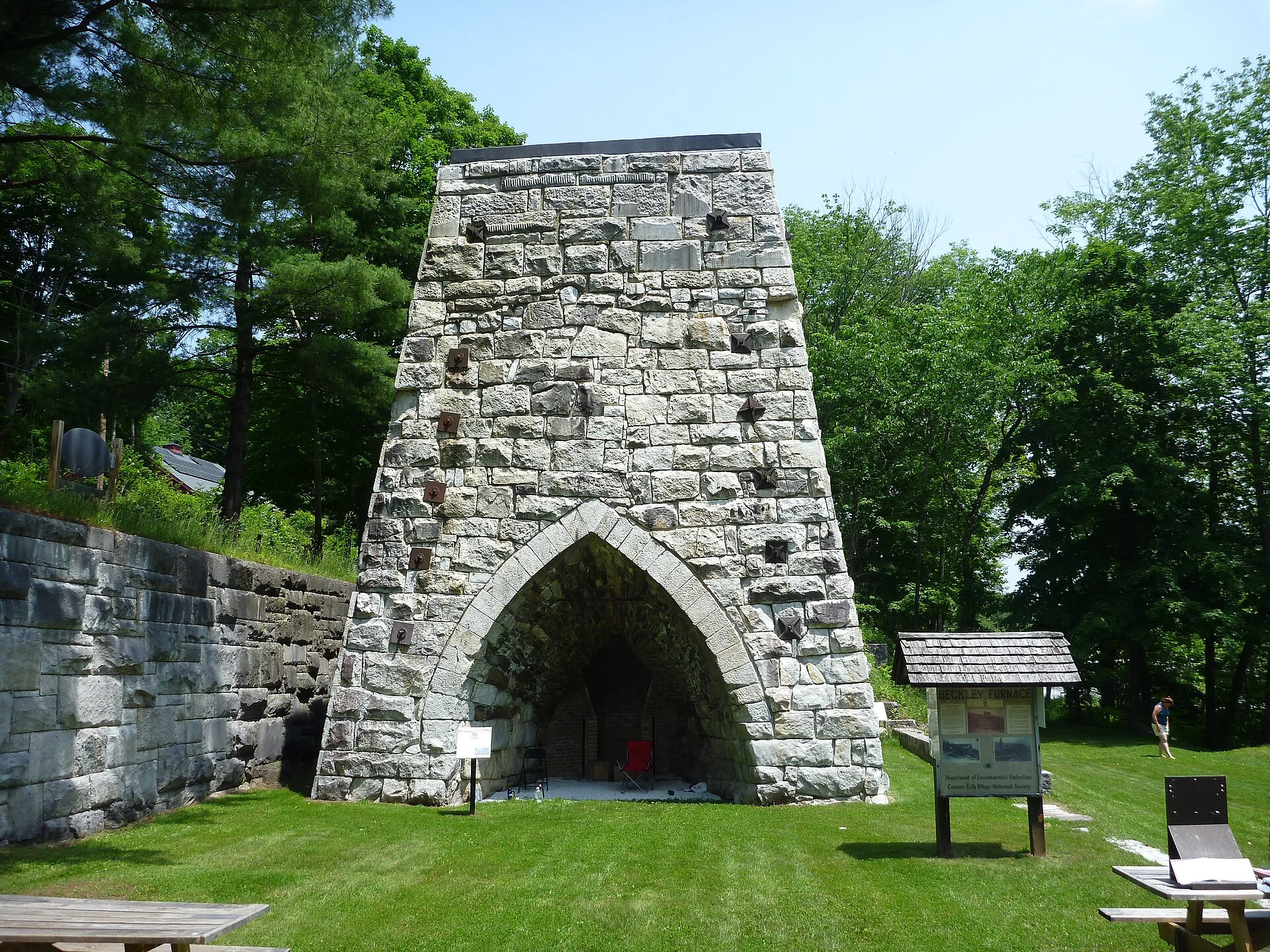
Beckley Furnace, built in 1847 on the banks of the Blackberry River, was one of the largest. Its 40-foot stone stack consumed charcoal and iron ore around the clock, producing pig iron that was forged into railroad wheels, Civil War cannons, and the infrastructure of industrial America. It is Connecticut’s only official industrial monument — and one of the best-preserved blast furnaces in New England.
What to See
| Feature | Details |
|---|---|
| The Furnace Stack | 40-foot stone blast furnace restored in 1999. The massive stone structure where iron ore and charcoal were loaded from the top and molten pig iron was tapped from the bottom |
| Slag Piles | Dark, glassy slag — the byproduct of iron smelting — still visible on the grounds. Touch the waste product of 19th-century heavy industry |
| Blackberry River | The furnace was built on the river to power the bellows that forced air into the furnace. The waterpower infrastructure is visible |
| Interpretive Trail | Self-guided tour with signage and QR codes explaining the charcoal smelting process — from ore to pig iron |
| Iron Heritage Trail | Beckley Furnace is part of the regional Iron Heritage Trail connecting sites from the Salisbury Iron District |
The Timeline
| Year | Event |
|---|---|
| 1700s | The Salisbury Iron District emerges in northwest Connecticut. Local ore is unusually high quality. During the Revolution, the district supplies a significant percentage of the cannons produced in the colonies |
| 1847 | John Adam Beckley builds the blast furnace on the Blackberry River in East Canaan (now North Canaan) |
| 1858 | Barnum & Richardson Company acquires the furnace. Upgrades the stack to 40 feet. It becomes one of the largest furnaces in the district |
| 1861–1865 | Civil War. Salisbury iron is used for cannons, muskets, and military equipment. Demand surges |
| 1870s–1900s | The furnace produces pig iron for railroad car wheels — Salisbury iron was known for extreme durability. The district’s iron keeps the railroads running |
| 1918–1919 | Beckley Furnace closes after World War I. Demand for charcoal iron has declined as Pennsylvania’s coal-fired furnaces dominate |
| 1946 | State of Connecticut purchases the site. Designated as Connecticut’s sole official industrial monument |
| 1978 | Listed on the National Register of Historic Places |
| 1999 | Full restoration of the furnace stack completed |
Best Time to Visit
| Season | Best For |
|---|---|
| Fall (Sep–Oct) | 🍂 Peak Litchfield County foliage. The stone furnace framed by fall color. Cool weather for exploring |
| Spring (May–Jun) | 🌿 Blackberry River running strong. Green hillsides. Wildflowers around the slag piles |
| Summer (Jul–Aug) | Full daylight. Warm weather. Good for combining with Housatonic River recreation |
| Winter (Dec–Feb) | New England winter. The bare stone stack is dramatic against winter skies |
Frequently Asked Questions
What is pig iron?
Pig iron is the raw iron produced by a blast furnace. Iron ore and charcoal are loaded into the top of the furnace, air is blasted in from the bottom, and molten iron collects at the base. The liquid iron is poured into molds called “pigs” — hence “pig iron.” It is then further refined into wrought iron or steel.
Why was Salisbury iron so good?
The local ore contained unusually low sulfur and phosphorus. This produced iron that was harder and more durable than iron from most other sources — which is why Salisbury iron was preferred for cannon barrels and railroad wheels, applications where failure meant catastrophe.
Why did the furnace close?
Charcoal iron couldn’t compete with coal-fired furnaces. By the early 1900s, Pennsylvania’s anthracite coal furnaces produced iron more cheaply and in greater volume. Charcoal iron was superior in quality but too expensive to produce at scale.
Make it a road trip: Pair a visit with Robbins Swamp Wildlife Management Area (a short drive away) or Skiff Mountain Coop Wildlife Management Area (a short drive away).
🏭 40 Feet of Stone. 70 Years of Fire. Connecticut’s Iron Legacy.
Revolution cannons. Civil War muskets. Railroad wheels. All from the iron smelted in the hills of northwest Connecticut. Beckley Furnace is the last one standing.
Wildlife & Nature
Beckley Furnace IM — the last remaining blast furnace in the Salisbury iron district — once America’s premier iron-producing region. The site’s Blackberry River, forest, and historic grounds support white-tailed deer, songbirds, and brook trout.
Nearby Attractions
East Canaan — adjacent. Litchfield County — surrounding. Housatonic River — nearby.

🐾 Dogs & Pets at Beckley Furnace Industrial Monument
- Pets allowed? statewide rule
- Pets on a leash are permitted in most Connecticut state parks and forests, but not in buildings, swimming areas or state park campgrounds.
- Leash rule statewide rule
- Pets must be leashed and under control at all times; in state forest camping areas the leash may be no longer than 7 feet.
- Beaches & swim areas statewide rule
- Pets are prohibited in swimming areas; Sherwood Island and Squantz Pond State Parks ban pets entirely April 15 - September 30.
- Cabins & lodging statewide rule
- Pets are banned from all state park campgrounds; they are allowed only in the American Legion, Pachaug and Salt Rock state forest campgrounds, but not on rustic cabin sites.
- Statewide exceptions statewide rule
- Pets prohibited year-round at Dinosaur State Park and in the formal gardens and beach at Harkness Memorial State Park.
Are dogs allowed at Beckley Furnace Industrial Monument?
Pets on a leash are permitted in most Connecticut state parks and forests, but not in buildings, swimming areas or state park campgrounds. Individual parks can post stricter rules — check signage on arrival.
Rules verified July 2026 via portal.ct.gov. More: Connecticut state parks guide · Dog rules in all 50 states compared
Park Location
Plan your gear for Beckley Furnace Industrial Monument
From our editorial guides, matched to this park’s activities:
Top Tours & Activities Near The Berkshires
 from $150
 from $29
 from $29