
🌤 Weather at Blackwater Falls State Park by season
| Spring | Summer | Fall | Winter |
|---|---|---|---|
| 24–64 °F | 53–75 °F | 29–68 °F | 16–36 °F |
Each range runs from the coldest monthly average low to the warmest monthly average high in that season (1991-2020 climate normals), measured at Davis 3SE, 3 mi away, elevation 3,715 ft. Conditions at the park can differ from the station, especially where elevation differs — check a forecast before you go.

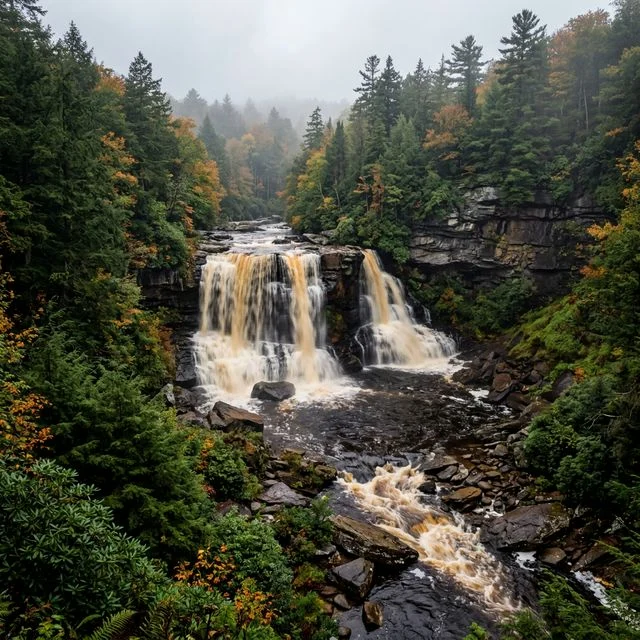
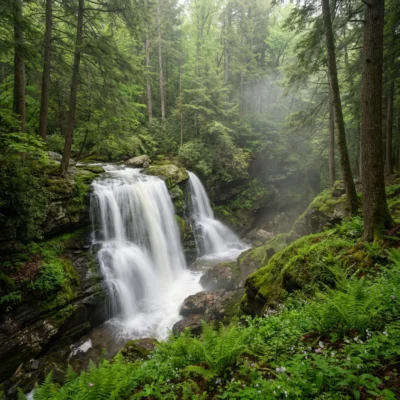
🏆 West-virginia — Iconic 57-foot waterfall where amber-colored water plunges over sandstone — the water is stained dark by tannic acid from fallen hemlock and red spruce needles! The Blackwater Canyon is called the “Grand Canyon of the East” and the surrounding Canaan Valley receives 180+ inches of snow annually!
Visitor Information
| Detail | Info |
|---|---|
| Location | West Virginia |
About Blackwater Falls
Blackwater Falls State Park in Tucker County features a dramatic 57-foot waterfall where the Blackwater River plunges over a sandstone ledge into a mile-long canyon. The water’s dark amber color — caused by tannic acid from fallen red spruce and hemlock needles — gives the river and falls their name. The park sits at 3,100 feet elevation on the Allegheny Plateau, creating a climate zone more like New England than the mid-Atlantic.
Things to Do
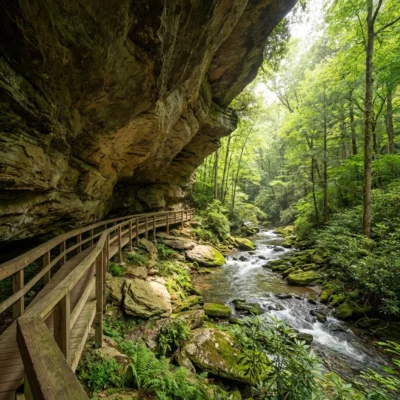
Viewing the 57-foot falls from the boardwalk, hiking the canyon rim, cross-country skiing (100+ inches of snow annually), staying at the lodge (54 rooms), fishing, mountain biking, and exploring the “Canada of West Virginia.”
Plan Your Visit
The lodge (54 rooms) and cabins (26) fill quickly — reserve months ahead for fall foliage season (mid-October). The 57-foot falls are accessible via a 214-step boardwalk from the main parking lot. Elakala Falls (4 cascading waterfalls) requires a moderate hike. Blackwater Canyon has some of the best cross-country skiing in the Mid-Atlantic (100+ inches of snow). Canaan Valley Resort and Timberline Mountain ski areas are 15 minutes south.
Insider Tips
Unreconstructed rebel: Robert Toombs was Georgia’s most defiant Confederate — he served as Confederate Secretary of State but refused to seek a pardon after the war, declaring “I am not loyal to the existing government.” Pro tip: Toombs fled to Europe to avoid arrest after the war, returning to Georgia where he lived defiantly until 1885. Washington, GA: The town of Washington claims to be the last meeting place of the Confederate Cabinet (1865).
Best Time to Visit
Spring/fall: Best touring weather. Year-round: House tours and exhibits. Summer: Full programming. Winter: Quiet visits.
Frequently Asked Questions
What happened to Confederate leaders after the war?
Most Confederate leaders eventually received pardons and rejoined American society — Jefferson Davis was imprisoned for two years, then released. Robert E. Lee became a college president. But Robert Toombs was one of the few who never sought pardon or reconciliation — he remained defiant until death. His house in Washington, Georgia tells the story of a man who never accepted the war’s outcome.
Make it a road trip: Pair a visit with Canaan Valley Resort State Park (a short drive away) or Fairfax Stone Historical Monument State Park (a short drive away).
Wildlife & Nature
Blackwater Falls SP — features Blackwater Falls — a 57-foot cascade of amber-colored water (tinted by tannic acid from hemlock and red spruce). The Blackwater Canyon is one of the deepest and most dramatic canyons east of the Mississippi. The park’s spruce-hemlock forest, canyon, and falls support black bears, northern flying squirrels, and snowshoe hares.
Nearby Attractions
Davis — adjacent. Canaan Valley Resort SP — 10 miles south. Dolly Sods Wilderness — 15 miles east.

🐾 Dogs & Pets at Blackwater Falls State Park
- Pets allowed? statewide rule
- Dogs and cats (the only pets permitted) are welcome in West Virginia state parks and forests, including campgrounds and trails, if leashed, restrained, vaccinated and in good health.
- Leash rule statewide rule
- Pets must be leashed and restrained at all times; in lodging public areas a sturdy leash no longer than 10 ft is required
- Cabins & lodging statewide rule
- Select pet-friendly cabins, cottages and lodge rooms at 16 state parks and 4 state forests (e.g. Babcock, Blackwater Falls, Cacapon Resort, Twin Falls Resort); lodge rooms $25 first night + $10 each additional night per pet (capped at $75 per visit), cabins $50 first night + $5 each additional night per pet
- Pet fees statewide rule
- Lodging pet fees: lodge rooms $25 first night + $10/additional night per pet (max $75/visit); cabins $50 first night + $5/additional night per pet
- Statewide exceptions statewide rule
- Only dogs and cats permitted; maximum two pets in pet-friendly lodging; rabies certification required for lodging stays
- Dogs & wildlife
- Never leave pet food outdoors at your campsite — the WVDNR lists it among the top bear attractants.
Are dogs allowed at Blackwater Falls State Park?
Dogs and cats (the only pets permitted) are welcome in West Virginia state parks and forests, including campgrounds and trails, if leashed, restrained, vaccinated and in good health. Individual parks can post stricter rules — check signage on arrival.
Rules verified July 2026 via wvstateparks.com. More: West Virginia state parks guide · Dog rules in all 50 states compared
🐻 Wildlife at Blackwater Falls State Park: What to Watch For — and Watch Out For
Worth watching for: The park's year-round naturalist program is built around local wildlife: guided morning bird walks along Pendleton Lake, programs on West Virginia's frogs and toads, and resident turtles at the nature center. Black bears also feature in the park's nature programming, reflecting their presence in this stretch of the Allegheny Highlands.
Watch out for: This is black bear habitat, and the West Virginia DNR's rules are simple: never feed or approach a bear, and secure food, garbage, and grills at camp — intentionally feeding a bear is illegal in West Virginia. If you encounter one, stay calm, quietly back away without running or climbing a tree, and give the bear a clear escape route. In the rare event of an attack, fight back immediately.
Are there bears at Blackwater Falls State Park?
Yes — see above for where they occur in the park and how to behave. Sightings are a normal part of a healthy park; incidents are rare when visitors keep distance and store food properly.
Wildlife information verified July 2026 via wvstateparks.com.
Park Location
Plan your gear for Blackwater Falls State Park
From our editorial guides, matched to this park’s activities:
Top Tours & Activities Near West Virginia
 from $109
 from $103
 from $200