🌤 Weather at Mooween State Park by season
| Spring | Summer | Fall | Winter |
|---|---|---|---|
| 29–70 °F | 58–84 °F | 34–76 °F | 21–43 °F |
Each range runs from the coldest monthly average low to the warmest monthly average high in that season (1991-2020 climate normals), measured at Norwich Public Utility Plt, 9 mi away, elevation 20 ft. Conditions at the park can differ from the station, especially where elevation differs — check a forecast before you go.

Overview
Mooween State Park is a 577-acre recreation area in Lebanon, Connecticut, centered around the scenic 127-acre Red Cedar Lake. Once the site of Camp Mooween — a beloved boys’ summer camp that operated from 1921 to 1960 — the park now offers an extensive trail network, excellent paddling, and fishing in one of eastern Connecticut’s most scenic lake settings. Remnants of the historic camp, including concrete foundations and stone structures, can still be discovered along the trails.
With approximately 15 miles of multi-use trails suitable for hiking, mountain biking, and horseback riding, Mooween State Park has become a popular destination for trail enthusiasts seeking diverse terrain through hardwood forests, wetland edges, and lakeside corridors. The park’s relatively uncrowded atmosphere makes it an excellent choice for visitors who prefer a quieter outdoor experience.
Recreation & Activities
Paddling & Boating
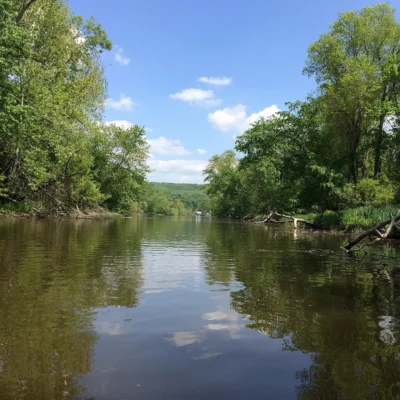
Red Cedar Lake is the centerpiece of Mooween State Park and offers excellent kayaking, canoeing, and stand-up paddleboarding. A boat launch is available at 166 Camp Mooween Road. The lake’s calm waters and forested shoreline create a peaceful paddling environment, ideal for both beginners and experienced paddlers looking for a relaxing outing.
Hiking & Mountain Biking
The park features roughly 15 miles of multi-use trails, including both singletrack and double-track paths that wind through forested terrain and past historic camp remnants. The trails offer a mix of easy to moderate difficulty and are shared by hikers, mountain bikers, and horseback riders. Please note that e-bikes are generally not permitted on park trails per state regulations.
Fishing
Red Cedar Lake supports populations of largemouth bass, bluegill, yellow perch, and other warm-water species. Shore fishing is accessible along various points of the lake, and boat-based fishing is available from the launch area. A valid Connecticut fishing license is required.
Hunting
Hunting is permitted in the park during designated seasons (mid-September through December 31). Visitors are advised to wear bright orange during hunting season and note that there is no hunting on state lands on Sundays in Connecticut.
Historical Exploration
History enthusiasts will enjoy seeking out remnants of Camp Mooween throughout the park. Concrete foundations, stone walls, and other artifacts from the 1921–1960 boys’ camp era are scattered along various trails, offering a unique window into the area’s recreational past.
Location & Directions
- Address: 166 Camp Mooween Rd, Lebanon, CT (boat launch)
- Coordinates: 41.6217°N, 72.2089°W
- Location: Town of Lebanon, eastern Connecticut, approximately 30 miles east of Hartford
Frequently Asked Questions
Can I swim at Mooween State Park?
Mooween State Park does not have a designated swimming area or beach. The park is primarily oriented toward paddling, fishing, hiking, and mountain biking.
Are e-bikes allowed on the trails?
No, e-bikes are generally not permitted on trails within Connecticut state parks per current state regulations. Standard bicycles and mountain bikes are welcome on designated trails.
What are the remnants of Camp Mooween?
Camp Mooween was a boys’ summer camp that operated on this land from 1921 to 1960. While the buildings are gone, visitors can find concrete foundations, stone fireplaces, and other structural remnants along the trail network, particularly near the lake’s southern shore.
Wildlife & Nature
Mooween State Park preserves Connecticut forest and recreation land. The park’s mixed hardwood forest supports the typical wildlife community of southern New England — white-tailed deer, wild turkeys, gray squirrels, and chipmunks are year-round residents. Seasonal visitors include dozens of warbler species during spring migration — Connecticut lies on the Atlantic Flyway, and May brings waves of colorful neotropical migrants passing through to breeding grounds further north. Great horned owls — the most powerful of Connecticut’s three common owl species — are apex nocturnal predators capable of taking prey as large as skunks. Their deep hooting begins in January when they start nesting — the earliest breeding bird in Connecticut.
Nearby Attractions
The surrounding area provides access to Connecticut’s outdoor recreation network. Shenipsit State Forest offers ridge hiking and the Soapstone Mountain fire tower with panoramic views. Shenipsit Trail — a 50-mile blue-blazed trail — traverses the eastern Connecticut highlands. Stafford Springs retains Victorian architecture from its mineral springs resort era. Stafford Motor Speedway has hosted stock car racing since 1948. UConn in Storrs offers cultural attractions and the Dairy Bar. Crystal Lake in Ellington provides summer swimming and fishing.
Nearby state parks: If you have extra time, Gardner Lake State Park is a short drive away, and Hopemead State Park is a short drive away.

🐾 Dogs & Pets at Mooween State Park
- Pets allowed? statewide rule
- Pets on a leash are permitted in most Connecticut state parks and forests, but not in buildings, swimming areas or state park campgrounds.
- Leash rule statewide rule
- Pets must be leashed and under control at all times; in state forest camping areas the leash may be no longer than 7 feet.
- Beaches & swim areas statewide rule
- Pets are prohibited in swimming areas; Sherwood Island and Squantz Pond State Parks ban pets entirely April 15 - September 30.
- Cabins & lodging statewide rule
- Pets are banned from all state park campgrounds; they are allowed only in the American Legion, Pachaug and Salt Rock state forest campgrounds, but not on rustic cabin sites.
- Statewide exceptions statewide rule
- Pets prohibited year-round at Dinosaur State Park and in the formal gardens and beach at Harkness Memorial State Park.
Are dogs allowed at Mooween State Park?
Pets on a leash are permitted in most Connecticut state parks and forests, but not in buildings, swimming areas or state park campgrounds. Individual parks can post stricter rules — check signage on arrival.
Rules verified July 2026 via portal.ct.gov. More: Connecticut state parks guide · Dog rules in all 50 states compared
Park Location
Plan your gear for Mooween State Park
From our editorial guides, matched to this park’s activities:

Top Tours & Activities Near New London
 from $79
 from $41
 from $550