
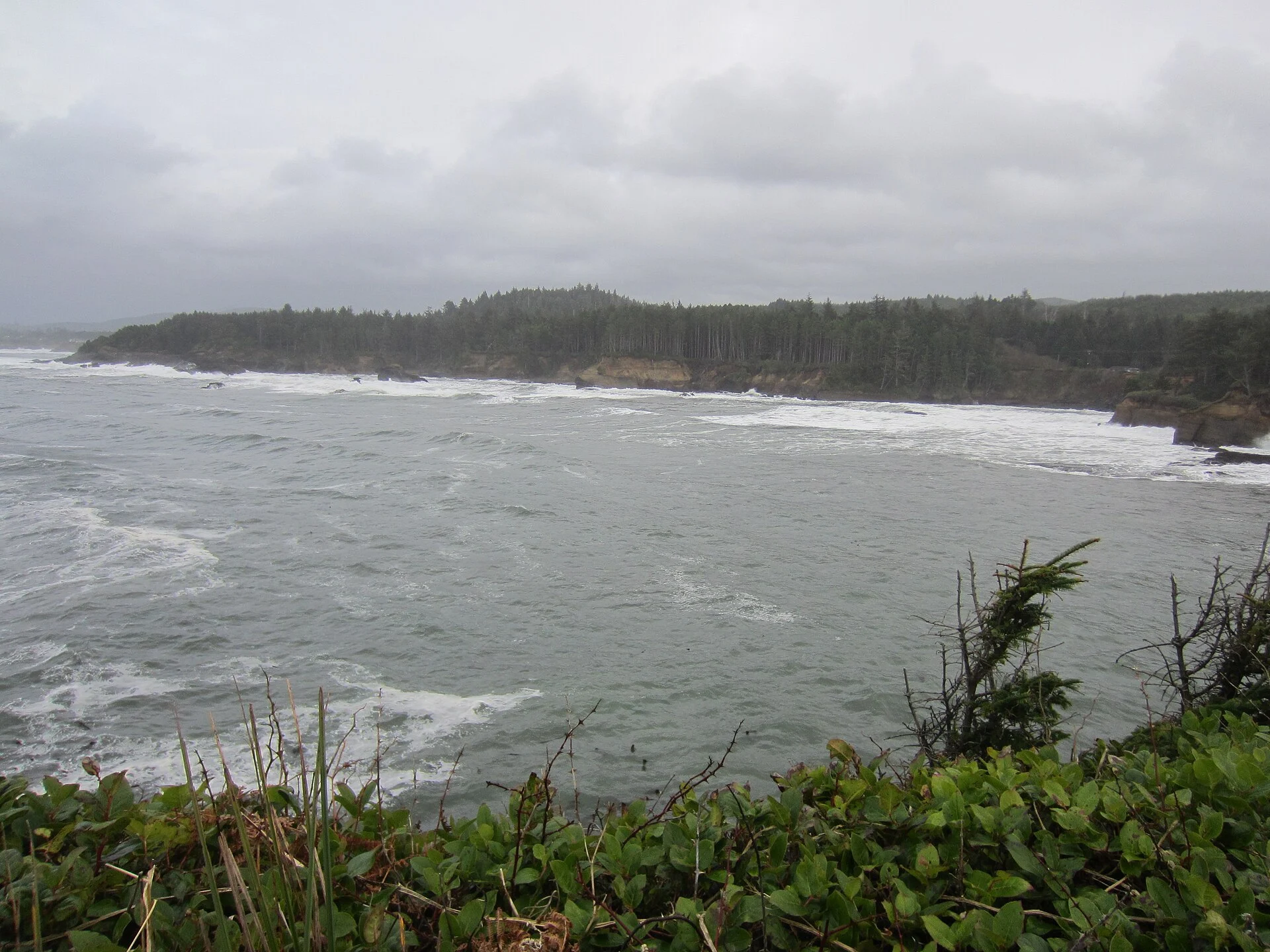
🌤 Weather at Boiler Bay State Scenic Viewpoint by season
| Spring | Summer | Fall | Winter |
|---|---|---|---|
| 41–59 °F | 49–66 °F | 44–66 °F | 41–55 °F |
Each range runs from the coldest monthly average low to the warmest monthly average high in that season (1991-2020 climate normals), measured at Newport 3N, 10 mi away, elevation 220 ft. Conditions at the park can differ from the station, especially where elevation differs — check a forecast before you go.

🌊 A Shipwreck Named the Viewpoint — Where a Burning Freighter’s Boiler Still Sits in the Surf — Boiler Bay State Scenic Viewpoint on the Oregon Coast near Depoe Bay, Lincoln County, named for the J. Marhoffer shipwreck (1910), basalt headland overlooking the Pacific, whale watching (gray whales year-round), storm watching, tidepools, seabirds, Highway 101 — Lincoln County, OR
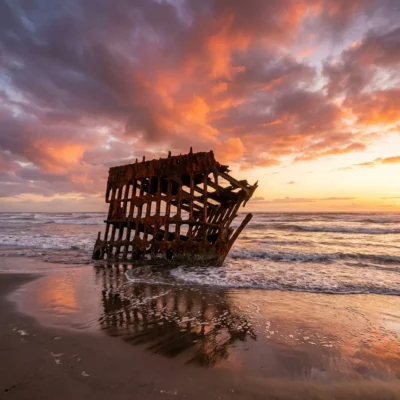
On May 18, 1910, the 175-foot steam schooner J. Marhoffer caught fire off the Oregon coast. The captain ran her aground in the bay north of Depoe Bay. The fuel tanks exploded, scattering debris across the headland. The crew survived. The ship didn’t.
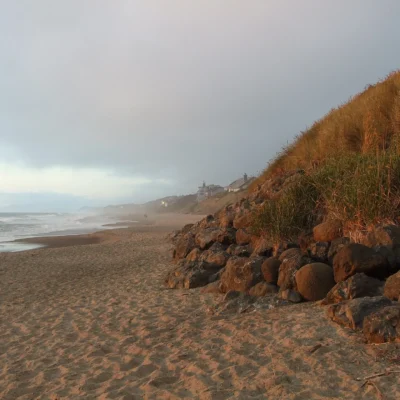
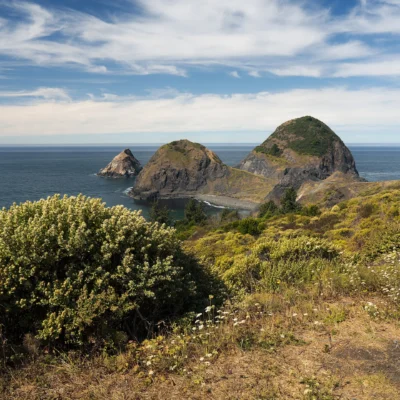
The boiler — the massive iron heart of the steam engine — still sits in the surf, visible at extreme low tides. They named the bay after it. Then they built a viewpoint on the basalt headland above. And it turns out the headland is one of the best whale watching spots on the entire Oregon coast.
What to See
| Feature | Details |
|---|---|
| The Boiler | The iron boiler of the J. Marhoffer — visible at extreme low tides at the water’s edge. 115+ years of saltwater haven’t destroyed it. Check tide tables for minus tides to see the remnant |
| Whale Watching | Gray whales migrate along the Oregon coast twice yearly — southbound December–January, northbound March–June. A resident pod of ~200 gray whales feeds off the central Oregon coast year-round. The elevated headland provides exceptional sightline |
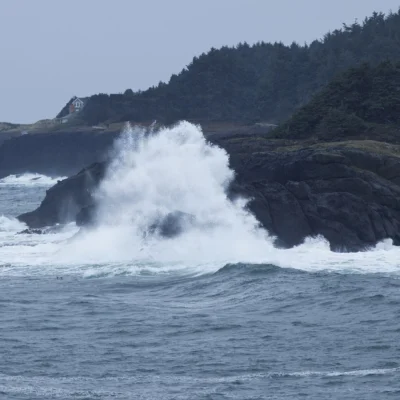
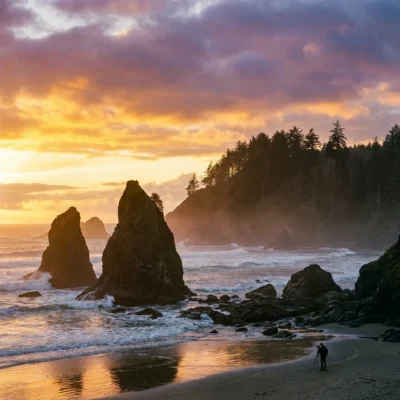
| Storm Watching | Winter storms drive Pacific swells against the basalt cliffs — waves exploding 50+ feet into the air. King tides amplify the drama. One of Oregon’s premier storm watching viewpoints |
| Seabirds | Shearwaters, jaegers, brown pelicans, black oystercatchers, cormorants, and albatrosses visible from the headland. The offshore rocks provide roosting habitat. Bring binoculars |
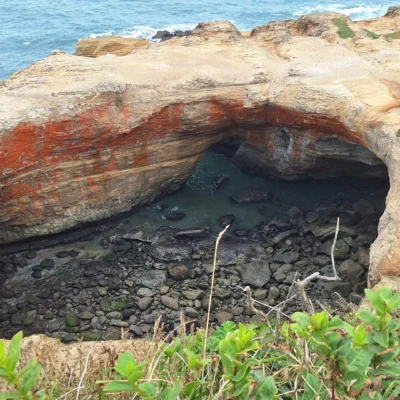
| Tidepools | Access to tidepool areas along the rocky shore below the viewpoint. Sea stars, anemones, mussels, and sculpins in the intertidal zone. Trail to the shore is steep and rugged |
The J. Marhoffer
| Detail | Description |
|---|---|
| The Ship | 175-foot steam schooner built in 1890. Carried lumber and cargo along the Pacific coast. Named for her owner, J. Marhoffer of San Francisco |
| The Fire | May 18, 1910 — fire broke out aboard while the ship was off the Oregon coast. Captain ran her aground in the bay. All crew rescued by lifesaving station. The ship burned to the waterline |
| The Explosion | After grounding, the fuel tanks exploded, scattering wreckage across the headland and into the surrounding forest. Debris was found hundreds of feet from the shore |
| The Legacy | The boiler — too heavy to salvage, too strong to rust away completely — remains in the surf. The bay was named “Boiler Bay” and the Oregon Parks department built a scenic viewpoint on the headland above |
Best Time to Visit
| Season | Best For |
|---|---|
| Winter (Dec–Feb) | 🌊 Storm watching at its most dramatic. Southbound whale migration. King tides. Massive Pacific swells against basalt cliffs. Bring rain gear |
| Spring (Mar–May) | 🐋 Northbound gray whale migration peak. Wildflowers on the headland. Calmer seas for tidepool access. Resident whale pod settling in |
| Summer (Jun–Aug) | Best weather. Resident gray whales feeding. Seabird activity at peak. Low tides for boiler viewing. Depoe Bay at its busiest |
| Fall (Sep–Nov) | Storms building. Fewer visitors. Fall bird migration. Dramatic light on the coast. The transition from calm to wild |
Frequently Asked Questions
Can I see the boiler?
Only at extreme low tides — the boiler sits at the water’s edge and is usually submerged. Check tide tables for minus tides (below 0.0 feet). Even then, it may be partially covered. The best viewing is during summer minus tides with calm seas.
Is Depoe Bay nearby?
Yes — Boiler Bay is about 1 mile north of Depoe Bay on Highway 101. Depoe Bay bills itself as the “Whale Watching Capital of the Oregon Coast” and has the world’s smallest navigable harbor. Charter whale watching boats operate from the harbor year-round.
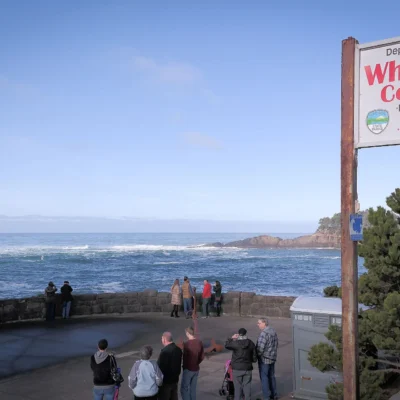
More parks nearby: Whale Watching Center is a short drive away, while Fogarty Creek State Recreation Area lies a short drive away.
🌊 The Ship Burned. The Boiler Survived. 115 Years Later, It’s Still in the Surf.
A steam schooner fire. A fuel tank explosion. An iron boiler too heavy to salvage. And a headland where gray whales pass year-round and Pacific storms hit basalt at 50 feet.
Wildlife & Nature
Boiler Bay SSV — named for the boiler of the steamship J. Marhoffer, which exploded and sank here in 1910 (the boiler is visible at low tide). The viewpoint’s rocky headlands, tidepools, and offshore rocks support gray whales, harbor seals, and sea lions. One of the best whale-watching spots on the Oregon Coast.
Nearby Attractions
Depoe Bay — adjacent — the “Whale Watching Capital of the Oregon Coast” (smallest navigable harbor in the world). Lincoln City — 10 miles north.

🐾 Dogs & Pets at Boiler Bay State Scenic Viewpoint
- Pets allowed? statewide rule
- Pets are welcome in Oregon state parks and on most ocean beaches but must be leashed except in designated off-leash areas.
- Leash rule statewide rule
- Leash no longer than 6 feet required in developed park areas
- Beaches & swim areas statewide rule
- Pets are allowed on most ocean beaches under direct control; western snowy plover nesting areas restrict pets March 15 - Sept. 15; leash required on the beach at some parks (e.g. Cape Lookout)
- Cabins & lodging statewide rule
- Designated pet-friendly yurts and cabins at many parks (South Beach has 14 pet-friendly yurts, Tugman 8); maximum two dogs and/or cats; $10 per night pet fee
- Pet fees statewide rule
- $10 per night for pet-friendly yurts/cabins; no pet fee for day use or campsites
- Statewide exceptions statewide rule
- Pets prohibited at Dabney SRA, the Trail of Ten Falls at Silver Falls, and Shore Acres; off-leash areas at Stub Stewart, Willamette Mission, Elijah Bristow, Cottonwood Canyon and LaPine
Are dogs allowed at Boiler Bay State Scenic Viewpoint?
Pets are welcome in Oregon state parks and on most ocean beaches but must be leashed except in designated off-leash areas. Individual parks can post stricter rules — check signage on arrival.
Rules verified July 2026 via stateparks.oregon.gov. More: Oregon state parks guide · Dog rules in all 50 states compared
Park Location
Top Tours & Activities Near Lincoln City
 from $600
 from $35