

🌤 Weather at Dahlonega Gold Museum State Historic Site by season
| Spring | Summer | Fall | Winter |
|---|---|---|---|
| 35–77 °F | 60–86 °F | 35–80 °F | 27–54 °F |
Each range runs from the coldest monthly average low to the warmest monthly average high in that season (1991-2020 climate normals), measured at Cleveland, 13 mi away, elevation 1,567 ft. Conditions at the park can differ from the station, especially where elevation differs — check a forecast before you go.

⛏️ America’s First Gold Rush — 21 Years Before California, Gold Fever Hit the Georgia Mountains — Dahlonega Gold Museum State Historic Site in Dahlonega, Georgia, housed in the 1836 Lumpkin County Courthouse (one of Georgia’s oldest courthouses), site of America’s first major gold rush (1828), Cherokee land, U.S. Branch Mint (1838–1861), gold coin exhibits, mining artifacts, gold panning demonstrations, Appalachian Mountain setting, Dahlonega town square — Lumpkin County, GA
In 1828 — twenty-one years before Sutter’s Mill — a deer hunter named Benjamin Parks kicked up a rock in the north Georgia mountains and found gold underneath. Within months, thousands of prospectors flooded into Cherokee territory, triggering America’s first major gold rush and, ultimately, one of the darkest chapters in American history: the forced removal of the Cherokee Nation on the Trail of Tears.
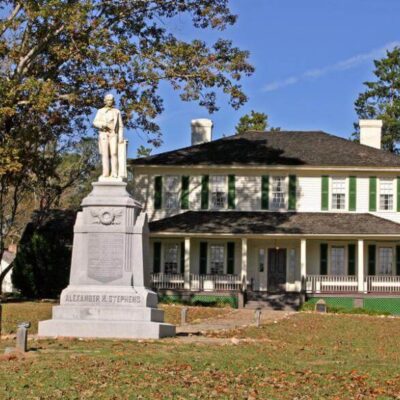
The Dahlonega Gold Museum sits at the center of that story — housed in the 1836 Lumpkin County Courthouse, one of the oldest public buildings in Georgia, on the town square where it all happened.
What to See
| Feature | Details |
|---|---|
| The Courthouse | 1836 Lumpkin County Courthouse — one of Georgia’s oldest courthouses. The building itself is a historic artifact, built during the peak of the gold rush |
| Gold Exhibits | Gold coins minted at the Dahlonega Branch Mint (1838–1861). Mining tools, assay equipment, and artifacts from the rush. Original gold nuggets |
| The Branch Mint | The U.S. government established a Branch Mint in Dahlonega in 1838 — one of only a handful outside Philadelphia. It operated until 1861, when Georgia seceded and Confederate forces seized it |
| Film | 23-minute introductory film covering the discovery, the gold rush, the Cherokee removal, and the mint |
| Gold Panning | Hands-on gold panning demonstrations available. Yes, there is still gold in these hills |
The Timeline
| Year | Event |
|---|---|
| ~1828 | Gold discovered on Cherokee land in north Georgia. America’s first major gold rush begins |
| 1829–1830 | Thousands of prospectors flood the area. Georgia begins legal action to seize Cherokee territory |
| 1832 | Georgia holds a land lottery, distributing Cherokee land to white settlers |
| 1836 | Lumpkin County Courthouse built on Dahlonega town square (the current museum building) |
| 1838 | U.S. Branch Mint opens in Dahlonega. Cherokee removal (Trail of Tears) begins |
| 1849 | California Gold Rush. Dahlonega assayer reportedly told departing miners: “There’s gold in them thar hills!” — the quote that became legend |
| 1861 | Confederate forces seize the Dahlonega Mint. It never reopens as a federal facility |
The Bigger Story
The Georgia Gold Rush wasn’t just an economic event — it was the catalyst for the Trail of Tears. Gold on Cherokee land gave Georgia the political leverage to demand federal action. President Andrew Jackson signed the Indian Removal Act in 1830. By 1838, the U.S. Army was forcibly marching 16,000 Cherokee from their homeland. An estimated 4,000 died on the journey. The gold museum tells this story alongside the mining history, making it one of the most historically layered sites in the Georgia state park system.
Best Time to Visit
| Season | Best For |
|---|---|
| Fall (Oct–Nov) | 🍂 North Georgia mountain fall color. Dahlonega hosts major fall festivals. Cool weather |
| Spring (Apr–May) | 🌿 Wildflowers in the Appalachians. Comfortable weather for the town square |
| Summer (Jun–Aug) | Full hours. Gold panning season. Can be hot. Good for families |
| Winter (Dec–Feb) | Quiet. Dahlonega’s small-town charm shines at the holidays. Reduced hours possible |
Frequently Asked Questions
Was this really before the California Gold Rush?
Yes — by 21 years. The Georgia Gold Rush of 1828 was America’s first significant gold rush. When news of Sutter’s Mill hit in 1849, many Dahlonega miners headed west, reportedly told “There’s gold in them thar hills!” by a local assayer.
Can I pan for gold?
Yes — both at the museum and at commercial gold panning operations in town. There is still trace gold in the streams and hills around Dahlonega.
What happened to the Cherokee?
The gold on their land triggered the Trail of Tears. The museum addresses this directly — the discovery of gold gave Georgia political leverage to force Cherokee removal, which began in 1838.
Make it a road trip: Pair a visit with Don Carter State Park (a short drive away) or Amicalola Falls State Park (within about an hour’s drive).
⛏️ Before California — America’s First Gold Rush
Gold discovered in 1828. A Branch Mint by 1838. The catalyst for the Trail of Tears. The story of America’s first gold rush, told in the courthouse where it happened.
Wildlife & Nature
Dahlonega Gold Museum SHS — in the 1836 Lumpkin County Courthouse — tells the story of the first major gold rush in America (1828-1849), predating the California Gold Rush by 20 years. Dahlonega is a Cherokee word meaning “yellow” (for gold). The surrounding North Georgia mountains support black bears, white-tailed deer, and wild turkeys.
Nearby Attractions
Dahlonega — surrounding — has a vibrant wine tasting trail. Amicalola Falls SP — 15 miles west. Springer Mountain (AT southern terminus) — 20 miles west. DeSoto Falls — 15 miles north.

🐾 Dogs & Pets at Dahlonega Gold Museum State Historic Site
- Pets allowed? statewide rule
- Leashed dogs are welcome in Georgia State Parks, including campgrounds and most park trails, and must be accompanied by the owner at all times.
- Leash rule statewide rule
- Leash no longer than 6 feet required at all times; dogs may not be tied to trees or fences.
- Beaches & swim areas statewide rule
- Pets are not permitted in swimming areas or on beaches.
- Cabins & lodging statewide rule
- Pets are banned from lodges, yurts and group camps; designated dog-friendly cottages are available for a $50 fee per dog (maximum 2 dogs) covering the entire stay.
- Pet fees statewide rule
- No day-use pet fee; $50 per dog (max 2) per stay in dog-friendly cottages.
- Statewide exceptions statewide rule
- Dogs prohibited on certain trails at Tallulah Gorge and Panola Mountain; fenced dog park at Laura S. Walker State Park; 'Tails on Trails Club' rewards program.
Are dogs allowed at Dahlonega Gold Museum State Historic Site?
Leashed dogs are welcome in Georgia State Parks, including campgrounds and most park trails, and must be accompanied by the owner at all times. Individual parks can post stricter rules — check signage on arrival.
Rules verified July 2026 via gastateparks.org. More: Georgia state parks guide · Dog rules in all 50 states compared
Park Location
Plan your gear for Dahlonega Gold Museum State Historic Site
From our editorial guides, matched to this park’s activities:
Top Tours & Activities Near Blue Ridge
 from $31
 from $20
 from $31