
🌤 Weather at Franklin Wildlife Management Area by season
| Spring | Summer | Fall | Winter |
|---|---|---|---|
| 29–70 °F | 58–84 °F | 34–76 °F | 21–43 °F |
Each range runs from the coldest monthly average low to the warmest monthly average high in that season (1991-2020 climate normals), measured at Norwich Public Utility Plt, 7 mi away, elevation 20 ft. Conditions at the park can differ from the station, especially where elevation differs — check a forecast before you go.

🏆 Quiet Corner Woodland — Upland forest habitat in Connecticut’s rural northeastern hills
Franklin Wildlife Management Area protects upland forest and wetland habitat in Franklin, Connecticut — part of the “Quiet Corner” of northeastern CT. The oak-hickory and mixed hardwood forest provides habitat for deer, turkey, and migratory songbirds. The area represents the less-developed side of Connecticut — stone walls, second-growth forest, and rural charm.
Visitor Information
| Detail | Information |
|---|---|
| Location | Franklin, New London County, CT |
| Entry Fee | Free |
| Region | CT’s “Quiet Corner” |
Frequently Asked Questions
What are the stone walls?
Connecticut has an estimated 50,000 miles of stone walls — remnants of colonial-era farming when the rocky soil was cleared by hand. Many now run through mature forest, marking boundaries of farms abandoned 150+ years ago.
About Franklin WMA
Franklin Wildlife Management Area in Franklin protects mixed forest and wetlands in the Thames River watershed of eastern Connecticut. The area provides habitat for white-tailed deer, wild turkey, and ruffed grouse in the rural woodlands of the “Quiet Corner” — Connecticut’s least-developed region.
Franklin Wildlife Management Area in New London County provides habitat for upland game species in eastern Connecticut. The area is managed with early-successional (young forest) habitat — brushy, sunlit clearings created by selective timber cutting. This habitat type, critical for ruffed grouse, American woodcock, and New England cottontail, has declined by 80% across New England as abandoned farmland succeeds to mature forest.
Things to Do
Hunting (deer, turkey, small game, and grouse), hiking through mixed hardwood forest, birdwatching, and enjoying the peaceful rural atmosphere of eastern Connecticut.
Hunting for ruffed grouse and woodcock (seasonal), birdwatching for young-forest specialists, hiking, deer hunting, and observing managed early-successional habitat — a conservation technique unique to the Northeast.
Wildlife & Nature
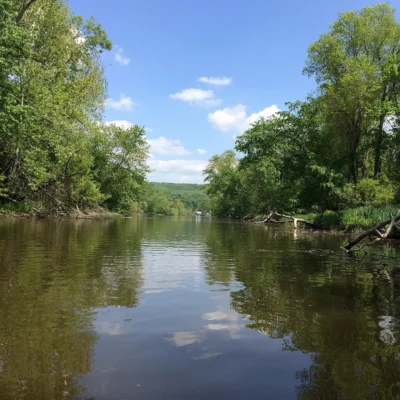
The Fenton River corridor provides riparian habitat through UConn’s Fenton River watershed — an actively studied waterway where university researchers monitor water quality, fish populations, and forest health. The river supports native brook trout in its cold headwaters and brown trout in downstream sections. Riparian buffers of hemlock, birch, and red maple shade the stream — maintaining cool temperatures essential for trout. Great horned owls and red-shouldered hawks nest in the mature forest canopy. The area’s eastern Connecticut location places it in the “Quiet Corner” — a region where forest cover and rural character persist despite the state’s overall density. Beaver activity creates wetland habitat that benefits wood ducks, green herons, and belted kingfishers.
Nearby Attractions
University of Connecticut in Storrs offers the Benton Museum of Art, the Connecticut State Museum of Natural History, and the beloved UConn Dairy Bar — selling ice cream made from the university’s own Holstein herd. Joshua’s Trust maintains 4,400+ acres of preserved land across 37 properties in the Quiet Corner. Mansfield Hollow State Park offers lake recreation and the dam that created it provides flood control for the Natchaug River. Willimantic — once a major thread manufacturing center (“Thread City”) — has reinvented itself with a vibrant arts community and the famous Frog Bridge.
Nearby state parks: If you have extra time, Hopemead State Park is a short drive away, and Salt Rock State Campground is a short drive away.

🐾 Dogs & Pets at Franklin Wildlife Management Area
- Pets allowed? statewide rule
- Pets on a leash are permitted in most Connecticut state parks and forests, but not in buildings, swimming areas or state park campgrounds.
- Leash rule statewide rule
- Pets must be leashed and under control at all times; in state forest camping areas the leash may be no longer than 7 feet.
- Beaches & swim areas statewide rule
- Pets are prohibited in swimming areas; Sherwood Island and Squantz Pond State Parks ban pets entirely April 15 - September 30.
- Cabins & lodging statewide rule
- Pets are banned from all state park campgrounds; they are allowed only in the American Legion, Pachaug and Salt Rock state forest campgrounds, but not on rustic cabin sites.
- Statewide exceptions statewide rule
- Pets prohibited year-round at Dinosaur State Park and in the formal gardens and beach at Harkness Memorial State Park.
Are dogs allowed at Franklin Wildlife Management Area?
Pets on a leash are permitted in most Connecticut state parks and forests, but not in buildings, swimming areas or state park campgrounds. Individual parks can post stricter rules — check signage on arrival.
Rules verified July 2026 via portal.ct.gov. More: Connecticut state parks guide · Dog rules in all 50 states compared
Park Location
Plan your gear for Franklin Wildlife Management Area
From our editorial guides, matched to this park’s activities:


Top Tours & Activities Near New London
 from $79
 from $41
 from $550