🌤 Weather at Saline County State Fish and Wildlife Area by season
| Spring | Summer | Fall | Winter |
|---|---|---|---|
| 36–78 °F | 65–89 °F | 36–82 °F | 24–48 °F |
Each range runs from the coldest monthly average low to the warmest monthly average high in that season (1991-2020 climate normals), measured at Harrisburg, 2 mi away, elevation 365 ft. Conditions at the park can differ from the station, especially where elevation differs — check a forecast before you go.

🏆 Salt Capital — Reclaimed lands near the historic Saline Springs — where Illinois’s first industry (salt production) began in the 1700s
Saline County State Fish and Wildlife Area sits near the historic Saline Springs — the salt licks that gave Saline County its name and launched Illinois’s first industry. Native peoples harvested salt here for thousands of years, and French colonists commercialized production in the 1700s. When Illinois became a state in 1818, salt production at Saline Springs was so important that the state constitution included a controversial provision allowing slave labor at the salt works — the only legal slavery in “free” Illinois.
Visitor Information
| Detail | Information |
|---|---|
| Location | Saline County, IL |
| Entry Fee | Free |
| History | IL’s first industry — salt since 1700s! |
| Dark History | Legal slavery in “free” IL — salt works exception! |
About Saline County
Saline County State Fish and Wildlife Area in southeastern Illinois provides hunting and fishing on reclaimed mine land in the Shawnee Hills. The area features lakes created by mining operations and managed grasslands that support diverse game species. The surrounding Shawnee Hills landscape adds scenic value to the outdoor experience.
Things to Do
Hunting (deer, turkey, quail, dove), fishing in the lakes for bass and catfish, hiking through the Shawnee Hills terrain, and wildlife observation.
Insider Tips
Salt springs: Saline County is named for its salt springs — Native Americans and early settlers harvested salt here for centuries. Pro tip: The Great Salt Spring (nearby) was Illinois’s most important salt source before commercial mining. Shawnee location: The FWA borders the Shawnee National Forest — combine your visit with hiking at Garden of the Gods or Bell Smith Springs.
Best Time to Visit
Fall: Shawnee fall color and hunting season. Spring: Wildflower season and turkey hunting. Summer: Fishing and Shawnee exploration. Winter: Quiet hiking and eagle watching.
Frequently Asked Questions
Why was salt so important?
Before refrigeration, salt was essential for preserving meat — making it one of the most valuable commodities on the frontier. Illinois’s salt springs near Equality were so important that the new state constitution (1818) allowed temporary slavery at the salt works. The salt trade was one of southern Illinois’s earliest industries.
Wildlife & Nature
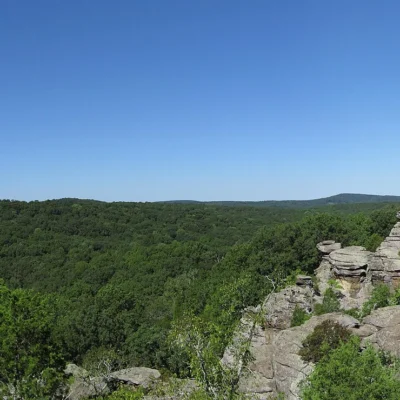
Saline County State Fish and Wildlife Area provides hunting and fishing access in the Shawnee Hills of southeastern Illinois. Saline County takes its name from the salt springs that attracted Native Americans and early settlers — salt was so valuable on the frontier that Illinois’ early constitution (1818) explicitly permitted temporary slavery at the Gallatin County salt works to ensure production. The surrounding oak-hickory forest supports diverse wildlife — white-tailed deer, wild turkeys, and eastern box turtles. Timber rattlesnakes — increasingly rare across Illinois — inhabit the rocky bluffs. Red-shouldered hawks nest in the forest canopy. The area’s streams support native aquatic species including darters — small, colorful bottom-dwelling fish that indicate excellent water quality.
Nearby Attractions
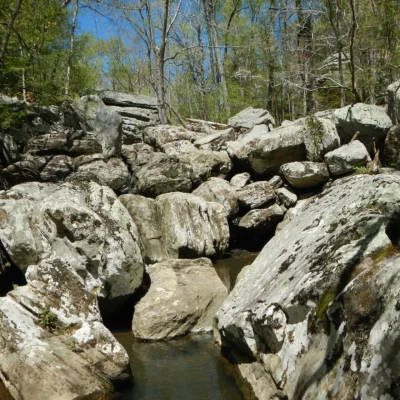
Harrisburg is the county seat. Garden of the Gods — one of Illinois’ most spectacular natural areas — is nearby. Shawnee National Forest offers extensive recreation. Pounds Hollow Recreation Area provides lake swimming and camping. Rim Rock Trail offers a geological journey through sandstone formations. Equality has the historic Half Moon Lick salt works. Cave-in-Rock State Park is 30 minutes east. Saline County Fish & Game Club provides community conservation programs.
Keep exploring: The closest neighbors are Tunnel Hill State Trail (a short drive away) and Sahara Woods (Illinois) (a short drive away).
Camping reservations: Book campsites and cabins for Illinois state parks online at camp.exploremoreil.com.
🧂 Visit Saline County SFWA
Salt springs — IL’s first industry and its darkest constitutional secret.

🐾 Dogs & Pets at Saline County State Fish and Wildlife Area
- Pets allowed? statewide rule
- Pets are allowed in Illinois state parks and on trails as long as they are leashed at all times.
- Leash rule statewide rule
- Leash required at all times; state code caps leash length at 10 feet
- Beaches & swim areas statewide rule
- Pets are prohibited in areas posted 'NO PETS', reserved for beach areas, concession areas and crowded campground/picnic areas (e.g. no dogs on the beach at Illinois Beach State Park)
- Cabins & lodging statewide rule
- Pets are not allowed in campground cabins
- Statewide exceptions statewide rule
- Leash rule exceptions for hunting dogs, field trials and dog training areas; pets must not be left unattended
Are dogs allowed at Saline County State Fish and Wildlife Area?
Pets are allowed in Illinois state parks and on trails as long as they are leashed at all times. Individual parks can post stricter rules — check signage on arrival.
Rules verified July 2026 via dnr.illinois.gov. More: Illinois state parks guide · Dog rules in all 50 states compared
Park Location
Plan your gear for Saline County State Fish and Wildlife Area
From our editorial guides, matched to this park’s activities: