🌤 Weather at Travelers’ Rest State Park by season
| Spring | Summer | Fall | Winter |
|---|---|---|---|
| 27–66 °F | 47–85 °F | 26–73 °F | 20–39 °F |
Each range runs from the coldest monthly average low to the warmest monthly average high in that season (1991-2020 climate normals), measured at Missoula 2 NE, 12 mi away, elevation 3,420 ft. Conditions at the park can differ from the station, especially where elevation differs — check a forecast before you go.

The Only Verified Lewis & Clark Campsite in America — A National Historic Landmark Near Missoula
Travelers’ Rest State Park near Lolo, Montana — just south of Missoula — preserves the only archaeologically verified campsite of the Lewis and Clark Expedition in the United States. The Corps of Discovery camped here twice: on their westbound journey (September 9–11, 1805) before tackling the brutal Lolo Trail over the Bitterroot Mountains, and again on their eastbound return (June 30–July 3, 1806), where the party split into two groups to explore different routes home.
In 2002, archaeologists discovered physical evidence confirming the expedition’s presence: a trench latrine containing mercury (a component of “Rush’s Pills,” the expedition’s primary medicine), fire hearths, and lead used for firearm repairs. This discovery elevated the site from historical tradition to scientific certainty — the only Lewis & Clark camp confirmed by archaeological evidence. But the site’s history extends far deeper: for centuries before European contact, this confluence was a gathering place and strategic crossroads for the Bitterroot Salish (Séliš), Pend d’Oreille, and Nez Perce peoples.
Things to Do
Lewis & Clark History
The park’s visitor center and museum provide comprehensive exhibits on:
- The Corps of Discovery’s two encampments at this location
- The archaeological evidence (mercury latrine, fire hearths, lead fragments) that confirmed the site
- The expedition’s route across the Bitterroot Mountains via the Lolo Trail
- A reconstructed frontier Main Street
Indigenous Heritage
The park actively honors the deep indigenous history of this crossroads:
- The Bitterroot Salish used this confluence for generations — as a staging point for bison hunts to the east, salmon fishing to the west, and horse trade to the south
- The Salish name for the tributary here is Tum-sum-lech (“No Salmon”)
- Native American storyteller programs share the history, culture, and society of the traditional inhabitants
Interpretive Trails
Walking trails loop through the historic campsite area with interpretive signage explaining both the expedition’s activities and the site’s indigenous significance. The trails are flat, accessible, and suitable for all ages.
Birding
The park’s location at the confluence of Lolo Creek and the Bitterroot River creates rich riparian habitat. Over 115 bird species have been recorded within the park, making it one of the more productive birding locations in western Montana.
Trails
| Trail | Distance | Difficulty | Highlights |
|---|---|---|---|
| Campsite Interpretive Loop | ~1 mi | Easy | Verified expedition campsite; archaeological discovery locations; interpretive panels |
| Riparian Trail | Varies | Easy | Creek and river corridor; bird habitat; cottonwood gallery; peaceful walking |
Camping
Travelers’ Rest is a day-use park — no overnight camping is available. For camping near Missoula/Lolo, consider Lolo National Forest campgrounds or Fort Missoula area options.
Best Time to Visit
| Season | Highlights | Considerations |
|---|---|---|
| Summer (Jun–Aug) | ⭐ Full visitor center hours; storyteller programs; lush riparian habitat; birding peak | Warm; bring water and sun protection; combine with Lolo Trail drive |
| Fall (Sep–Oct) | ⭐ The Corps camped here in September — experience the same season; cottonwood gold; bird migration | Visitor center hours may decrease; cooler evenings |
| Spring (Apr–May) | Spring birding; Lolo Creek high water; wildflowers along trails | Variable weather; check visitor center hours; some trails may be wet |
| Winter (Dec–Mar) | Quiet contemplation; winter wildlife; snow-covered historic landscape | Visitor center may have limited hours; cold; check access |
Visitor Tips
- Visitor center first: Start at the museum and visitor center — the exhibits provide essential context about the archaeological discoveries and indigenous history that make the outdoor trails far more meaningful.
- Lewis & Clark route: Combine with a drive up Highway 12 over Lolo Pass — the route follows the Corps of Discovery’s path across the Bitterroot Mountains. The Lolo Trail interpretive sites along the highway complete the story.
- National Historic Landmark: The site was designated a National Historic Landmark in 1960, with the boundary updated in 2006 to include the verified campsite.
- 115+ bird species: Bring binoculars — the riparian corridor supports an exceptional diversity of birds. The cottonwood gallery along Lolo Creek is particularly productive.
- Missoula proximity: The park is just 10 minutes south of Missoula via Highway 93 — easy to combine with a Missoula visit.
Frequently Asked Questions
Is Travelers’ Rest the real Lewis and Clark campsite?
Yes — Travelers’ Rest is the only archaeologically verified Lewis and Clark campsite in the United States. In 2002, researchers discovered a trench latrine containing mercury (from the expedition’s medicine, “Rush’s Pills”), fire hearths, and lead fragments from firearm repairs. This physical evidence, combined with journal entries from Lewis and Clark, scientifically confirms that the Corps of Discovery camped at this exact location in September 1805 and again in June–July 1806.
Can you camp at Travelers’ Rest State Park?
No — Travelers’ Rest is a day-use park only. No overnight camping is permitted. The park is located just 10 minutes south of Missoula, Montana, where numerous lodging options are available. For camping, the Lolo National Forest offers several campgrounds in the surrounding area.
Last updated: April 2026
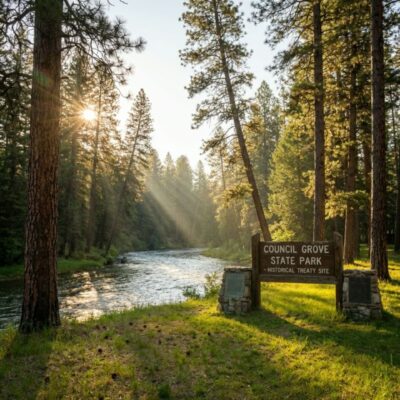
Keep exploring: The closest neighbors are Council Grove State Park (a short drive away) and Council Grove State Park (a short drive away).

🐾 Dogs & Pets at Travelers’ Rest State Park
- Pets allowed? statewide rule
- Pets are allowed at most Montana state parks but must be leashed and not left unattended.
- Leash rule statewide rule
- Leash no longer than 8 feet required, unless otherwise posted.
- Beaches & swim areas statewide rule
- Pets are prohibited from swimming beaches and posted restricted areas.
- Statewide exceptions statewide rule
- Pets prohibited at Frenchtown Pond and Wild Horse Island; kennel service offered during Lewis and Clark Caverns tours; Spring Meadow Lake no pets April 16 - October 14; Lake Elmo has a fenced dog park.
Are dogs allowed at Travelers’ Rest State Park?
Pets are allowed at most Montana state parks but must be leashed and not left unattended. Individual parks can post stricter rules — check signage on arrival.
Rules verified July 2026 via fwp.mt.gov. More: Montana state parks guide · Dog rules in all 50 states compared
Park Location
Plan your gear for Travelers’ Rest State Park
From our editorial guides, matched to this park’s activities: