
🌤 Weather at Watts Towers of Simon Rodia State Historic Park by season
| Spring | Summer | Fall | Winter |
|---|---|---|---|
| 53–71 °F | 62–79 °F | 54–78 °F | 49–67 °F |
Each range runs from the coldest monthly average low to the warmest monthly average high in that season (1991-2020 climate normals), measured at Hawthorne Municipal Airport, 5 mi away, elevation 63 ft. Conditions at the park can differ from the station, especially where elevation differs — check a forecast before you go.

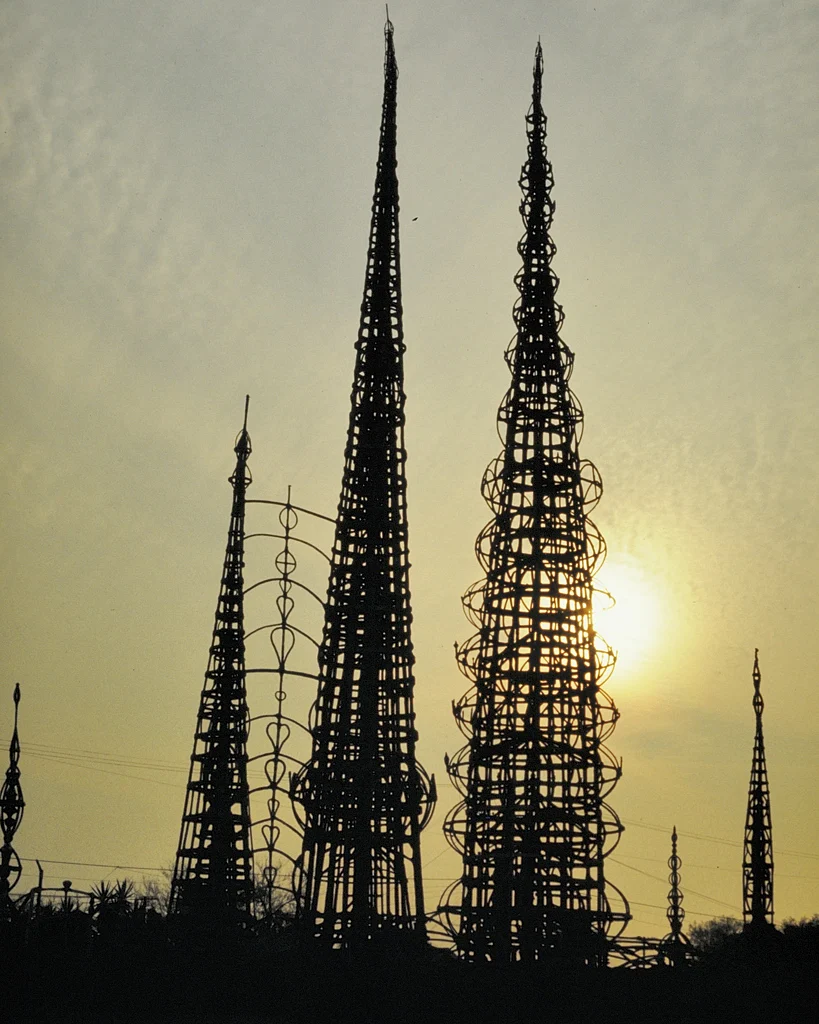
🗼 One Man. 33 Years. 17 Towers Built From Broken Dishes and Dreams. — Watts Towers of Simon Rodia State Historic Park in Los Angeles, California, National Historic Landmark, 17 interconnected structures (tallest 99.5 feet), built 1921–1954 by Sabato “Simon” Rodia, Italian immigrant, steel rebar/mortar/found objects (broken pottery, seashells, glass bottles, tiles), masterpiece of outsider art, Watts neighborhood, South LA — Los Angeles County, CA
In 1921, an Italian immigrant named Sabato “Simon” Rodia began building towers in his backyard in Watts, Los Angeles. He used steel rebar, wire mesh, mortar, and whatever he could find — broken dishes, seashells, glass bottles, ceramic tiles, mirrors. He worked alone. No scaffolding. No machinery. No plan on paper.
He didn’t stop for 33 years.
When he finished in 1954, he had created 17 interconnected structures — the tallest reaching 99.5 feet — that stand as one of the most extraordinary works of art ever created by a single person. He deeded the property to a neighbor and walked away. He never returned.
What to See
| Feature | Details |
|---|---|
| The Towers | 17 interconnected structures of steel, mortar, and found objects. The tallest reaches 99.5 feet. No bolts, rivets, or welds — everything is wire-tied and pressed into wet mortar |
| Mosaic Surfaces | Every surface is covered with embedded objects — broken pottery from neighboring restaurants, 7-Up bottles, corn cobs, seashells collected from the beach, ceramic tiles, mirrors, and glass |
| The Ship of Marco Polo | A large ship-shaped structure in the yard, covered in mosaic — Rodia’s tribute to the great Italian explorer |
| Watts Towers Arts Center | Gallery and community art center adjacent to the towers. Rotating exhibitions, workshops, and cultural events celebrating the Watts community |
| Guided Tours | 30-minute guided tours (required for close-up access). Guides explain Rodia’s techniques, materials, and the community’s fight to save the towers |
The Timeline
| Year | Event |
|---|---|
| 1879 | Sabato Rodia born in Ribottoli, Italy. Immigrates to the United States as a teenager |
| 1921 | Rodia, now living in Watts, begins construction in his backyard. Working alone with hand tools, no scaffold, no blueprints |
| 1921–1954 | 33 years of continuous work. Rodia collects found objects from the neighborhood, beaches, and restaurants. He bends rebar with railroad ties and pipe wrenches |
| 1954 | Rodia completes the project. He deeds the property to his neighbor and moves away. He never returns to see the towers |
| 1959 | The city of Los Angeles orders the towers demolished as “unsafe structures.” A stress test is conducted — a crane pulls at the towers with 10,000 pounds of force. The crane fails. The towers don’t move |
| 1965 | Designated a National Historic Landmark and a California State Historic Park |
| 1965 | Watts riots. The towers survive. They become a symbol of community resilience |
Best Time to Visit
| Season | Best For |
|---|---|
| Fall (Sep–Nov) | 🌅 Clearest skies in LA. Annual Watts Towers Day of the Drum Festival (September). Golden light on the mosaic |
| Spring (Mar–May) | 🌺 Comfortable temperatures. Simon Rodia Watts Towers Jazz Festival. Good touring weather |
| Summer (Jun–Aug) | Full hours. Hot but tolerable. Morning tours recommended for best light |
| Winter (Dec–Feb) | Mild LA winter. Fewer visitors. Good for photography |
Frequently Asked Questions
Did Rodia really build these alone?
Yes — entirely by hand, working alone, for 33 years. He used no scaffolding; instead, he climbed the structures using window-washer’s equipment. He bent rebar with railroad ties and pipe wrenches. He pressed found objects — broken dishes, shells, bottles — into wet mortar one piece at a time.
Why did he do it?
He never fully explained. When asked, Rodia reportedly said: “I had in mind to do something big, and I did it.” He had no formal training in art, architecture, or engineering. He was a tile-setter and telephone repairman by trade.
Did the city really try to demolish them?
Yes — in 1959, Los Angeles ordered the towers torn down as unsafe. A public campaign saved them. Engineers conducted a stress test, attaching a crane and pulling with 10,000 pounds of force. The cable snapped. The towers didn’t move. They were declared safe and preserved.
Make it a road trip: Pair a visit with Kenneth Hahn State Recreation Area (a short drive away) or Los Angeles State Historic Park (a short drive away).
🗼 “I Had in Mind to Do Something Big”
One immigrant. 33 years. No blueprint. 99.5 feet of steel, mortar, and broken beauty. The city tried to tear them down — the crane broke first.
Wildlife & Nature
Watts Towers SHP — features the Watts Towers — 17 interconnected sculptural towers built by Italian immigrant Simon Rodia over 33 years (1921-1954) using steel, mortar, tiles, and found objects. The tallest tower reaches 99.5 feet. A National Historic Landmark and one of the most remarkable works of outsider art in the world.
Nearby Attractions
Watts — in Los Angeles. Los Angeles — surrounding.

🐾 Dogs & Pets at Watts Towers of Simon Rodia State Historic Park
- Pets allowed? statewide rule
- Dogs are permitted in California State Parks only in developed areas — campgrounds, picnic areas, parking lots and paved roads — and are prohibited on most trails, beaches and undeveloped areas unless specifically designated as dog-friendly.
- Leash rule statewide rule
- Maximum 6-foot leash at all times; dogs may not be left unattended.
- Beaches & swim areas statewide rule
- Dogs are prohibited on most state beaches; only beaches specifically designated as dog-allowed permit them (varies by park).
- Cabins & lodging statewide rule
- Pets are generally not allowed in buildings or cabins; overnight campers must keep dogs inside a tent or vehicle at night.
- Statewide exceptions statewide rule
- Designated dog-friendly trails and beaches vary park by park; misrepresenting a pet as a service animal is a misdemeanor.
Are dogs allowed at Watts Towers of Simon Rodia State Historic Park?
Dogs are permitted in California State Parks only in developed areas — campgrounds, picnic areas, parking lots and paved roads — and are prohibited on most trails, beaches and undeveloped areas unless specifically designated as dog-friendly. Individual parks can post stricter rules — check signage on arrival.
Rules verified July 2026 via parks.ca.gov. More: California state parks guide · Dog rules in all 50 states compared
Park Location
Plan your gear for Watts Towers of Simon Rodia State Historic Park
From our editorial guides, matched to this park’s activities:

Top Tours & Activities Near Redondo Beach
 from $16
 from $125
 from $2,450