Jockeys Ridge State Park
Where the Tallest Living Sand Dunes on the East Coast Touch the Sky
Jockey’s Ridge State Park is an astonishing anomaly — a massive, actively migrating sand dune system rising 80 to 100 feet above the barrier island landscape of the Outer Banks, creating a surreal desert-in-miniature on one of the most developed stretches of North Carolina’s Atlantic coast. Drive along US-158 through the beachside strip of Nags Head — past rental cottages, ice cream shops, and surf outfitters — and suddenly an enormous dune rises against the sky like a misplaced piece of the Sahara, bare sand gleaming white in the sun, its crest shifting and reshaping with every prevailing wind.
These are the tallest natural living sand dunes on the entire Atlantic coast, and “living” is the key word. Unlike stabilized dunes anchored by vegetation, Jockey’s Ridge is a medano — a massive, unvegetated dune system that migrates south-southwest with the prevailing winds at a rate of approximately 3 to 6 feet per year, constantly reshaping its profile and swallowing everything in its path. It’s a geological process happening in real time, visible within a single lifetime — houses, roads, and even sections of the miniature golf course that bordered the dune in the 1970s have been buried under advancing sand. The park exists because citizens fought to preserve this extraordinary natural system from the development that consumed the rest of the Outer Banks shoreline.
The Dune System: Geology in Motion
Jockey’s Ridge is a medano — a rare type of sand dune found only where a large supply of sand, steady wind, and minimal vegetation combine to create actively migrating dune forms. The dune complex covers approximately 420 acres and consists of several interconnected dune ridges that constantly shift shape and height. The highest ridge was measured at 140 feet in the 1930s; erosion, wind redistribution, and rising sea levels have reduced it to approximately 80 feet today, though the exact height changes with every major storm and wind event.
The sand itself originated from the erosion of the Appalachian Mountains millions of years ago — carried east by rivers to the continental shelf, then pushed shoreward by waves and currents to form the Outer Banks barrier islands. Once deposited on the beach, prevailing southwest and northeast winds blow the dry sand inland, building and reshaping the dune complex in a ceaseless dance of accretion and erosion. The process creates three distinct dune faces: the gently sloping windward face where sand creeps upward grain by grain, the steep slip face (30–34 degrees, the angle of repose for dry sand) where sand avalanches cascade downward, and the flat deflation plain in the dune’s wind shadow where sand has been stripped down to the water table, creating a unique wetland habitat.
On the sound side of the dune, the deflation plain creates ephemeral pools — temporary freshwater ponds that support an improbable community of freshwater fish, frogs, and wading birds in the middle of a maritime sand dune. These pools appear and disappear with rainfall and water table fluctuations, creating a habitat as unexpected as the dune itself.
Hang Gliding: Following the Wright Brothers
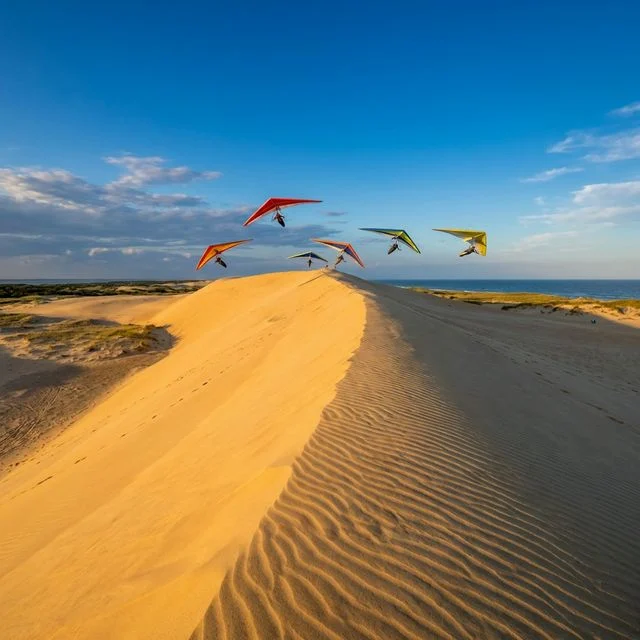
It was the same steady Atlantic winds that shape Jockey’s Ridge that drew Wilbur and Orville Wright to the Outer Banks in 1900 — and it is the same wind, combined with the dune’s forgiving soft-sand slope and consistent updrafts, that has made Jockey’s Ridge one of the premier hang gliding training sites in the world. The connection is poetic and literal: the Wright Brothers experimented with gliders on the Kill Devil Hills sand dunes just four miles north before achieving powered flight on December 17, 1903. Today, hang gliding at Jockey’s Ridge continues that tradition of human flight born on the Outer Banks.
Kitty Hawk Kites — the world’s largest hang gliding school, operating at the dune for over 40 years — offers beginner hang gliding lessons daily (weather permitting, approximately $109 per person). Students launch from the dune’s gentle windward slope, glide 10 to 15 feet above the soft sand, and land softly — all under the direct supervision of certified instructors. No prior experience is needed; children as young as 5 and adults of all fitness levels regularly complete the introductory course. Tandem flights with an instructor are available for those wanting a higher-altitude experience.
The sight of colorful hang gliders floating above the dune crest against the brilliant Outer Banks sky is one of the most iconic and joyful images in North Carolina tourism — and the experience of running off a dune edge and feeling the wind lift you, even briefly, off the earth is universally unforgettable.
Sandboarding and Kite Flying
Sandboarding at Jockey’s Ridge offers a desert-sport thrill: strap your feet into a board (available for rent from Kitty Hawk Kites) and ride the steep slip face of the dune in a sand-spraying descent that recalls snowboarding on a summer day. The soft sand provides a forgiving surface for falls, and the climb back to the top is part of the workout — and part of the fun.
Kite flying is perhaps the most popular activity at the dune — the steady winds and wide-open space make it one of the best kite-flying locations on the entire East Coast. Visitors bring everything from simple diamond kites to elaborate multi-line stunt kites, and on breezy afternoons the sky above the dune is alive with color. Kitty Hawk Kites sells and rents kites at the park and in their adjacent shop.
The Soundside: Kayaking and Sunsets
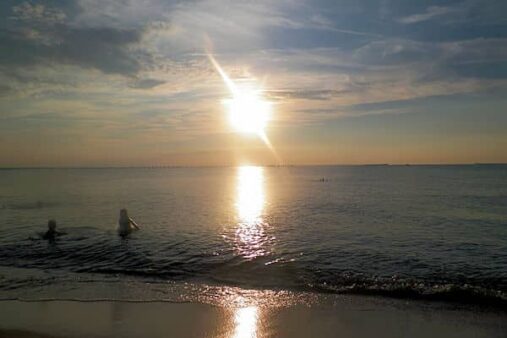
The western edge of Jockey’s Ridge State Park descends to the shore of Roanoke Sound — a calm, shallow body of water separating the Outer Banks from Roanoke Island. This soundside access provides a completely different experience from the dune: calm water for kayaking, stand-up paddleboarding, and wading, with views of Roanoke Island and the sweeping sky that make it the finest sunset viewing location on the Outer Banks.
The Soundside Nature Trail (1 mile) winds through maritime shrub thicket — wax myrtle, yaupon holly, and live oak sculpted by the wind into dramatic, stunted forms — past the soundside beach and through the unique wetland ecology of the deflation plain. At low tide, the sound is barely knee-deep for hundreds of yards, creating a natural wading pool popular with families. During migration season (spring and fall), the sound shore and deflation ponds attract shorebirds — oystercatchers, willets, plovers — and the occasional osprey hunting the shallow waters.
History: From Shipwreck Landmark to Citizen-Saved Park
The name “Jockey’s Ridge” likely derives from the dune’s use as a vantage point by early Outer Banks residents who gathered on the high ridge to watch horse races (jockeying) on the flat beach below, or possibly from the Jockey family who lived in the area — historians debate the etymology, and both explanations have merit.
For centuries, the towering dune served as a navigational landmark for sailors approaching the treacherous Outer Banks coast — the “Graveyard of the Atlantic” — visible for miles offshore, marking the land in a region where low-lying barrier islands were otherwise nearly invisible from the sea. The dune also served as a lookout point during both the American Revolution and the Civil War.
The modern park exists because of Carolista Baum, a local resident who in 1973 noticed bulldozers preparing to level the dune for a housing development. Baum launched a grassroots campaign that galvanized public support, drew national media attention, and ultimately persuaded the North Carolina General Assembly to purchase the land and establish Jockey’s Ridge State Park in 1975. The park is a direct product of citizen conservation activism — saved by the passion of one woman and the community she inspired.
Mountains-to-Sea Trail Terminus
Jockey’s Ridge State Park serves as the eastern terminus of North Carolina’s Mountains-to-Sea Trail (MST) — a 1,175-mile continuous footpath stretching from Clingmans Dome in the Great Smoky Mountains to the Outer Banks. Thru-hikers who complete the entire MST end their journey by crossing the dune at Jockey’s Ridge and descending to the Atlantic Ocean — a symbolic and literal journey from the highest point in North Carolina (6,643 feet) to sea level, from ancient mountain forest to wind-sculpted sand. A trail marker at the park commemorates the terminus.
Visitor Guide: Planning Your Dune Adventure
Getting There
Jockey’s Ridge State Park is located on US-158 in Nags Head, North Carolina, in the heart of the Outer Banks. Norfolk International Airport (Virginia) is the nearest major airport, approximately 90 miles (2 hours) north. The park is accessible via US-158 from the north (crossing the Wright Memorial Bridge from mainland NC) or via the Outer Banks Scenic Byway (NC-12) from Hatteras Island to the south.
Fees and Hours
Admission to the park is completely free. The park is open daily from 8 a.m. to varying sunset-dependent closing times (6 p.m. in winter, 9 p.m. in summer). The visitor center features exhibits on dune ecology, local history, and Outer Banks natural science, plus restrooms and water fountains. No advance reservations are needed.
Best Times to Visit
Spring and Fall: Ideal temperatures, consistent winds for kites and hang gliding, fewer crowds, excellent bird migration viewing at the soundside. Summer: Peak tourism season on the Outer Banks — the park is busy but the experience is still excellent. Sand surface temperatures can exceed 140°F at midday — wear shoes even though the dune looks inviting barefoot. Winter: Quiet and hauntingly beautiful, with dramatic storm-light and the possibility of the dune dusted with rare Outer Banks snow.
Essential Tips
Bring water — the dune offers zero shade. Wear shoes or sandals with straps (flip-flops will be lost to the sand). The climb to the dune crest is approximately 15–20 minutes of soft sand walking — more strenuous than it looks. Stay for sunset — watching the sun drop behind Roanoke Sound from the dune crest, with the silhouettes of hang gliders and kites against the orange sky, is one of the most beautiful free experiences in the Outer Banks.
Frequently Asked Questions
How tall is the dune?
The main dune currently stands approximately 80 feet above sea level, though the height changes with storms and prevailing wind patterns. In the 1930s, the dune was measured at approximately 140 feet. The decrease is attributed to a combination of development disrupting natural sand supply, storm erosion, and sea-level rise — the dune is actively migrating rather than shrinking.
Is hang gliding safe for beginners?
Yes — the beginner lessons at Jockey’s Ridge are specifically designed for people with zero experience. Students launch from the gentle windward slope and fly only 10 to 15 feet above the soft sand, making even “crash landings” nothing more than a gentle tumble. Kitty Hawk Kites has offered lessons here for over 40 years with an exceptional safety record. Children as young as 5 can participate.
Can I sandboard at the park?
Yes — sandboards are available for rent from Kitty Hawk Kites (located adjacent to the park). The steep slip face provides the best runs. No experience is needed, and the soft sand provides a very forgiving surface — falls are part of the fun. The climb back to the top is the real workout.
Is there a connection to the Wright Brothers?
Yes — the Wright Brothers chose the Outer Banks for their flight experiments specifically because of the steady winds that also shape Jockey’s Ridge. Kill Devil Hills, where they achieved powered flight in 1903, is just four miles north. The Wright Brothers National Memorial is a natural companion visit — the two sites together tell the story of human flight from glider to airplane, all powered by the same Atlantic winds.
Is there a fee to enter the park?
No — Jockey’s Ridge State Park is completely free to enter and enjoy, including access to the dune, all trails, the soundside beach, and the visitor center. Only concession activities (hang gliding lessons, sandboard rentals) carry separate fees charged by third-party operators.