🌤 Weather at Mohawk Forest/Mohawk Mountain State Park by season
| Spring | Summer | Fall | Winter |
|---|---|---|---|
| 23–65 °F | 54–78 °F | 30–69 °F | 14–35 °F |
Each range runs from the coldest monthly average low to the warmest monthly average high in that season (1991-2020 climate normals), measured at Norfolk 2 SW, 11 mi away, elevation 1,340 ft. Conditions at the park can differ from the station, especially where elevation differs — check a forecast before you go.

Connecticut’s Highest Overlook — Panoramic Views from the Litchfield Hills
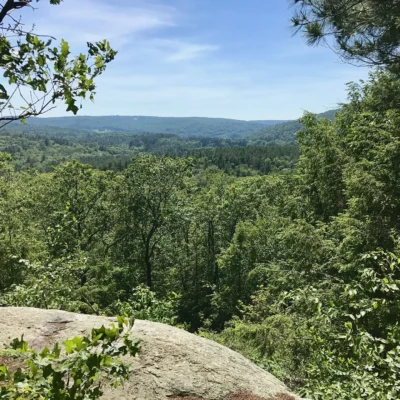
Mohawk Mountain State Park — part of the 4,000-acre Mohawk State Forest — rises to 1,683 feet in Connecticut’s Litchfield Hills, making it one of the highest accessible summits in the state. On clear days, the panoramic views from the summit overlook extend across the Taconic and Berkshire Mountains, reaching as far as the Catskill Mountains in New York. The drive-to summit (open April–November) makes this one of the most accessible mountain-top experiences in New England.
But Mohawk is far more than a viewpoint. Over 30 miles of trails wind through the forest, including segments of the blue-blazed Mattatuck Trail and the historic Mohawk Trail — a former alignment of the Appalachian Trail. A rare Black Spruce Bog with a boardwalk trail offers a glimpse into a peat-bog ecosystem more typical of northern Canada. In winter, the nearby Mohawk Mountain Ski Area provides downhill skiing and snowboarding, while the forest trails welcome snowshoers and cross-country skiers. Add the historic Cunningham Tower (built 1912) and the region’s legendary fall foliage, and you have one of Connecticut’s most complete four-season outdoor destinations.
Things to Do
Hiking
The park’s trail system offers 30+ miles through diverse terrain — from rocky ridgelines to deep hardwood forest. The Mattatuck Trail (blue-blazed) traverses the park with challenging elevation changes and scenic overlooks. The Black Spruce Bog boardwalk is a must-visit: a rare late-stage peat bog supporting black spruce, sphagnum moss, and carnivorous sundew plants — an ecosystem remnant from the last Ice Age.
Fall Foliage
Mohawk Mountain is consistently ranked among Connecticut’s top fall foliage destinations. The summit overlook provides sweeping views of the color display across the Litchfield Hills, typically peaking in mid-to-late October. The drive-to summit makes it accessible even for those who can’t hike.
Winter Sports
The nearby Mohawk Mountain Ski Area offers downhill skiing and snowboarding with multiple runs. Within the state forest, 10+ miles of trails are designated for snowmobiling (when snow permits), and the broader trail system is popular for cross-country skiing, snowshoeing, and winter hiking.
Fishing & Picnicking
The forest includes pond and stream fishing opportunities, plus designated picnic areas near the summit and along forest roads. Youth group camping is available by reservation.
Trails
| Trail | Distance | Difficulty | Highlights |
|---|---|---|---|
| Mattatuck Trail | Multi-mile segment | Moderate–Strenuous | Blue-blazed; rocky ridgelines; panoramic overlooks; diverse forest |
| Mohawk Trail | Multi-mile segment | Moderate | Former AT alignment; historic route; forest walking |
| Black Spruce Bog Boardwalk | Short loop | Easy | Rare peat bog; black spruce; carnivorous plants; Ice Age remnant |
| Summit Overlook Trail | ~0.5 mi | Easy | Drive-to access; panoramic views of 3 mountain ranges; Cunningham Tower |
Camping
Mohawk State Forest offers youth group camping by reservation. Individual tent or RV camping is not available within the park. For nearby camping, consider Housatonic Meadows State Park (15 minutes west) or Lake Waramaug State Park, both offering developed campgrounds in the Litchfield Hills region.
Best Time to Visit
| Season | Highlights | Considerations |
|---|---|---|
| Fall (Sep–Nov) | ⭐⭐ PEAK: Legendary fall foliage; summit overlook at its best; crisp hiking | Extremely popular weekends; arrive early for parking; peak mid-late Oct |
| Summer (Jun–Aug) | Full trail access; wildflowers; long days; Black Spruce Bog at its best | Warm and humid at lower elevations; summit is cooler |
| Spring (Apr–May) | Summit road opens; spring wildflowers; birding; bog awakening | Muddy trails; variable weather; some trails may be soft |
| Winter (Dec–Mar) | Skiing; snowshoeing; cross-country trails; winter views through bare trees | Summit road closed; access via trails only; cold and windy at elevation |
Visitor Tips
- Drive-to summit: The summit road is open April through November (weather permitting), making the panoramic overlook accessible without hiking. Gates close in winter.
- Black Spruce Bog: Don’t skip this — it’s one of only a few peat bogs in Connecticut and features plants you won’t see anywhere else in the state. The boardwalk keeps your feet dry and protects the fragile ecosystem.
- Cunningham Tower: The stone tower (built 1912) is a historic landmark. While the tower itself may not be climbable, the overlook area provides the views.
- Foliage timing: Peak color at the summit typically arrives 1–2 weeks before lower elevations. Check Connecticut’s foliage reports for real-time updates.
- Free for CT residents: Admission is free for Connecticut residents. Out-of-state vehicles may be subject to a parking fee during peak season.
Wildlife & Nature
Mohawk Mountain SP — features the Mohawk Mountain lookout tower with panoramic views of the Litchfield Hills. The park’s hardwood forest, mountain, and streams support black bears, wild turkeys, and bobcats. Home of Mohawk Mountain Ski Area.
Nearby Attractions
Cornwall — adjacent. Litchfield Hills — surrounding. Housatonic River — nearby.
Can you drive to the top of Mohawk Mountain?
Yes — the summit road is open from approximately April through November (weather permitting), allowing visitors to drive directly to the 1,683-foot summit overlook. The views extend across the Taconic and Berkshire Mountains, and on clear days you can see the Catskill Mountains in New York. The road is closed during winter months when the gates are locked.
What is the Black Spruce Bog at Mohawk Mountain?
The Black Spruce Bog is a rare late-stage peat bog located within the Mohawk State Forest. It supports black spruce trees, sphagnum moss, and carnivorous sundew plants — an ecosystem more typical of northern Canada, preserved here as a remnant from the last Ice Age. A boardwalk trail allows visitors to explore the bog without disturbing the fragile ecosystem.
Last updated: April 2026
Nearby state parks: If you have extra time, Wyantenock State Forest is a short drive away, and Housatonic Meadows State Park is a short drive away.

🐾 Dogs & Pets at Mohawk Forest/Mohawk Mountain State Park
- Pets allowed? statewide rule
- Pets on a leash are permitted in most Connecticut state parks and forests, but not in buildings, swimming areas or state park campgrounds.
- Leash rule statewide rule
- Pets must be leashed and under control at all times; in state forest camping areas the leash may be no longer than 7 feet.
- Beaches & swim areas statewide rule
- Pets are prohibited in swimming areas; Sherwood Island and Squantz Pond State Parks ban pets entirely April 15 - September 30.
- Cabins & lodging statewide rule
- Pets are banned from all state park campgrounds; they are allowed only in the American Legion, Pachaug and Salt Rock state forest campgrounds, but not on rustic cabin sites.
- Statewide exceptions statewide rule
- Pets prohibited year-round at Dinosaur State Park and in the formal gardens and beach at Harkness Memorial State Park.
Are dogs allowed at Mohawk Forest/Mohawk Mountain State Park?
Pets on a leash are permitted in most Connecticut state parks and forests, but not in buildings, swimming areas or state park campgrounds. Individual parks can post stricter rules — check signage on arrival.
Rules verified July 2026 via portal.ct.gov. More: Connecticut state parks guide · Dog rules in all 50 states compared
Park Location
Plan your gear for Mohawk Forest/Mohawk Mountain State Park
From our editorial guides, matched to this park’s activities:
Top Tours & Activities Near Connecticut
 from $100
 from $28from $75