🌤 Weather at Run Hill State Natural Area by season
| Spring | Summer | Fall | Winter |
|---|---|---|---|
| 43–75 °F | 69–86 °F | 48–79 °F | 36–55 °F |
Each range runs from the coldest monthly average low to the warmest monthly average high in that season (1991-2020 climate normals), measured at Manteo Airport, 7 mi away, elevation 13 ft. Conditions at the park can differ from the station, especially where elevation differs — check a forecast before you go.

🏆 Tallest Dune on Atlantic Coast — 100-foot sand dune — the TALLEST natural sand dune on the US Atlantic coast, on the Outer Banks
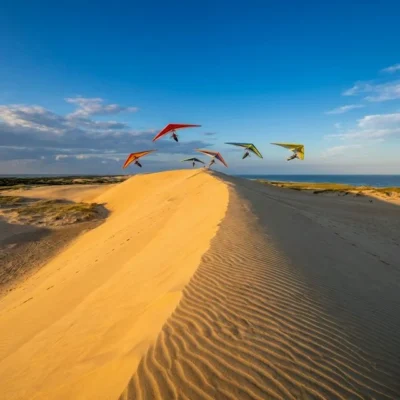
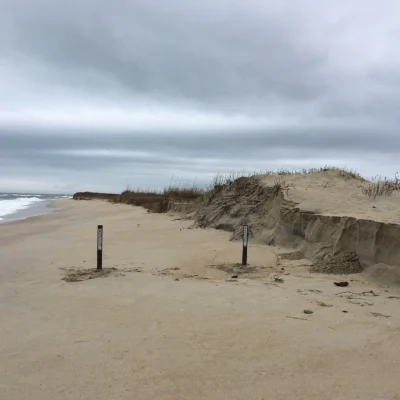
Run Hill State Natural Area protects the tallest natural sand dune on the US Atlantic coast — a 100-foot-high dune on the Outer Banks between Kitty Hawk and Nags Head. This massive “medano” (migrating dune) moves southwest at 3–6 feet per year, burying everything in its path including 200-year-old maritime forest. Run Hill was named by the Wright Brothers era pilots who used the steep dune for practice runs. The dune is part of the Jockey’s Ridge dune complex — the largest natural sand dune system on the East Coast. The Outer Banks themselves are one of the most dynamic coastlines in the world.
Visitor Information
| Detail | Information |
|---|---|
| Location | Outer Banks, NC (Kitty Hawk!) |
| Entry Fee | Free |
| Height | 100 feet — TALLEST on Atlantic! |
| Movement | Migrating 3–6 feet per year! |
About Run Hill
Run Hill State Natural Area on the Outer Banks in Dare County protects the tallest sand dune on the Outer Banks — rising nearly 100 feet above sea level. The dune, a remnant of the massive Jockey’s Ridge complex, provides critical habitat for rare plants adapted to the shifting sand. The Outer Banks are barrier islands constantly reshaped by wind and waves — Run Hill is a snapshot of this dynamic coastal process.
Things to Do
Hiking to the dune summit for panoramic views, observing sand-adapted plant species, birdwatching, nature photography, and studying barrier island dynamics on the Outer Banks.
Insider Tips
Living dune: Run Hill is the tallest natural sand dune system on the Outer Banks — reaching 90+ feet. Pro tip: The Outer Banks dunes are constantly moving — wind pushes sand westward, slowly migrating the entire barrier island system. Jockey’s Ridge: Nearby Jockey’s Ridge (100+ feet) is the tallest living dune on the East Coast — Run Hill is its wild, undeveloped counterpart.
Best Time to Visit
Fall: Comfortable weather and fewer crowds. Spring: Wildflowers in dune swales. Summer: Beach access. Winter: Dramatic dune landscapes.
Frequently Asked Questions
How do sand dunes move?
Wind pushes sand grains up the windward side of a dune and deposits them on the lee side — the dune slowly migrates downwind. On the Outer Banks, prevailing winds push dunes westward at 3-6 feet per year. Over centuries, migrating dunes have buried forests, roads, and buildings. Living dune systems are dynamic — they require wind and sand supply to survive. Stabilizing dunes with vegetation actually threatens the ecosystem.
Nearby state parks: If you have extra time, Jockeys Ridge State Park is a short drive away, and Pettigrew State Park is elsewhere in the state.
Wildlife & Nature
Run Hill SNA — preserves sand dunes on the Outer Banks. The area’s dunes, maritime shrub, and beach support ghost crabs, shorebirds, and sea turtles. The dunes shift with wind and storms.
Nearby Attractions
Nags Head — adjacent. Jockeys Ridge SP — nearby. Wright Brothers NM — nearby.

🐾 Dogs & Pets at Run Hill State Natural Area
- Pets allowed? statewide rule
- Pets are permitted in all North Carolina state parks as long as they are on an attended leash and under the constant control of the owner.
- Leash rule statewide rule
- Attended leash or other restraint no longer than 6 feet required at all times
- Beaches & swim areas statewide rule
- Pets are not permitted at swim areas or in bathhouses
- Cabins & lodging statewide rule
- Pets are strictly prohibited from entering any building, including cabins; no pet-friendly cabin program
- Statewide exceptions statewide rule
- Not all campgrounds allow pets (contact the park office first); pets must be confined to tent or vehicle during quiet hours (10 p.m.-7 a.m.); at Hammocks Beach visitors must arrange their own transportation for pets to Bear Island
Are dogs allowed at Run Hill State Natural Area?
Pets are permitted in all North Carolina state parks as long as they are on an attended leash and under the constant control of the owner. Individual parks can post stricter rules — check signage on arrival.
Rules verified July 2026 via ncparks.gov. More: North Carolina state parks guide · Dog rules in all 50 states compared
Park Location
Plan your gear for Run Hill State Natural Area
From our editorial guides, matched to this park’s activities: